
Cooking is the single biggest cause of accidental house fires in every nation of the UK, and it has been for as long as the statistics have been collected. This page gathers the official UK cooking fire statistics in one referenced place: the accidental dwelling fire figures from MHCLG’s detailed fire analysis and fire statistics data tables for England (tables FIRE0601 and FIRE0602), the Scottish Fire and Rescue Service’s incident statistics, the Welsh Government’s fire and rescue figures, and the Home Office’s ad-hoc air-fryer data. The data period is stated next to every figure, so you can cite any number on this page with confidence. Because the three nations define and count fires slightly differently, the figures are presented per nation and never summed into a single “UK percentage”.
Key facts and figures
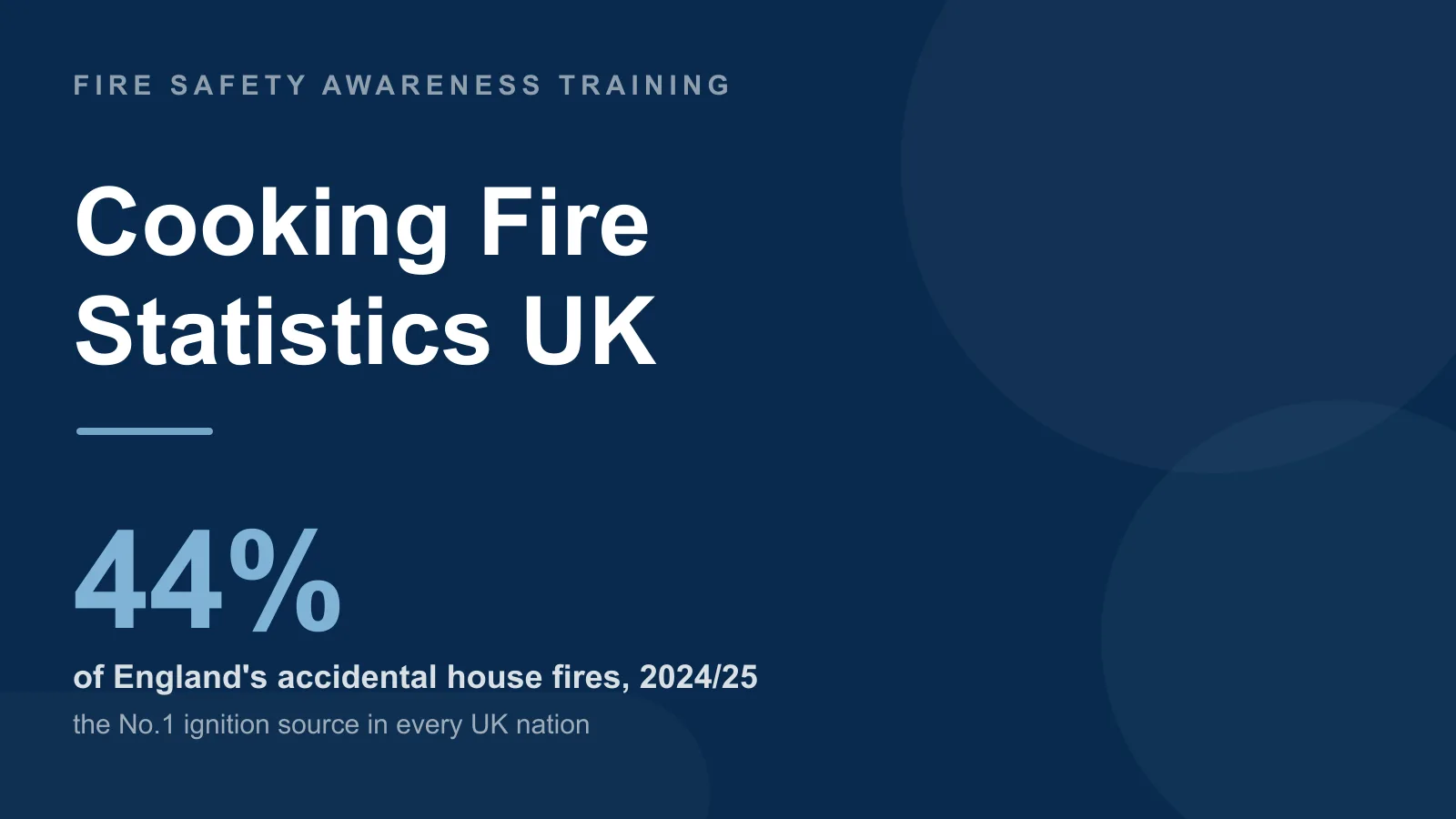
- 44% of England’s accidental dwelling fires were started by cooking appliances in 2024/25 (year ending March 2025) — the largest single ignition category.
- 56.8% of Scotland’s accidental dwelling fires were caused by cooking appliances in 2024-25 — the highest share since that series began in 2009-10.
- 45% of Wales’s accidental dwelling fires were ignited by cooking appliances in 2024-25 — the largest single source there too.
- 22,877 accidental dwelling fires were recorded in England in 2024/25, with cooking the leading cause.
- 36% — the fall in cooking-appliance accidental dwelling fires in England since 2010/11, even as cooking’s share of the total has stayed on top.
- 9.3% of England’s fire deaths came from cooking fires despite them causing 44% of accidental dwelling fires — the “injury paradox” that defines this cause.
- 146 dwelling fires in England mentioned an “air fryer” in the incident report in 2023/24, up from 23 two years earlier.
- ~60% of fires in the home start in the kitchen, according to London Fire Brigade.
These are the latest published figures as of July 2026, and this page is updated when new data is released — the core England sources (MHCLG’s detailed fire analysis and the FIRE0601/FIRE0602 tables) are refreshed every August, with quarterly incident statistics in between and annual Scottish and Welsh releases each autumn.
What is the most common cause of house fires in the UK?
Cooking is the most common cause of accidental house fires across the UK. In England, cooking appliances were the largest specified ignition category for accidental dwelling fires in 2024/25, at 44% (MHCLG detailed analysis of fires, published August 2025). It is not close: cooking has been the number one accidental ignition source year after year, because it is the one open-flame, high-heat activity almost every household does every day.
The same ranking holds in the devolved nations, and if anything is more pronounced. In Scotland, cooking appliances were the main ignition source in 56.8% of accidental dwelling fires in 2024-25 — comfortably over half, and the highest share since the Scottish series began in 2009-10 (Scottish Fire and Rescue Service, FRIS 2024-25). In Wales, cooking appliances were the single largest ignition source at 45% in 2024-25 (Welsh Government fire and rescue incident statistics).
A note on definitions: cause categories differ between the classifications used by MHCLG, the Scottish Fire and Rescue Service and the Welsh Government, so the three percentages above should be read side by side, not averaged. There is no official combined “UK cooking fire percentage”, and any figure presented as one is a splice of incompatible series.
How many house fires are caused by cooking each year?
England recorded 22,877 accidental dwelling fires in 2024/25 (year ending March 2025), and cooking appliances were behind the largest single slice of them at 44% (MHCLG detailed analysis). That puts cooking-related accidental dwelling fires in England in the order of ten thousand a year — comfortably more than any other cause.
The more recent quarterly data continues the pattern. England recorded 26,298 dwelling fires and 23,897 accidental dwelling fires in the year ending December 2025, with accidental dwelling fires up 5.4% on the 22,683 of the previous year (MHCLG fire and rescue incident statistics, published 29 April 2026). Cooking remains the leading accidental ignition source across that period.
In Scotland there were 3,687 accidental dwelling fires in 2024-25, of which 2,094 — that 56.8% — had cooking appliances as the main ignition source (SFRS FRIS 2024-25). In Wales, 681 accidental primary fires were ignited by cooking appliances in 2024-25, which the Welsh Government notes is the lowest in the series going back to 2001-02, down 7% year on year. Put plainly: cooking starts thousands of house fires across the UK every year, but the long-run trend in each nation is downward.
Is it the appliances or the cooking that goes wrong?
Misuse of equipment or appliances was the largest cause category for England’s accidental dwelling fires in 2024/25, at 29% (MHCLG detailed analysis). That matters for how you read the cooking figures: most cooking fires are not caused by a faulty hob or a defective oven, but by how the appliance is used — pans left unattended, heat left on too high, tea towels or packaging too close to a burner, distraction and tiredness.
This is the crucial distinction between cooking fires and the electrical or product-fault fires covered by our sister sites. Faulty appliances and electrical distribution belong to a different lane — our sister site covers electrical fire statistics and the white goods fire statistics page deals with recall-prone tumble dryers, washing machines and fridge-freezers. Cooking fire prevention, by contrast, is overwhelmingly about behaviour: never leaving cooking unattended is the single most effective control, which is why every fire and rescue service leads with it.
Are chip pan fires still a problem?
Chip and fat pan fires in England nearly halved, from 2,328 in 2010/11 to 1,182 in 2022/23 (Home Office incident recording system data, from the FIRE0601 “Chip/fat pan fires” category). The deep-fat chip pan — a metal pan of hot oil on an open hob — was once the archetypal British kitchen fire, and its decline is one of the quiet public-health wins of the last two decades, driven by the shift to thermostatically controlled fryers, oven chips and air fryers, plus decades of fire-service campaigning.
The wider picture is the same. Accidental dwelling fires ignited by cooking appliances in England have fallen 36% since 2010/11 (MHCLG detailed analysis). Cooking still tops the table because everything else has fallen too — but a modern kitchen is measurably less likely to catch fire than one from the early 2010s. The enduring advice on a chip or fat pan fire has not changed: never move the pan and never throw water on it. Turn off the heat if it is safe to do so, get everyone out, and call 999.
Are air fryers a fire risk?
Dwelling fires in England that mentioned an “air fryer” in the incident report rose from 23 in 2021/22 to 93 in 2022/23 and 146 in 2023/24 (Home Office ad-hoc analysis, Table A38, published 24 October 2024). On the face of it that is a sixfold rise in two years, and it drove a wave of headlines in outlets such as ITV, NationalWorld and Deeside through 2025.
The number needs care, and the Home Office attaches a caveat to it on the source page. Table A38 is a free-text search of incident reports for the words “air fryer”, not a formal ignition category. The steep rise tracks the explosion in air-fryer ownership over exactly this period, so a rising count of air-fryer-mention fires is partly a story about how many air fryers now exist, not proof that they are unusually dangerous per unit. It is an ad-hoc snapshot (2015/16 to 2023/24), updated once, and should be cited as a signal rather than a settled trend.
The sensible reading: air fryers are a small but growing presence in the kitchen-fire data, and they are electrical appliances that should not be left running unattended or overnight, and should be given space to vent — the same advice fire services give for any powered kitchen appliance.
Why do cooking fires cause so many injuries but relatively few deaths?
Cooking appliances caused 44% of England’s accidental dwelling fires but only 9.3% of fire-related fatalities in 2024/25, while smoking materials caused 25% of fatalities from just 6.7% of fires (MHCLG detailed analysis). This is the “injury paradox” that makes cooking fires distinctive, and it is the most important thing to understand about them.
The explanation lies in when and how cooking fires start. They almost always begin while someone is awake and near the kitchen — a pan boils over, oil starts to smoke, a tea towel catches — so they are usually noticed and tackled early. That limits fatalities but produces a great many burns and smoke-inhalation injuries. Smoking-material fires, by contrast, often start when a person has fallen asleep, so they are discovered late and are far deadlier per fire despite being rarer.
Wales shows the same shape from a different angle: cooking-appliance-ignited accidental dwelling fires there have caused 12% of fatalities but 53% of non-fatal casualties since 2009-10 (Welsh Government FRIS 2024-25). In other words, cooking is the cause most likely to hurt you and least likely — proportionally — to kill you. The practical lesson fire services draw from this is about how people react: many injuries come from trying to move a burning pan or throw water on hot oil, when the safer response is to leave it, get out and call for help.
Cooking fire statistics at a glance
The table below summarises the key UK cooking fire figures by nation, with the data period and direction of travel for each measure.
| Measure | Figure | Nation, period and trend |
|---|---|---|
| Cooking’s share of accidental dwelling fires | 44% | England 2024/25 — the largest single ignition category |
| Cooking’s share of accidental dwelling fires | 56.8% | Scotland 2024-25 — highest share since 2009-10 |
| Cooking’s share of accidental dwelling fires | 45% | Wales 2024-25 — largest single source |
| Accidental dwelling fires (all causes) | 22,877 | England 2024/25 |
| Accidental dwelling fires (all causes) | 3,687 | Scotland 2024-25 — down 3.5% year on year |
| Cooking-appliance accidental fires | Down 36% | England, since 2010/11 |
| Chip and fat pan fires | 2,328 → 1,182 | England, 2010/11 to 2022/23 — nearly halved |
| “Air fryer”-mention dwelling fires | 23 → 93 → 146 | England, 2021/22 to 2023/24 (free-text search) |
| Cooking’s share of fire deaths vs fires | 9.3% vs 44% | England 2024/25 — the injury paradox |
Do these figures cover the whole of the UK?
No single table covers cooking fires across the whole UK. England, Scotland and Wales each publish their own fire and rescue statistics on their own definitions and timetables, and Northern Ireland does likewise. England’s MHCLG series is the most detailed, breaking fires, fatalities and casualties down by source of ignition through the FIRE0601 and FIRE0602 tables; Scotland’s figures come from the Scottish Fire and Rescue Service; Wales’s from the Welsh Government and StatsWales.
That is why this page reports 44% (England), 56.8% (Scotland) and 45% (Wales) as three separate figures rather than blending them. The classifications behind them are close but not identical — for example, what counts as a “dwelling” and how “cooking appliances” is bounded can vary slightly — so summing or averaging them would produce a number that does not correspond to anything either statistics agency actually measures. Where you need a single-nation figure, quote the relevant national release.
What about restaurant and commercial kitchen fires?
This page covers domestic cooking fires only — homes, hobs, chip pans, unattended cooking, air fryers and student or HMO kitchens. Commercial cooking is a different risk profile with its own duties: extraction ductwork, deep-fat fryers running for hours, gas interlocks, wet-chemical suppression and the Regulatory Reform (Fire Safety) Order 2005 sitting over the whole operation. Restaurant, takeaway and commercial kitchen fire statistics stay in our sister site’s lane — see the Fire Marshal Training guidance for that setting rather than the household figures here.
How do you prevent a cooking fire?
Given that cooking is the number one cause of accidental house fires in every UK nation, and that most cooking fires come from misuse rather than faults, prevention is squarely about attention. The advice from UK fire and rescue services is consistent: never leave cooking unattended, and take pans off the heat if you have to leave the kitchen. Keep the hob and grill clear of tea towels, packaging, oven gloves and anything else that can catch; turn saucepan handles inward; and take extra care when tired or after drinking, when a large share of the most serious cooking fires start.
Do not tackle a chip or fat pan fire with water and never try to carry a burning pan outside — the two mistakes behind many of the burns in the casualty figures. And because cooking fires can grow while your back is turned, the other half of prevention is early warning: a working smoke alarm, sited so it detects a kitchen fire without nuisance-triggering on toast. Our companion page on smoke alarm statistics sets out the ownership and failure data, and if the worst happens our guides to the UK fire classes and how to use a fire extinguisher explain what is — and is not — safe to tackle. Cooking oil fires in particular need the right agent, covered on our fire extinguisher for cooking oil page.
For workplaces with kitchen or catering facilities — offices, care homes, schools, hospitality back-of-house — cooking risk belongs in the fire risk assessment, and staff fire awareness training is part of the control measures the Responsible Person must provide.
Frequently asked questions
What is the most common cause of house fires in the UK?
Cooking. Cooking appliances are the single largest ignition source for accidental dwelling fires in every UK nation — 44% in England (2024/25), 56.8% in Scotland (2024-25) and 45% in Wales (2024-25). It has been the number one accidental cause for as long as the statistics have been collected.
How many house fires are caused by cooking each year?
England recorded 22,877 accidental dwelling fires in 2024/25, with cooking behind 44% of them — on the order of ten thousand cooking-related accidental dwelling fires a year in England alone. Scotland had 2,094 cooking-ignited accidental dwelling fires in 2024-25, and Wales had 681 cooking-ignited accidental primary fires. The long-run trend in each nation is downward.
Are air fryers a fire risk?
Air-fryer-related fires are a small but growing part of the data. Dwelling fires in England mentioning an “air fryer” rose from 23 in 2021/22 to 146 in 2023/24 (Home Office Table A38) — but that is a free-text search, and much of the rise reflects how many more air fryers now exist rather than a high risk per appliance. Treat them like any powered kitchen appliance: don’t run them unattended or overnight, and give them space to vent.
Why do cooking fires cause so many injuries but relatively few deaths?
Because they usually start while someone is awake and nearby, so they are noticed and tackled early — which limits deaths but produces many burns and smoke-inhalation injuries. Cooking caused 44% of England’s accidental dwelling fires but only 9.3% of fire deaths in 2024/25, whereas smoking materials caused 25% of deaths from 6.7% of fires because they often start when someone is asleep.
Are chip pan fires still common?
Much less than they were. Chip and fat pan fires in England nearly halved, from 2,328 in 2010/11 to 1,182 in 2022/23, as households moved to thermostatic fryers, oven chips and air fryers. If a pan of oil does catch fire, never move it and never use water — turn off the heat if safe, get out and call 999.
Where do UK cooking fire statistics come from?
The core England source is MHCLG’s detailed analysis of fires and its fire statistics data tables (FIRE0601 on cause and FIRE0602 on casualties by ignition source), refreshed every August with quarterly incident updates in between. Scotland’s figures come from the Scottish Fire and Rescue Service and Wales’s from the Welsh Government and StatsWales; the air-fryer figures are a Home Office ad-hoc release.
Related guides
- Smoke Alarm Statistics UK: Ownership, Failures & Lives Saved
- Carbon Monoxide Poisoning Statistics UK: Deaths, Incidents & Alarms
- Candle Fire Statistics UK: Fires, Deaths & Seasonal Trends
- White Goods Fire Statistics UK: Appliance Fires & Recalls
- Fire Extinguisher for Cooking Oil: The UK Guide
- How to Use a Fire Extinguisher: The PASS Method Explained
Sources & references
- MHCLG — Detailed analysis of fires attended by fire and rescue services, England, April 2024 to March 2025 (published 14 August 2025)
- MHCLG — Fire and rescue incident statistics, England: year ending December 2025 (published 29 April 2026)
- MHCLG — Fire statistics data tables, tables FIRE0601 (cause, incl. chip/fat pan fires) and FIRE0602 (casualties by source of ignition)
- Home Office — Number of dwelling fires in England with “air fryer” mentioned in the free text, Table A38 (published 24 October 2024)
- Scottish Fire and Rescue Service — Fire and Rescue Incident Statistics 2024-25
- Welsh Government — Fire and rescue incident statistics, April 2024 to March 2025
- StatsWales — Accidental dwelling fires by source of ignition and year
- London Fire Brigade — Cooking fire safety guidance
Cooking is the No.1 cause of house fires — get every employee fire aware in around 90 minutes.
Explore the Fire Safety Awareness Training course →
Mark writes about workplace health & safety, fire safety awareness and accredited online training for Fire Safety Awareness Training, part of Online CPD Academy.