
Big domestic appliances — tumble dryers, washing machines, dishwashers, fridge-freezers — start around three fires a day in England, and now and then a single faulty model triggers a national recall reaching hundreds of thousands of homes. This page gathers the official UK white goods fire statistics in one referenced place: the FOI-based appliance analysis from Electrical Safety First, MHCLG’s fire statistics tables for England, the London Fire Brigade white-goods ignition dataset on the London Datastore, and the live 2025-26 recall action from the Office for Product Safety and Standards (OPSS). The data period is stated next to every figure.
Key facts and figures
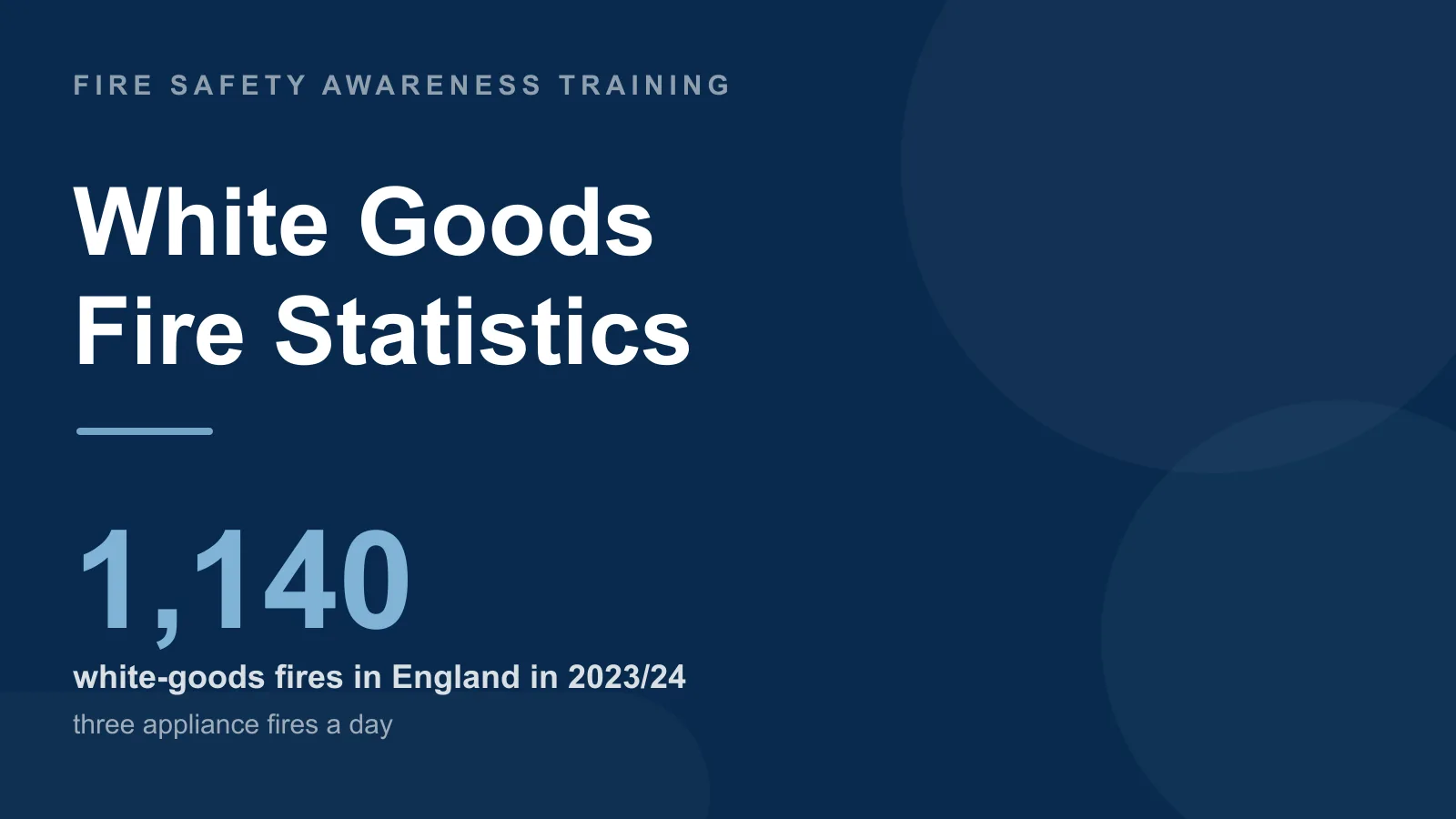
- 1,140 accidental fires involving white goods were recorded in England in 2023/24 — three appliance fires a day.
- 186 of those fires were in Greater London, the worst-hit area — the equivalent of three every week.
- Over half of England’s 43 fire and rescue service areas saw white-goods fires rise year-on-year, with washing-machine fires up 7% across England.
- 51% of white-goods fire insurance claims involve tumble dryers, and almost a quarter (24%) involve dishwashers.
- £36,870 is the average white-goods fire insurance claim; the highest single claim was just under £290,000.
- 85,000 Haier-made heat-pump tumble dryers were placed under an urgent stop-use safety check by OPSS in December 2025 — the biggest appliance recall action since Whirlpool.
- 258 white-goods fires were attended by London Fire Brigade in 2025, with washing machines the single biggest cause at 92.
- 750+ fires were linked to the Whirlpool tumble dryer defect, with up to 800,000 unmodified machines estimated still in homes at the 2019 recall.
These are the latest published figures as of July 2026, and this page is updated when new data is released — Electrical Safety First re-runs its white-goods FOI analysis roughly every February, MHCLG’s domestic-appliance incident dataset refreshes each July, and the FIRE0601/0602 tables and the London Datastore series update through the year.
How many white goods fires are there in the UK each year?
There were 1,140 accidental fires involving common household white goods in England in 2023/24 — an average of three every day — according to Electrical Safety First’s analysis of Freedom of Information data from fire and rescue services, published in February 2025. It counts fires started by the large appliances in kitchens and utility rooms: tumble dryers, washing machines, dishwashers, fridges and freezers.
The picture is not improving evenly. More than half of the 43 fire and rescue service areas in England recorded a year-on-year rise in white-goods fires, and washing-machine fires specifically rose 7% on the previous year. These are appliances people leave running unattended and overnight, often on timers, in exactly the rooms where a fire has time to grow before it is noticed.
A note on scope. This page is about the appliances themselves — the product-level fire and recall story. How many electrical fires the UK has in total, and the role of wiring, sockets, extension leads and chargers, sits with our sister site’s guide to electrical fire statistics in the UK. Battery and lithium-ion product fires — e-bikes, e-scooters, power banks — are a separate hazard, covered on our page on lithium-ion battery fire statistics.
Which white goods cause the most fires?
Tumble dryers are the standout culprit, accounting for 51% of white-goods fire insurance claims, with dishwashers next at almost a quarter (24%), according to the insurer claims analysis quoted in Electrical Safety First’s February 2025 release. A dryer combines a heating element, a motor and a build-up of highly combustible lint, and it is routinely left to run unattended.
Regional fire data varies by measure. In London, washing machines top the list of white-goods ignitions, while the insurance-claims league is led by dryers — the difference comes down to washing machines being more numerous in homes, not just to fire frequency. Fridges and freezers cause fewer fires but carry an outsized reputation because of one catastrophic case, covered further down.
| Appliance | Share of white-goods fire insurance claims | Notes |
|---|---|---|
| Tumble dryers | 51% | Heating element plus flammable lint; often run unattended and overnight |
| Dishwashers | 24% | Water, heat and electrics in one sealed unit; faults in control boards and heaters |
| Washing machines | Remainder (top cause by count in London) | Most numerous appliance; England-wide fires up 7% year-on-year |
| Fridges & freezers | Lower share of claims | Fewer fires, but the Grenfell origin appliance and a major recall focus |
Source: insurer claims analysis in the Electrical Safety First release (February 2025) for the claim shares; London Fire Brigade data (2025) for the London ranking. Percentages are of white-goods claims, not of all appliance fires.
What do the London figures show?
London Fire Brigade attended 258 white-goods fires in 2025, and washing machines were the single biggest cause at 92 — about a third of the total — with tumble dryers second on 86, per the brigade’s cause-of-ignition dataset published on the London Datastore. Greater London was also the worst-hit area in the national FOI analysis, with 186 accidental white-goods fires in 2023/24 — roughly three a week.
The longer London series has trended broadly downward from a mid-2010s peak: 303 fires in 2016, a peak of 361 in 2018, down to 234 by 2024 before the 258 recorded in 2025. That decline, against a rising number of appliances in homes, points to safer product design and better consumer awareness doing real work — but the total still sits above 200, which is why the brigade keeps issuing appliance-fire warnings.
| Year | White-goods fires attended (London) | Trend |
|---|---|---|
| 2016 | 303 | — |
| 2018 | 361 | Peak of the series |
| 2024 | 234 | Down from peak |
| 2025 | 258 | Slight rise; washing machines top at 92 |
Source: London Fire Brigade white-goods cause-of-ignition dataset, London Datastore (data to April 2025, 2025 total reported January 2026).
Are heat-pump tumble dryers being recalled in 2025-26?
Yes — in December 2025 the Office for Product Safety and Standards ordered urgent safety checks on 85,000 Haier-made heat-pump tumble dryers because an internal short circuit can occur during normal use and cause the dryer to ignite. Owners are told to stop using the appliance until the repair has been completed, and, where the plug is accessible, to switch off and unplug it. The affected machines were sold under eight brands: Baumatic, Candy, Caple, Haier, Hoover, Lamona, Iberna and Montpellier.
This was not a standing start. On 1 August 2025 the regulator had already issued a stop-use warning covering more than 17,000 of the dryers after judging Haier’s original modification programme inadequate. The wider corrective-action programme covered around 103,000 machines; after an updated fix was agreed, the 85,000 still presenting a hazard were pulled into the December action. It is the most significant appliance safety enforcement in Britain since the Whirlpool saga — a live story that is likely to keep moving, which is why this page carries a recall-watch rather than a single fixed figure.
The takeaway for households and landlords: heat-pump dryers are not immune from the fire risks of older vented and condenser models, and a recall on a modern “energy-efficient” appliance is exactly as serious as one on an older machine.
What was the Whirlpool tumble dryer scandal?
The Whirlpool tumble dryer defect was linked to at least 750 fires since 2004, and at the point of the full 2019 recall an estimated 800,000 defective machines were still in UK homes, according to the House of Commons BEIS Committee, which investigated the handling of the case. The affected Hotpoint, Indesit, Creda, Swan and Proline dryers could catch fire when fluff came into contact with the heating element — and the response was criticised for being slow, with years of “modify in your home” advice before a full recall.
The clean-up has been enormous but incomplete. A government progress update recorded 126,975 cases fully resolved by October 2021 — 84,537 machines replaced and 14,180 modified — and the recall remained active beyond that point, with many unregistered machines still unaccounted for. Whirlpool is the reference case that reshaped how the UK handles appliance recalls, and the benchmark against which the 2025-26 heat-pump dryer action is being measured.
| Measure | Figure | Period and source |
|---|---|---|
| Fires linked to the Whirlpool defect | 750+ | Since 2004 — BEIS Committee, UK Parliament |
| Defective machines still in homes at recall | Up to 800,000 | At the 2019 recall — BEIS Committee |
| Cases fully resolved | 126,975 | By October 2021 — GOV.UK progress update (84,537 replaced, 14,180 modified) |
| Heat-pump dryers under 2025 safety check | 85,000 | December 2025 — OPSS (Haier brands) |
How much damage do white goods fires cause?
The average white-goods fire insurance claim is £36,870, and the highest single claim recorded was just under £290,000 (insurer claims data over three years, quoted in the Electrical Safety First release, February 2025). White goods sit with a mains supply, a water feed and, in dryers, a store of combustible lint — so when one fails it can readily set fire to the units and building fabric around it.
That severity is what makes appliance fires disproportionate. Even where nobody is hurt, a fridge-freezer or dryer fire routinely means a gutted kitchen, smoke damage through the house and months out of the property — the reason regulators treat a single defective model as a national issue rather than a run of isolated accidents.
Did a white good start the Grenfell Tower fire?
Yes — the Grenfell Tower fire of 14 June 2017, in which 72 people died, started in a fridge-freezer in a fourth-floor flat, according to the Grenfell Tower Inquiry Phase 1 report. The appliance itself was the ignition point; the catastrophe that followed was driven overwhelmingly by the building’s combustible cladding and the failure of compartmentation, which is a building-safety story rather than an appliance one and sits outside the scope of this page.
What Grenfell did for white-goods safety was decisive: it turned the fridge-freezer, a low-frequency fire source, into the emblem of why product safety and recall enforcement matter. The creation of the Office for Product Safety and Standards and the tightening of recall processes trace back in part to that origin. The wider building-safety and evacuation lessons of Grenfell are covered by our sister site on fire safety in high-rise buildings.
What do figures outside London and England-wide show?
In Wales, tumble dryers accounted for 57% of all white-goods fires over a three-year period, with an average of 158 white-goods fires a year, according to South Wales Fire & Rescue Service, which runs an annual campaign tied to Electrical Fire Safety Week. The Welsh figure is a useful cross-check on the England-and-London picture: it puts dryers even further ahead of other appliances than the insurance-claims league does, reinforcing that the tumble dryer is the single most fire-prone category of white good.
England publishes the most detailed appliance-level fire data of the UK nations, through MHCLG’s domestic-appliance incident dataset and the FIRE0601/0602 tables, which record appliance type and, in the incident-level data, make and model. Scotland, Wales and Northern Ireland publish their own fire statistics separately. When people cite “UK white goods fire statistics” they are almost always quoting the England series or the Electrical Safety First analysis — for the devolved nations, use their own publications rather than scaling the English numbers.
What should I do if my appliance is recalled?
If your white good is subject to a recall or safety notice, the advice from OPSS and fire services is consistent: stop using it immediately, switch it off and unplug it at the socket where safe to do so, and do not use it again until the manufacturer has repaired or replaced it. Do not assume that a machine that “seems fine” is safe — the whole point of a recall is that the fault is intermittent and can appear during normal use.
To check whether your model is affected, find the make, model and serial number (usually on a rating plate on the door frame, the back, or inside the drum or lid) and enter them on the manufacturer’s recall-checker or the government product recalls database. Register new appliances when you buy them — unregistered machines are the reason recalls drag on for years. And a working smoke alarm remains the backstop that turns an appliance fault into an anecdote rather than a tragedy; our companion page on smoke alarm statistics sets out the ownership and failure data.
For workplaces and landlords, appliance safety is part of the fire risk assessment and, for rented homes, of the electrical safety obligations the Responsible Person or landlord must meet — including keeping staff and tenants informed when a recall lands. Fire awareness training keeps appliance risk on people’s radar.
Frequently asked questions
Which white goods cause the most fires in the UK?
Tumble dryers. They account for 51% of white-goods fire insurance claims, with dishwashers next at almost a quarter (24%), per the insurer analysis in Electrical Safety First’s February 2025 release. In London specifically, washing machines top the count (92 fires in 2025) because they are the most numerous appliance, but dryers lead on claim frequency and severity, and made up 57% of white-goods fires in Wales over three years.
How many white goods fires happen in the UK each year?
There were 1,140 accidental white-goods fires in England in 2023/24 — three a day — according to Electrical Safety First’s FOI analysis. More than half of England’s 43 fire and rescue service areas saw a year-on-year rise, and washing-machine fires were up 7%. Greater London was the worst-hit area with 186. Scotland, Wales and Northern Ireland publish separate figures.
Are heat-pump tumble dryers a fire risk in 2026?
They can be. In December 2025 the Office for Product Safety and Standards ordered urgent safety checks on 85,000 Haier-made heat-pump tumble dryers (sold as Baumatic, Candy, Caple, Haier, Hoover, Lamona, Iberna and Montpellier) because an internal short circuit can cause them to ignite. Owners are told to stop using the machines until they are repaired. An earlier August 2025 warning covered 17,000+ of the dryers. Check your model and serial number against the manufacturer’s recall-checker.
What should I do if my appliance is recalled?
Stop using it at once, switch it off and unplug it where safe, and do not use it again until the manufacturer has repaired or replaced it. Find the make, model and serial number on the rating plate and enter them on the manufacturer’s recall-checker or the government product recalls database. Register your appliances so manufacturers can contact you, and keep your smoke alarms working.
Did a white good really start the Grenfell Tower fire?
Yes. The Grenfell Tower fire of June 2017, in which 72 people died, started in a fridge-freezer, according to the Inquiry’s Phase 1 report. The scale of the disaster was driven by the building’s cladding and compartmentation failures rather than the appliance, but the fridge-freezer origin is why product-safety and recall enforcement were overhauled afterwards.
Where do UK white goods fire statistics come from?
The 1,140 headline comes from Electrical Safety First’s annual FOI analysis of fire and rescue service data. England’s official appliance data is in MHCLG’s domestic-appliance incident dataset and the FIRE0601/0602 tables. London figures come from the London Fire Brigade dataset on the London Datastore, recall data from OPSS and GOV.UK, and regional detail from South Wales Fire & Rescue Service.
Related guides
- Lithium-ion Battery Fire Statistics UK: E-bikes, E-scooters & Storage
- Smoke Alarm Statistics UK: Ownership, Failures & Lives Saved
- Carbon Monoxide Poisoning Statistics UK: Deaths, Incidents & Alarms
- The Right Fire Extinguisher for an Electrical Fire
- How to Use a Fire Extinguisher: The PASS Method Explained
Sources & references
- Electrical Safety First — White goods linked to three fires a day as more than half of areas in England see a rise (February 2025)
- MHCLG — Domestic appliance fires incident-level dataset guidance (year ending March 2025, updated 10 July 2025)
- MHCLG — Fire statistics data tables, FIRE0601/FIRE0602 (year ending December 2025 edition)
- London Fire Brigade — Fires in London where the cause of ignition is white goods (London Datastore, data to April 2025)
- OPSS / GOV.UK — Urgent safety check for 85,000 tumble dryers (10 December 2025)
- GOV.UK — Update on Whirlpool tumble dryer recall progress (resolution figures to October 2021)
- South Wales Fire & Rescue Service — Tumble dryer dos and don’ts (three-year Wales analysis)
- BEIS Committee, UK Parliament — Safety of electrical goods / Whirlpool report (2019-20 session)
White goods start three fires a day in England — get every employee fire aware in around 90 minutes.
Explore the Fire Safety Awareness Training course →
Mark writes about workplace health & safety, fire safety awareness and accredited online training for Fire Safety Awareness Training, part of Online CPD Academy.