
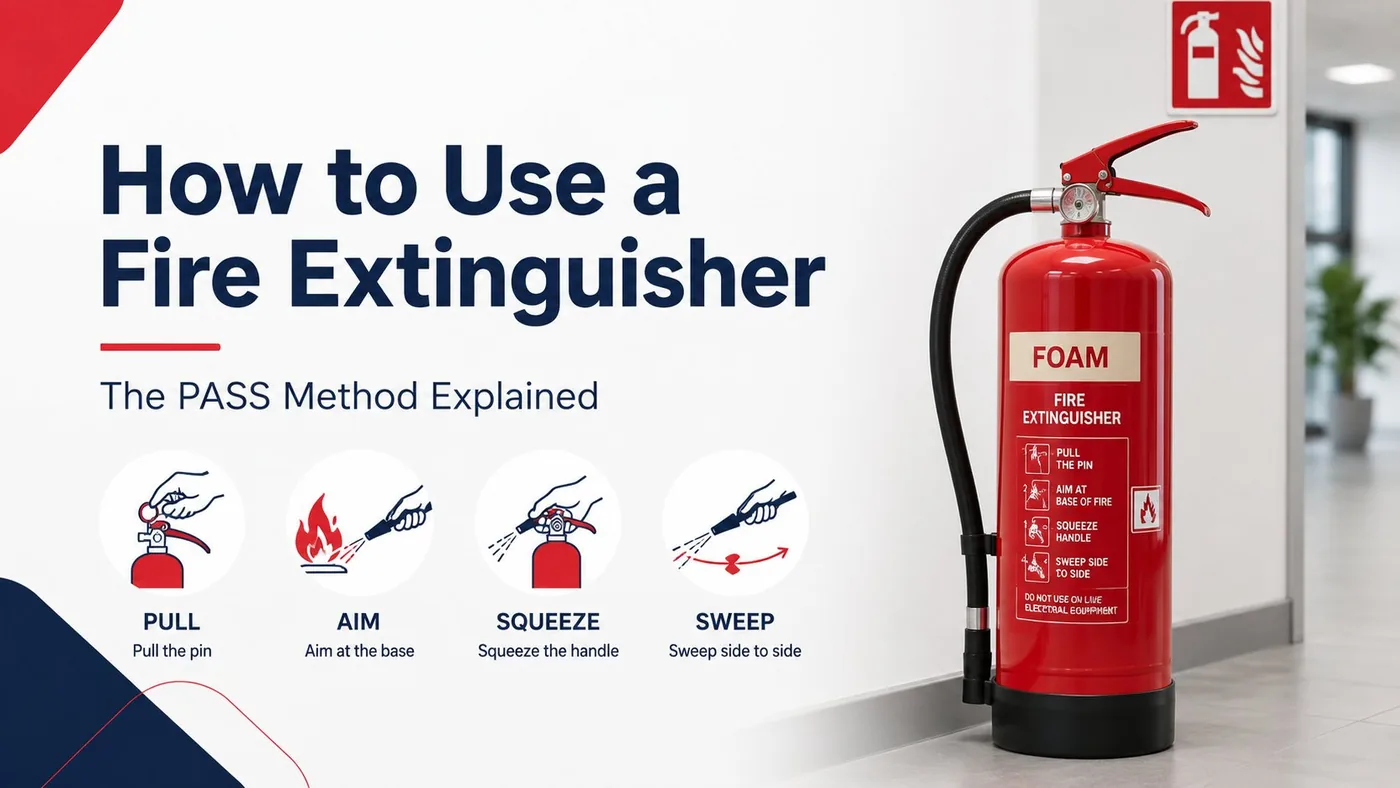
The standard UK method for using a portable fire extinguisher is built around four steps and a four-letter mnemonic: PASS — Pull, Aim, Squeeze, Sweep. The acronym is universally taught, but it is not the whole story. Knowing the four steps matters less than knowing whether to use the extinguisher at all, and recognising what is different about the unit in your hand once you do.
This page walks through PASS, sets out the assessment that has to come first, and covers what changes between extinguisher types — because the same four steps look quite different with a CO2 horn, a powder cloud, and a wet chemical lance.
What PASS stands for
The four letters break down to:
- P — Pull the safety pin.
- A — Aim at the base of the fire.
- S — Squeeze the lever.
- S — Sweep from side to side.
That sequence is the basis for every type of UK portable extinguisher. The reason it is taught as four words is simple: under stress, people forget detailed instructions. A four-letter mnemonic survives the moment.
Before you pick it up: assess the fire
PASS is the second decision, not the first. The first decision is whether to fight the fire at all.
Three questions to run through, faster than they read on the page:
Has the alarm been raised? If the fire alarm hasn't been activated, do that first. Other people in the building need to know, and the response (evacuation, fire and rescue service called) needs to be in motion before you concentrate on a single fire point.
Is the fire small enough? Portable extinguishers are designed for small, manageable fires — typically waste-bin scale, a small flare in a piece of equipment, the early seconds of a chip-pan fire. Once a fire is bigger than waste-bin scale, or once it has spread to walls or ceiling, an extinguisher will not stop it. The right answer at that point is to evacuate and let the fire and rescue service handle it.
Do I have a clear escape route? This is the question people miss most often. Position yourself so the fire is between you and the burning material, with an unobstructed exit behind you. If the only way out is past the fire, do not engage — leave.
If any of those answers is no, the right action is to evacuate, close the door behind you, and call 999. Fighting a fire that is too big, with no exit, with the alarm not raised, kills people. It is not a failure of nerve to walk away; it is the standard advice from every UK fire and rescue service.
Pull
The pin (sometimes called a tamper seal pin) sits at the top of the extinguisher, below the lever. It is held in place by a small plastic tag that breaks when the pin is pulled. Often a quarter-turn or twisting motion makes the pin come out more easily — the tag is designed to break with that movement.
Pulling the pin does not start the extinguisher. It just removes the safety lock that prevents the lever from being squeezed accidentally. Until you squeeze, nothing comes out.
If the pin is missing or the tag is already broken when you reach the extinguisher, that is a problem worth noticing afterwards: the unit may have been tampered with or partially discharged and should be replaced or serviced. In the moment, the extinguisher will still operate.
Aim
Aim at the base of the fire, not at the flames. This is the step people most often get wrong. Flames are the visible product of combustion; the chemistry that sustains the fire is happening at the fuel surface below. Spraying a fine cloud of agent through the air above the flames does very little. Hitting the burning material itself takes the heat (water), the oxygen (foam, powder, CO2), or the chemical chain reaction (powder again, in a different way) out of the fire triangle.
Stand at a sensible distance. For a 9 L water or foam extinguisher, that is around 2 metres at the point of first discharge — close enough to be accurate, far enough that radiant heat won't drive you back. CO2 is normally used closer in, around 1 to 1.5 metres, because the gas dissipates fast. Dry powder is somewhere in between, depending on the unit's discharge range.
For most extinguishers, the agent loses force quickly with distance — there is no benefit in standing further back than necessary, and there is a real cost in not getting the agent onto the fuel.
Squeeze
Squeeze the lever — firmly, not in pulses. The extinguisher is a pressure vessel, and once you start the discharge, it is more effective to use it in one continuous flow than to fire short bursts.
A typical 6 L water or foam extinguisher empties in around 30 to 40 seconds. A 6 kg dry powder extinguisher discharges in about 20 seconds. A 5 kg CO2 unit empties in about 12 seconds. You don't have long. Treat the trigger as a tap that, once opened, stays open until either the fire is out or you are.
If the fire isn't out by the time the extinguisher is empty, that is the signal to evacuate. Do not try to find a second extinguisher and continue. By the time you locate, fetch, deploy a second one, the fire has had another minute to spread, and you are now fighting in a worse position.
Sweep
Sweep the discharge across the base of the fire from side to side. Two reasons for this. First, it covers a wider area — most fires are not a neat point source, and you need to address the whole burning surface. Second, it stops the agent from hitting one spot and bouncing off, which is especially a problem with water on a hard surface or foam on a flammable liquid.
Move closer as the fire shrinks, but cautiously. The visible flames will go out before the underlying material is fully cool, so it is easy to back off, watch the flames die, and then have the fire re-ignite from a hot spot. Once the fire appears out, keep applying agent for another few seconds across the previously-burning area, especially with water (which cools but evaporates) and foam (which forms a sealing layer that can be displaced).
Type-specific notes
PASS is universal in shape but the details vary by extinguisher type. The differences that matter most:
Water and foam
A jet or spray nozzle, fired in a sweeping motion across the base of the fire. The discharge is heavy and wets surfaces — expect water on the floor and runoff after use. With foam, the sweep should leave a continuous foam blanket on a flammable liquid surface; if the blanket breaks, the fire can re-ignite through the gap. With water, focus particularly on hot spots after the visible fire is out.
CO2
The discharge horn becomes extremely cold during use. Hold the extinguisher by the handle and the discharge tube, never by the horn itself — frostbite is a real risk in the seconds it takes to use the extinguisher. The horn also expands the gas with a noisy, forceful blast at first, which can blow loose paper or small flammable items around; aim with that in mind. CO2 has no visible discharge after the first second or two, so you are working from the cooling effect rather than seeing where the agent is going.
Dry powder
The discharge is a thick, opaque cloud of powder that drastically reduces visibility within seconds. In an enclosed space, this can mean losing sight of your escape route, the fire, and the people behind you. The standard advice in BS 5306-8:2023 is that powder extinguishers should not normally be used indoors unless that risk has been mitigated through a health and safety risk assessment. Use a dry powder extinguisher in earnest, and you will spend the next hour cleaning powder off everything in the room.
Wet chemical
Wet chemical extinguishers are supplied with a long lance rather than a short nozzle. The lance is there for a reason: it lets you apply the mist from a safe distance to a hot oil fire without the discharge force splashing burning oil out of the pan. Don't try to use a wet chemical extinguisher up close like a foam unit — keep the lance extended, point the mist into the burning oil, and let the saponification chemistry do the work. (More on that on our wet chemical fire extinguisher page.)
Water mist
Sweep the mist across the fire as you would water, but expect a finer, gentler discharge. Water mist works through a combination of cooling, oxygen displacement, and rapid steam generation; it doesn't drench surfaces the way bulk water does. Useful in confined spaces where heavy water damage matters.
When not to fight a fire
A short list, worth memorising:
- The fire is bigger than waste-bin or chair-back size.
- The fire has reached the ceiling, the walls, or another room.
- The room is filling with smoke that obscures vision or makes breathing difficult.
- The only escape route runs past the fire.
- The right type of extinguisher isn't immediately to hand.
- You haven't been trained to use the extinguisher in front of you.
- You are alone in the building, or others haven't been alerted yet.
Any one of these is a reason to evacuate, close the door behind you to slow the spread, raise the alarm, and call 999. None of them are a reason to feel embarrassed afterwards. The duty for almost everyone in a UK workplace is to evacuate safely; only nominated and trained fire wardens or fire marshals are expected to use extinguishers on incipient fires. There is more on that distinction on who is responsible for fire extinguishers in UK workplaces.
Why training beats reading
PASS can be learned from a page. Using a fire extinguisher confidently in the actual seconds of a fire is harder, and that gap is the whole reason fire safety training exists.
The Regulatory Reform (Fire Safety) Order 2005 requires employers to provide adequate fire safety training to all employees, including how to react to a fire and the basics of fire safety equipment. For most staff, that does not mean live-fire practice — it means knowing the alarms, the escape routes, the assembly point, and the principle of when to fight versus when to flee. Our online fire safety awareness training course covers exactly that ground for UK workplaces, in 90 minutes, RoSPA-approved and CPD-accredited.
For nominated fire wardens and fire marshals, training goes further — practical extinguisher handling, evacuation leadership, and post-incident duties — and is normally provided as a separate course.
The point is that nobody learns to drive from reading the Highway Code. The same applies here. PASS gives you the framework; training gives you the muscle memory.
Frequently asked questions
What does PASS stand for?
Pull, Aim, Squeeze, Sweep — the four-step technique for operating a portable fire extinguisher. Pull the pin, aim at the base of the fire, squeeze the lever, sweep across the burning material.
How close should I stand to a fire when using an extinguisher?
For water and foam, about 2 metres at first discharge, moving closer as the fire shrinks. For CO2, around 1 to 1.5 metres. For dry powder and wet chemical, follow the markings on the unit — wet chemical in particular is designed to be used with the lance fully extended for distance.
When should I not try to put out a fire?
Anytime the fire is bigger than waste-bin size, has spread, is filling the room with smoke, or is between you and the only exit. Anytime you are alone with the alarm not yet raised. Anytime the right type of extinguisher isn't immediately available. Evacuate, close doors, call 999.
Does PASS work for every type of extinguisher?
The four steps apply to every UK portable extinguisher type, but the details differ. CO2 has the frostbite hazard on the horn, dry powder produces a visibility-blocking cloud, wet chemical is used at a longer distance through the supplied lance. The principles are universal; the technique adapts.
How often should I refresh fire safety training?
There is no statutory minimum, but the practical guidance is every 1 to 3 years for general fire awareness, depending on the workplace and the role. For appointed fire wardens or marshals, annual refresher training is the common standard. The right interval comes from your fire risk assessment.
Where this connects
If you have read this far and want the next layer of detail, the most useful next steps are:
- Types of fire extinguisher — the colour code, the five extinguisher types, and which fires they handle.
- UK fire classes explained — how fires are classified and which class needs which extinguisher.
- Fire extinguisher servicing and inspection — what makes the unit you are about to pick up actually work when you squeeze the lever.
And if it is your team's training that needs sorting, the online fire safety awareness course is the place to start — every UK employee needs the basics, and ours delivers them in 90 minutes with an instant certificate.
Related guides
- Who is responsible for fire extinguishers in the UK?
- Fire extinguisher disposal: the UK guide
- Fire extinguisher servicing and inspection: the UK guide
Give every employee the confidence to act in the first minute of a fire.
Explore the Fire Safety Awareness Training course →
Mark writes about workplace health & safety, fire safety awareness and accredited online training for Fire Safety Awareness Training, part of Online CPD Academy.