
Candles start close to a thousand house fires in England every year, and the fires they start are markedly more likely to hurt someone than almost any other kind of dwelling fire. This page gathers the official UK candle fire statistics in one referenced place: the candle-ignition figures from MHCLG’s fire statistics data tables (table FIRE0602), the national fire and rescue incident statistics for England, insurer claims analysis from Aviva, and seasonal incident data from London Fire Brigade. The data period is stated next to every figure, so you can cite any number on this page with confidence.
Key facts and figures
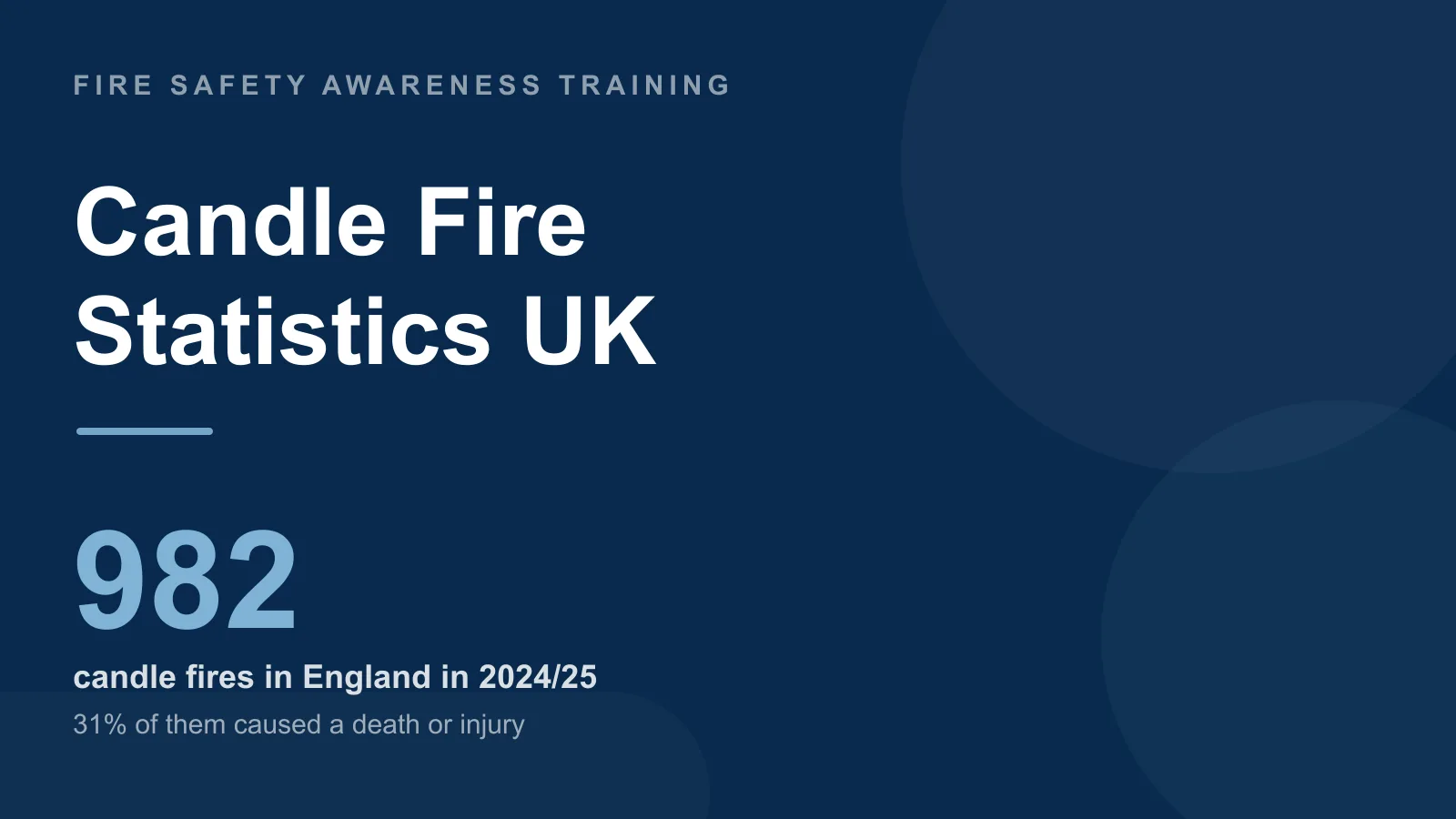
- 982 primary fires in England were started by candles in 2024/25 (year ending March 2025).
- 9 people died in candle-ignited fires in England in 2024/25 — roughly 10 deaths a year over the past decade.
- 298 people suffered non-fatal injuries in candle fires in England in 2024/25, around 307 casualties in total including fatalities.
- 31% of candle fires caused a death or injury in 2024/25, against roughly 11% of all primary fires — about three times the rate.
- 15% of the home fire claims Aviva receives in December involve candles — more than double the 6% share for chimneys and fireplaces (claims 2021–2024).
- £25,000+ is the average cost of a candle-related home fire insurance claim (Aviva claims analysis, 2021–2024).
- ~200 candle-related fires were attended by London Fire Brigade in December and January alone across one three-year period.
- 271 people died in fires in England in the year ending March 2025 (up 8% on the previous year) — 9 of them in candle fires.
These are the latest published figures as of July 2026, and this page is updated when new data is released — the core source, MHCLG’s fire-cause tables (FIRE0602), is refreshed every August as part of the annual detailed fire statistics for England.
How many candle fires are there in the UK each year?
982 primary fires in England were started by candles in 2024/25 (the year ending March 2025), according to MHCLG fire statistics table FIRE0602. That continues a remarkably stable long-run pattern: there were 1,041 candle-ignited fires in 2023/24, 1,045 in 2022/23, and 1,122 back in 2010/11 — the total has hovered around the 1,000-a-year mark for well over a decade, drifting down only slowly (2024/25 is about 12% below the 2010/11 figure).
“Primary fires” are the more serious incidents in the official statistics — broadly, fires in buildings, vehicles or other structures, plus any fire involving casualties, rescues or attendance by five or more appliances. In practice, almost all candle fires are dwelling fires: a candle is a deliberate open flame inside someone’s home, usually within reach of curtains, bedding, furniture or decorations. That domestic setting is exactly why the casualty figures below are so disproportionate.
Put simply: on an average day in England, between two and three house fires are started by candles.
How many people do candle fires kill and injure?
9 people died in candle-ignited fires in England in 2024/25, and a further 298 suffered non-fatal injuries — around 307 casualties in total, from 982 fires (FIRE0602, year ending March 2025). The death toll moves around year to year on small numbers: there were 12 candle-fire fatalities in 2022/23 and 14 in 2021/22, and the running rate over the past decade works out at roughly 10 deaths a year. Non-fatal casualties fell from 337 in 2023/24 to 298 in 2024/25.
For context, there were 271 fire-related deaths in England overall in the year ending March 2025, an 8% rise on the previous year (MHCLG fire and rescue incident statistics). Candle fires therefore account for roughly one in thirty fire deaths in England — a small share of a much bigger picture, which we cover in full in our sister site’s guide to fire deaths in the UK. What makes candles stand out is not the absolute number of deaths but the injury rate per fire, covered next.
How dangerous are candle fires compared with other fires?
31% of candle fires caused a death or injury in 2024/25 — 307 casualties from 982 fires — compared with roughly 11% across all primary fires in England (6,681 casualties from 61,649 fires, computed from the same FIRE0602 tables). A fire started by a candle is about three times more likely to hurt someone than the average primary fire.
The reasons are not mysterious. Candle fires happen almost exclusively in occupied homes, in the rooms where people relax and sleep, and often in the evening or at night. The flame is small, so the fire tends to smoulder and grow close to soft furnishings before it is noticed — and the person who lit the candle is usually nearby when it takes hold. Fire and rescue services consistently highlight unattended candles, candles placed too close to combustible materials, and candles left burning while people sleep as the recurring circumstances behind these incidents.
That injury rate is the single most citable fact on this page: candles are a small cause of fires overall, but among the most dangerous per fire.
Candle fire statistics at a glance
The table below summarises the key UK candle fire figures, with the data period and direction of travel for each measure.
| Measure | Figure | Period and trend |
|---|---|---|
| Candle-ignited primary fires (England) | 982 | 2024/25 — down from 1,041 in 2023/24 and 1,045 in 2022/23 |
| Deaths in candle fires (England) | 9 | 2024/25 — roughly 10 a year over the decade (14 in 2021/22) |
| Non-fatal casualties (England) | 298 | 2024/25 — down from 337 in 2023/24 |
| Candle fires causing death or injury | 31% | 2024/25 — about 3x the ~11% rate across all primary fires |
| Candles’ share of December home fire claims | 15% | Aviva claims 2021–2024 — vs 6% for chimneys and fireplaces |
| Average candle fire insurance claim | Over £25,000 | Aviva claims 2021–2024 (published November 2025) |
| All fire-related deaths (England) | 271 | Year ending March 2025 — up 8% on the previous year |
Do candle fires spike in December?
Candles account for 15% of the home fire claims Aviva receives in December — more than double the 6% share attributed to chimneys and fireplaces — according to the insurer’s analysis of claims made between 2021 and 2024, published in November 2025. The same analysis found the average candle-related fire claim exceeds £25,000, a reminder that even a “small” candle fire routinely means a wrecked room, smoke damage through the house, and weeks out of the property.
Fire services see the same seasonal pattern on the ground. London Fire Brigade reported attending almost 200 candle-related fires in December and January alone over one three-year span (2022 festive warning), and over Christmas 2025 it attended four serious candle fires in just four days — including a maisonette fire in Peckham, caused by an unattended candle, that took six fire engines and around 40 firefighters to bring under control.
The reasons for the spike are straightforward: longer, darker evenings, more time spent at home, and festive candles burning near decorations, cards and greenery. It is why the National Fire Chiefs Council and local fire services run an annual Candle Fire Safety Week campaign, and why insurers and brigades issue candle warnings every November and December.
Is the home-fragrance boom changing the risk?
Between roughly 438 million and 829 million US dollars — that is the range of 2025 market-research estimates for the size of the UK candle market, with forecasts of around 5% annual growth into the 2030s (Grand View Research and comparable market reports). The same industry research reports the home-fragrance category growing at more than 25% year on year at times, with an estimated 70–80% of UK households buying at least one scented candle annually. These are market-research estimates rather than official statistics, and should be cited as such — but the direction is clear: there are more candles, in more homes, burning more often than a generation ago.
Set against that boom, the official fire series is arguably reassuring: candle-ignited fires in England have drifted slowly downwards even as candle ownership has grown, suggesting safety messaging and smoke alarm coverage are doing real work. But the exposure is enormous and growing — every one of those scented candles is an open flame in a living room or bathroom — which is precisely why fire services keep candles on their seasonal campaign list year after year.
Do these figures cover the whole of the UK?
The headline figures on this page cover England, which publishes the most detailed fire-cause data in the UK through MHCLG’s FIRE0602 tables (fires, fatalities and non-fatal casualties by source of ignition). There is no single published UK-wide candle fire table. Scotland’s figures are published separately by the Scottish Fire and Rescue Service, which maintains its own incident statistics (published to 2024/25) alongside dedicated candle safety guidance; Wales and Northern Ireland likewise publish their own fire statistics.
Because England accounts for the large majority of UK households, the England series is the standard proxy used when people cite “UK candle fire statistics” — but if you are quoting figures for Scotland, Wales or Northern Ireland specifically, use the devolved publications rather than scaling the English numbers.
What do fire services advise?
Given that around one in three candle fires ends with someone hurt (31% in 2024/25), the advice from UK fire and rescue services is consistent and blunt. Never leave a lit candle unattended, and put candles out completely before leaving the room or going to sleep. Keep them well away from curtains, bedding, furniture and decorations, on a stable, heat-resistant holder — and keep them out of reach of children and pets. Fire services also single out tealights, which can melt through plastic surfaces such as baths and televisions if placed directly on them, and increasingly suggest LED flameless candles as a like-for-like swap in bedrooms and bathrooms.
The other half of the equation is early warning: a working smoke alarm turns a smouldering candle fire from a tragedy into an anecdote. Our companion page on smoke alarm statistics sets out the ownership and failure data. And if a small fire does take hold, knowing what is — and is not — safe to tackle matters: see our guides to the UK fire classes and how to use a fire extinguisher.
For workplaces — hospitality venues, care settings, salons and spas where candles and oil burners are part of the environment — candle risk belongs in the fire risk assessment, and staff fire awareness training is part of the control measures the Responsible Person must provide.
Frequently asked questions
How many candle fires are there per year in the UK?
In England, 982 primary fires were started by candles in 2024/25 (year ending March 2025), per MHCLG table FIRE0602. The figure has stayed close to 1,000 a year for over a decade — 1,041 in 2023/24, 1,045 in 2022/23 and 1,122 in 2010/11. Scotland, Wales and Northern Ireland publish separate figures.
How many people die in candle fires in the UK each year?
There were 9 fatalities in candle-ignited fires in England in 2024/25, with roughly 10 deaths a year over the past decade (14 in 2021/22, 12 in 2022/23). A further 298 people suffered non-fatal injuries in candle fires in 2024/25.
Why do candle fires spike in December?
Darker evenings, more time at home and festive candles burning near decorations. Aviva’s claims analysis (2021–2024) found candles behind 15% of its December home fire claims — over double the share for chimneys and fireplaces — and London Fire Brigade has attended spates of candle fires over recent Christmas periods, including four serious fires in four days over Christmas 2025.
How much damage does a candle fire cause?
The average candle-related home fire insurance claim exceeds £25,000, according to Aviva’s analysis of claims made between 2021 and 2024 — before counting the disruption of smoke damage and time out of the home.
Are tealights included in the candle fire statistics?
Yes — the official FIRE0602 ignition-source category covers candles of all types, including tealights. Fire services warn about tealights specifically because, without a proper holder, they can melt through plastic surfaces such as baths and TV casings and ignite them.
Where do UK candle fire statistics come from?
The core source is MHCLG’s fire statistics data tables for England — table FIRE0602 gives fires, fatalities and non-fatal casualties by source of ignition, including candles. It is an Accredited Official Statistics series, refreshed every August; the current edition covers the year ending March 2025. Insurer claims data (Aviva) and fire brigade incident reports add the seasonal detail.
Related guides
- Smoke Alarm Statistics UK: Ownership, Failures & Lives Saved
- Carbon Monoxide Poisoning Statistics UK: Deaths, Incidents & Alarms
- UK Fire Classes Explained: A, B, C, D, F (and L)
- How to Use a Fire Extinguisher: The PASS Method Explained
- Water Fire Extinguishers: The UK Guide
- Who Is Responsible for Fire Extinguishers in the UK?
Sources & references
- MHCLG — Fire statistics data tables, table FIRE0602: fires, fatalities and non-fatal casualties by source of ignition (year ending March 2025 edition)
- MHCLG — Fire and rescue incident statistics, England: year ending March 2025
- Aviva plc — Households urged to take caution during festive season as candle fires spike in December (November 2025)
- London Fire Brigade — Warning after spate of candle fires over festive period (December 2025)
- London Fire Brigade — Festive warning as candle fires spike (December 2022)
- Scottish Fire and Rescue Service — Candle safety guidance and Scottish fire statistics
- East Sussex Fire & Rescue Service / NFCC — Candle Fire Safety Week
- Grand View Research — UK candle market outlook (market-research estimates)
Candles start nearly 1,000 fires a year in England — get every employee fire aware in around 90 minutes.
Explore the Fire Safety Awareness Training course →
Mark writes about workplace health & safety, fire safety awareness and accredited online training for Fire Safety Awareness Training, part of Online CPD Academy.