
Most UK homes now have at least one smoke alarm — yet almost a quarter of the dwelling fires attended by fire and rescue services in England still happen in homes with no alarm at all, and even where an alarm is present it raises the alarm in barely half of fires. This page gathers the key UK smoke alarm statistics on ownership, failure rates and lives saved in one place, with every figure cited to its source. The data comes principally from MHCLG’s fire statistics data tables (the dedicated smoke alarm series FIRE0701 to FIRE0708) and its annual detailed analysis of fires in England, alongside the English Housing Survey, the Scottish Fire and Rescue Service and the Welsh Government’s fire and rescue incident statistics.
Key facts and figures
- 92% of households in England had a working smoke alarm in the year ending March 2024.
- 24% of dwelling fires in England — 5,977 incidents — had no smoke alarm present in the year ending March 2025.
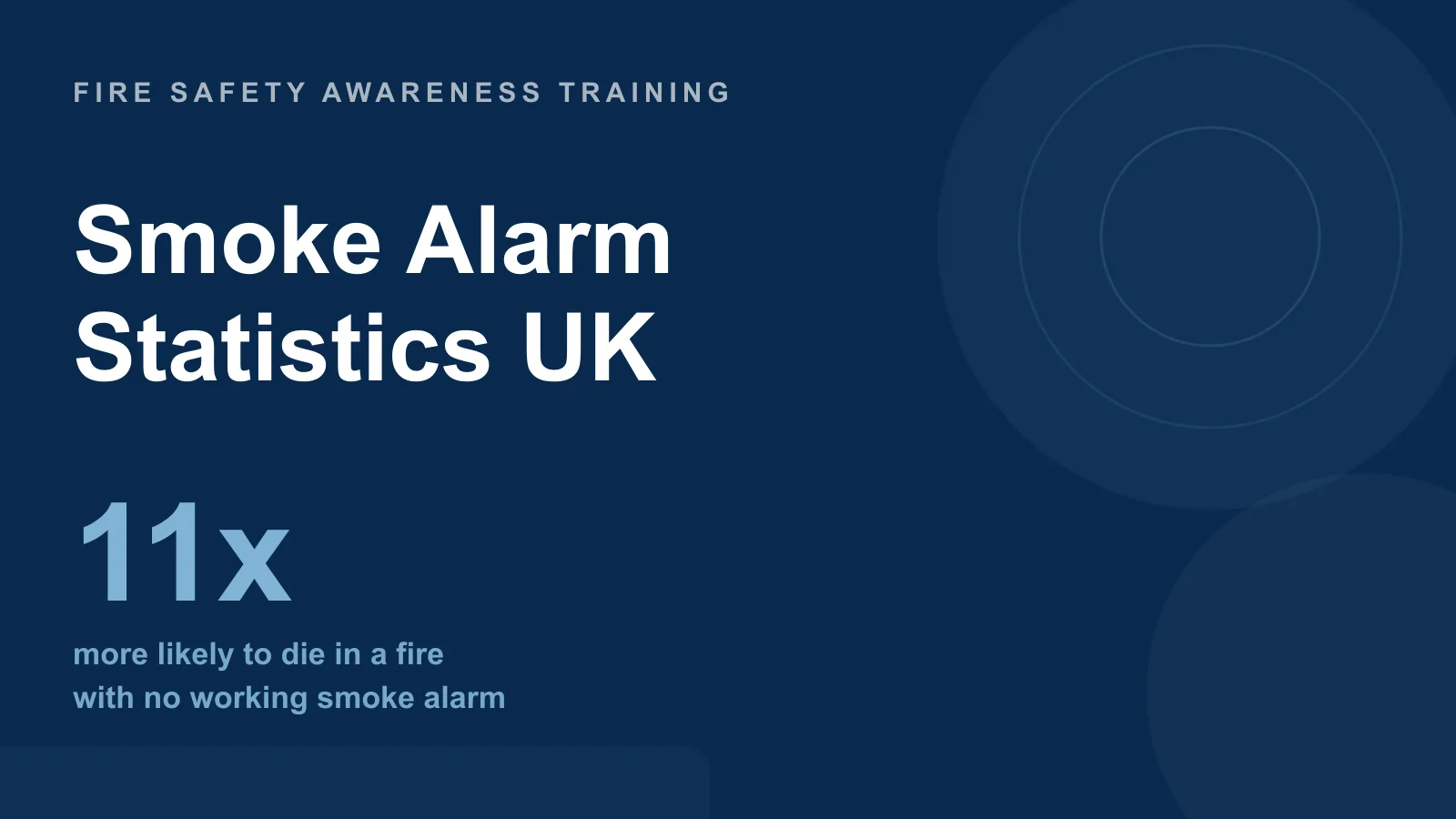
- Around 11 times more likely to die in a dwelling fire: the current official risk multiplier for homes without a working smoke alarm (five-year average).
- 48% of dwelling fires in England in 2024/25 had a smoke alarm that operated and raised the alarm — barely half.
- 31% of dwelling-fire fatalities in England in 2024/25 — 64 deaths — occurred in homes with no smoke alarm.
- 19% of dwelling fires in 2024/25 had an alarm present that did not operate.
- 7% of UK adults — around 4 million people — never test their smoke alarm.
- 1 October 2022 — the date from which every rented home in England, social as well as private, must have a smoke alarm on every storey.
Figures are the latest available as of July 2026, and this page is updated when new data is released — principally MHCLG’s detailed analysis of fires each August, with the English Housing Survey’s annual headline report and quarterly fire statistics updates in between.
How many homes in the UK have smoke alarms?
92% of households in England had at least one working smoke alarm in the year ending March 2024, according to the English Housing Survey — a slight dip from 93% in the year ending March 2022. Ownership, in other words, is close to universal: the long campaign to get an alarm on the ceiling of every home has largely been won on installation.
The remaining 8% — roughly one household in twelve — matters far more than its size suggests, because homes without alarms account for a disproportionate share of fires and fire deaths, as the next two sections show. And ownership is not the same thing as protection: the incident data below shows that even where alarms are present, they successfully raise the alarm in only around half of dwelling fires.
The official series behind these numbers sits in MHCLG’s fire statistics data tables — the dedicated smoke alarm tables FIRE0701 to FIRE0708 cover ownership, alarm presence and operation in attended fires, and the reasons alarms fail — with household ownership tracked year to year by the English Housing Survey.
How many dwelling fires happen with no smoke alarm?
24% of dwelling fires in England — 5,977 incidents — had no smoke alarm present in the year ending March 2025, according to MHCLG’s detailed analysis of fires attended by fire and rescue services. Homes without alarms make up a small minority of the housing stock, yet they account for a quarter of all attended dwelling fires.
The fatality picture is starker still. 31% of dwelling-fire fatalities in England — 64 deaths — occurred in homes with no smoke alarm in the year ending March 2025. For context, there were 271 fire-related deaths in England overall that year, up 8% on the year before, according to MHCLG’s fire and rescue incident statistics. Homes without alarms produce roughly a quarter of dwelling fires but nearly a third of the deaths.
The pattern extends beyond housing. 44% of ‘other building’ fires — non-dwelling buildings such as offices, shops and warehouses — had no smoke alarm present in 2024/25, and 58% of the fire fatalities in those buildings occurred where no alarm was present. In a workplace that is not just a safety gap but a legal one: the Regulatory Reform (Fire Safety) Order 2005 requires the Responsible Person to equip premises with appropriate fire detection and alarms.
How much more likely are you to die without a working smoke alarm?
People in homes without a working smoke alarm are around 11 times more likely to die in a dwelling fire, based on the five-year average in MHCLG’s latest detailed analysis of fires in England (April 2024 to March 2025).
If that number looks unfamiliar, it is because an older one is still in wide circulation. For years the Fire Kills campaign and countless safety pages quoted “around 8 times more likely to die” — a figure you will still find on fire service websites and alarm packaging. That figure has been superseded: MHCLG’s current analysis puts the multiplier at around 11. Any page still citing 8 times is working from older data.
The mechanism is straightforward. A working alarm converts the earliest minutes of a fire — when smoke is building but escape routes are still passable — into warning time. Without one, a fire that starts while the household is asleep or in another room can grow undetected until escape is difficult or impossible. The multiplier is the single most important number on this page, and the strongest argument for the monthly test covered below.
Why do smoke alarms fail to raise the alarm?
Owning an alarm is necessary but not sufficient. In the year ending March 2025, a smoke alarm operated and raised the alarm in only 48% of dwelling fires in England. In 19% of dwelling fires an alarm was present but did not operate; in a further 10% the alarm operated but did not raise the alarm — it sounded without successfully alerting anyone, for example because nobody was within earshot; and in the remaining 24% of fires there was no alarm at all.
Why do present alarms fail? The reasons recorded by fire and rescue services point at positioning and coverage more than at the hardware itself. In 48% of failure-to-operate cases in 2024/25, fire products — smoke and heat — simply never reached the detector, and in a further 15% the fire started in an area not covered by the system. An alarm on an upstairs landing does nothing for a fire smouldering behind a closed kitchen door; alarms on every storey, positioned where smoke from the likeliest fire-starting rooms will actually reach them, are what turn an owned alarm into a working defence.
The headline measures in one place:
| Measure | Figure | Data period |
|---|---|---|
| Households in England with a working smoke alarm | 92% | Year ending March 2024 |
| Dwelling fires with no smoke alarm present | 24% (5,977 fires) | Year ending March 2025 |
| Dwelling-fire fatalities in homes with no alarm | 31% (64 deaths) | Year ending March 2025 |
| Alarm present, operated and raised the alarm | 48% of dwelling fires | Year ending March 2025 |
| Alarm present but did not operate | 19% of dwelling fires | Year ending March 2025 |
| Alarm operated but did not raise the alarm | 10% of dwelling fires | Year ending March 2025 |
| Extra risk of dying with no working alarm | Around 11 times higher | Five-year average, 2024/25 release |
| ‘Other building’ fires with no alarm present | 44% | Year ending March 2025 |
How often do people test their smoke alarms?
7% of UK adults — around 4 million people — never test their smoke alarm, and only 22% test monthly, the frequency fire and rescue services recommend, according to a 2025 Electrical Safety First survey of 2,000 UK adults. Everyone else falls somewhere in between — testing occasionally, after a false alarm, or when the low-battery chirp forces the issue.
The testing gap connects directly to the failure figures above. Nearly one in five dwelling fires involves an alarm that was present but did not operate, and a monthly button-test is the simplest way to catch dead batteries, removed batteries and expired sensors before a fire finds them. The routine takes seconds: press the test button, confirm the sound carries to the bedrooms, once a month.
How do Scotland and Wales compare?
Fire statistics are devolved, and the smoke alarm picture differs across Great Britain.
In Wales, a smoke alarm operated and raised the alarm in 47% of dwelling fires in 2024-25 — almost identical to England’s 48% — according to the Welsh Government’s fire and rescue incident statistics.
Scotland has gone furthest on the regulatory front. Since February 2022, every home in Scotland — owner-occupied as well as rented — has been required to have interlinked smoke alarms in the living room and every hallway and landing, plus a heat alarm in the kitchen. The Scottish Fire and Rescue Service recorded 36 fire-related deaths in 2024-25, down from 42 the year before, with house fires at a record low since the interlinked-alarm standard came into force, according to SFRS incident statistics.
What are the smoke alarm rules for landlords?
In England, the Smoke and Carbon Monoxide Alarm (England) Regulations 2015 have required private landlords to provide a smoke alarm on every storey with living accommodation since 1 October 2015. The Smoke and Carbon Monoxide Alarm (Amendment) Regulations 2022, in force from 1 October 2022, extended the smoke alarm duty to social landlords and added a carbon monoxide alarm requirement for any room with a fixed combustion appliance (gas cookers excluded). Landlords must repair or replace any alarm reported as faulty, and local authorities can fine up to £5,000 per breach, according to the GOV.UK guidance for landlords and tenants.
The same 2022 regulations set the carbon monoxide alarm rules — we cover the CO side of the story, including deaths, incidents and alarm ownership, in our carbon monoxide poisoning statistics UK page.
For workplaces and other non-domestic premises, detection duties sit with the Responsible Person under the Regulatory Reform (Fire Safety) Order 2005 — the same role that owns extinguisher provision and staff fire safety training. Our guide to who is responsible for fire extinguishers in the UK sets out how that role works in practice.
Frequently asked questions
How many homes in the UK have smoke alarms?
92% of households in England had a working smoke alarm in the year ending March 2024, according to the English Housing Survey. Coverage is close to universal — but the unprotected minority accounts for a disproportionate share of fires and fire deaths.
What percentage of house fires have no smoke alarm?
24% of dwelling fires in England — 5,977 incidents — had no smoke alarm present in the year ending March 2025, and 31% of dwelling-fire fatalities (64 deaths) occurred in homes with no alarm.
How many times more likely are you to die in a fire without a smoke alarm?
Around 11 times more likely, based on the five-year average in MHCLG’s latest detailed analysis of fires in England. This supersedes the widely quoted historic figure of around 8 times.
What is the smoke alarm failure rate in the UK?
In the year ending March 2025, 19% of dwelling fires in England had an alarm present that did not operate, and a further 10% had an alarm that operated but did not raise the alarm. The most common reason for failure to operate — 48% of cases — was that fire products never reached the detector.
How often should you test your smoke alarm?
Monthly, using the test button. Only 22% of UK adults actually do, and 7% — around 4 million people — never test at all, according to Electrical Safety First’s 2025 survey.
Do landlords have to provide smoke alarms?
Yes. Rented homes in England must have a smoke alarm on every storey with living accommodation — a private-rented requirement since October 2015, extended to social housing from 1 October 2022 — and alarms must be repaired or replaced when reported faulty. Local authorities can fine landlords up to £5,000 for non-compliance.
Related guides
- Carbon Monoxide Poisoning Statistics UK: Deaths, Incidents & Alarms
- Candle Fire Statistics UK: Fires, Deaths & Seasonal Trends
- UK Fire Classes Explained: A, B, C, D, F (and L)
- Who Is Responsible for Fire Extinguishers in the UK?
- How to Use a Fire Extinguisher: The PASS Method Explained
Sources & references
All statistics on this page are drawn from the following official and industry sources:
- MHCLG — Fire statistics data tables (smoke alarm tables FIRE0701 to FIRE0708)
- MHCLG — Detailed analysis of fires and response times to fires attended by fire and rescue services, England, April 2024 to March 2025
- MHCLG — Fire and rescue incident statistics, England, year ending March 2025
- MHCLG — English Housing Survey (smoke alarm ownership)
- Scottish Fire and Rescue Service — Fire and Rescue Incident Statistics 2024-25
- Welsh Government — Fire and rescue incident statistics, April 2024 to March 2025
- GOV.UK — The Smoke and Carbon Monoxide Alarm (England) Regulations: Q&A booklet for landlords and tenants
- Electrical Safety First (via International Fire & Safety Journal) — UK smoke alarm testing survey, 2025
Working smoke alarms buy escape time — trained people know how to use it. Get every employee fire aware in around 90 minutes.
Explore the Fire Safety Awareness Training course →
Mark writes about workplace health & safety, fire safety awareness and accredited online training for Fire Safety Awareness Training, part of Online CPD Academy.