
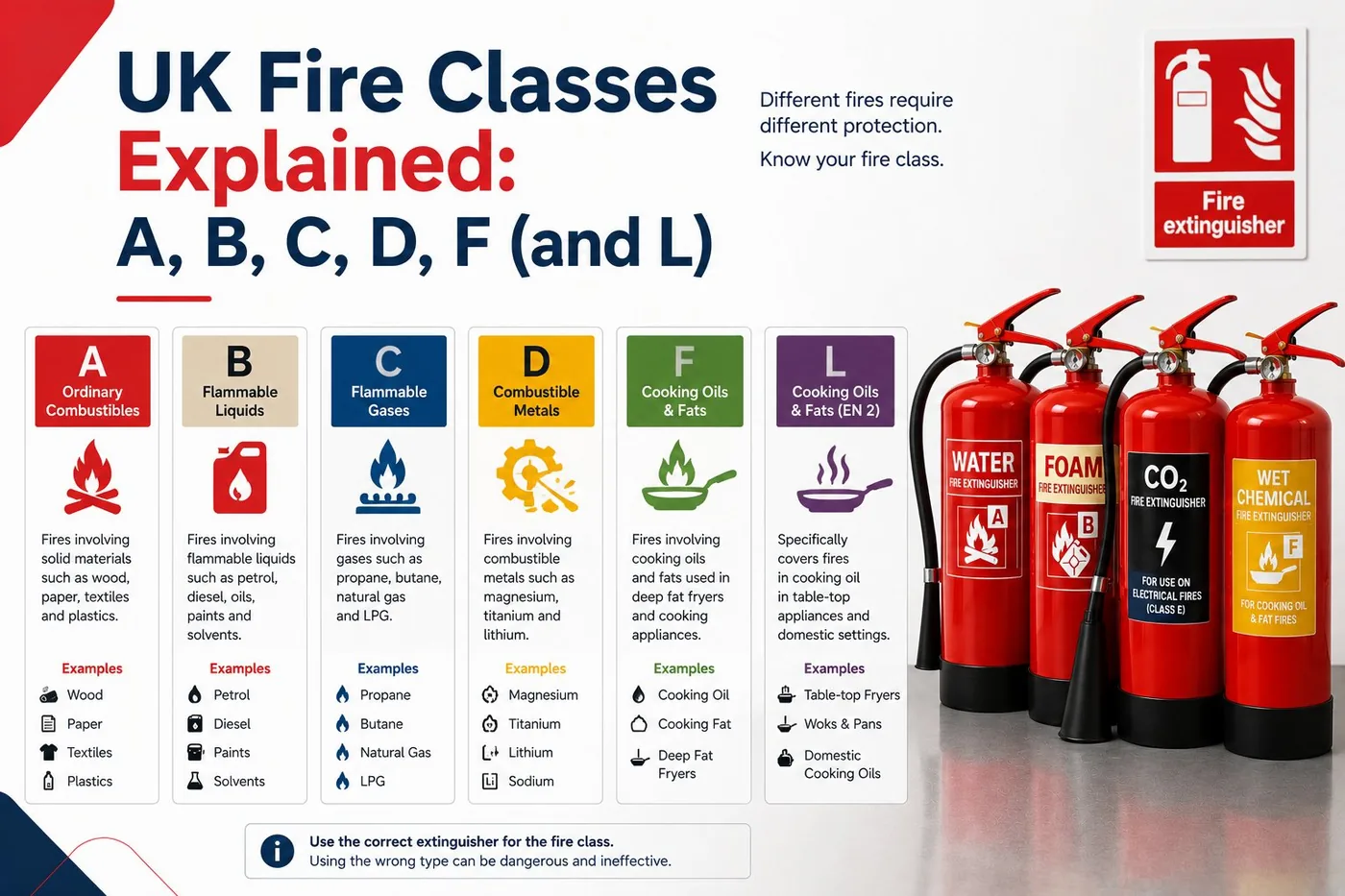
Fires in the UK are classified by what is burning, not by how big the fire is or where it is. The classification system — set out in BS EN 2 — sorts fires into five categories by fuel type, and the system matters because each class needs a different extinguisher. Get the class right and the choice of equipment becomes straightforward; get it wrong and you have either an extinguisher that doesn't work or, worse, one that makes the fire spread.
This page sets out all five UK fire classes with examples, explains why "Class E" is not on the list (despite circulating widely on older guides), and covers the new Class L introduced by BS ISO 3941:2026 in January 2026 for lithium-ion battery fires.
What fire classification is — and the standard behind it
Fire classification is the system used to match a fire's fuel to the right extinguishing agent. In the UK, the system is set out in BS EN 2:1992+A1:2004 — Classification of fires, the British and European standard.
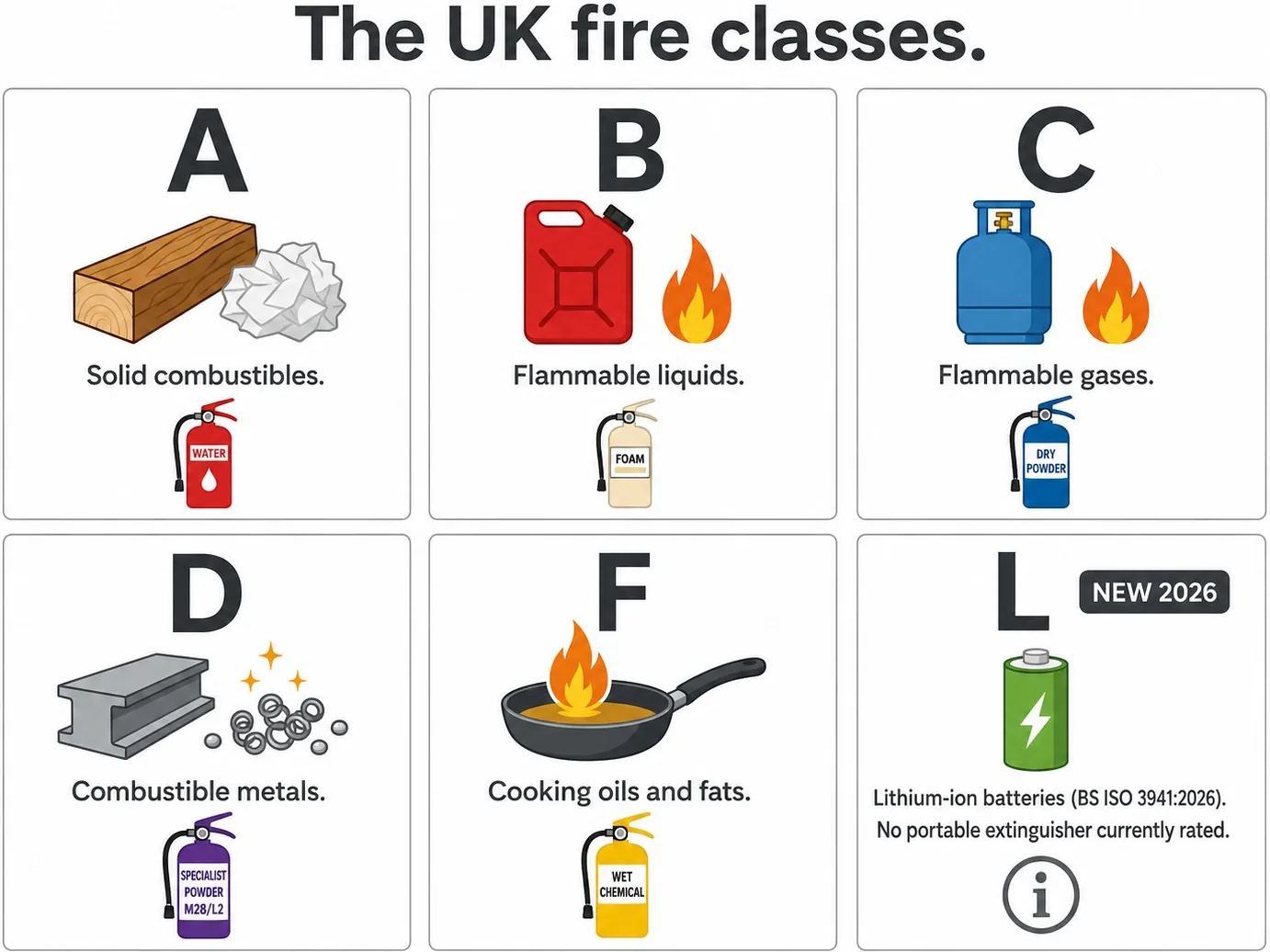
Five fire classes exist under BS EN 2: A, B, C, D and F. (You will notice E is missing. We will come to that.) Each class corresponds to a category of fuel that behaves similarly in a fire and that responds to similar extinguishing agents.
Knowing which class a fire belongs to lets you pick the right extinguisher type from the five UK extinguisher types — and, equally important, avoid the wrong one. The matching is set out in BS 5306-8:2023, the British Standard governing selection and positioning of portable fire extinguishers in UK premises.
Class A — solid combustibles
Class A covers fires involving ordinary solid materials that produce glowing embers as they burn:
- Wood, timber, plywood, MDF
- Paper, cardboard, files, books, packaging
- Textiles — clothing, upholstery, curtains, bedding
- Most soft plastics and rubber
- Coal, wood pellets, solid fuels
In a typical UK office, school or home, Class A risk is the dominant fire risk by volume. Furniture, paperwork, books, fabrics — most of what is in the building falls into this category.
The right extinguishers for Class A: water, foam, water mist, and ABC dry powder (outdoor only in most cases). Water is the cheapest and works through cooling. Foam works through both cooling and a smothering layer. Wet chemical is also rated for small Class A in some units, but it is a Class F primary, not a Class A primary.
The wrong extinguishers for Class A: CO2 (will visibly knock the fire down but doesn't cool, so re-ignition is highly likely), and dry powder indoors (works, but the visibility loss and respiratory issues make it impractical).
For the deeper detail on the products themselves, see our water fire extinguisher page and our foam fire extinguisher page.
Class B — flammable liquids
Class B covers fires involving flammable liquids and liquefiable solids:
- Petrol, diesel, kerosene, paraffin, fuel oils
- Paints, varnishes, stains (oil-based)
- Solvents — white spirit, methylated spirits, acetone, isopropanol
- Adhesives, sealants, contact cements
- Spirits and alcohols in commercial quantities
- Bitumen, tar, waxes (when heated to a liquid state)
Class B fires behave differently from Class A. The fuel can flow, spreading the fire across a surface or into drainage. The fuel can pressurise containers (paint tins, fuel cans) and rupture them violently. Extinguishing relies on smothering the surface or interrupting the chemical reaction, not on cooling the fuel.
The right extinguishers for Class B: foam (the standard answer; the foam blanket seals the surface), CO2 (for small contained fires, especially near electrics), and dry powder (outdoor and large-scale).
The wrong extinguishers: water (sinks beneath the fuel, flashes to steam, ejects the burning liquid as a fireball — the most dangerous mismatch in fire safety) and wet chemical (despite the name, it is for cooking oils only and has no useful effect on petrol or solvents).
For the deeper picture, see our guide on the right extinguisher for flammable liquids.
Class C — flammable gases
Class C covers fires involving flammable gases:
- Propane, butane, LPG (liquefied petroleum gas)
- Natural gas (methane)
- Hydrogen
- Acetylene
- Ammonia (in industrial settings)
Class C fires have a feature that makes them genuinely different: the fuel arrives continuously, under pressure, until the supply is shut off. Extinguishing the flame without isolating the supply produces a worse outcome — a leaking, unburnt, increasingly large cloud of explosive gas with an ignition source already nearby.
The standard rule for Class C is: isolate the supply first, extinguish second. Without supply isolation, you should not attempt to extinguish a gas fire — let the gas burn off in a controlled way until the supply is closed, then deal with any residual fire (often Class A surrounding material).
Where extinguishers do play a role on Class C, ABC dry powder is the conventional choice. The agent interrupts the chemical chain reaction and is the only common UK extinguisher that carries a Class C rating. CO2 may temporarily knock down the visible flame but does nothing about the underlying gas leak. Water and foam are not Class C agents.
The deeper detail on the dry powder product is on our dry powder fire extinguisher page.
Class D — combustible metals
Class D covers fires involving combustible metals:
- Lithium (the metallic element)
- Magnesium and magnesium alloys
- Sodium, potassium and other alkali metals
- Titanium (in certain forms — swarf, fine particles)
- Aluminium swarf and fine aluminium powder
- Zirconium
Class D fires are uncommon in general workplaces but matter in specific industrial and laboratory settings. The hazard is not the metal as a solid block — most of these metals are stable in air. The hazard is the metal in finely divided form (swarf, dust, shavings, ribbon) where the surface area to volume ratio allows rapid oxidation.
Class D fires need specialist powder, not ordinary extinguishers. L2 powder is rated for fires involving lithium metal. M28 powder covers the broader range — magnesium, sodium, potassium and others. Both work through smothering and chemical inhibition without the violent reactions that water (or, in some cases, standard ABC powder) would trigger.
The wrong extinguishers for Class D: water (reacts with several Class D metals to release hydrogen gas, escalating the fire), foam (water-based, same problem), CO2 (some Class D metals will reduce CO2, sustaining the fire from the gas itself), and standard ABC powder (not formulated for metal fires).
The disambiguation that matters most in 2026: L2 powder is for lithium metal, not for lithium-ion batteries. We come to that under Class L below.
Class F — cooking oils and fats
Class F covers fires involving animal and vegetable cooking oils and fats:
- Vegetable oils — sunflower, rapeseed, olive, palm, corn
- Animal fats — beef dripping, lard, bacon fat, butter
- Hot oil in deep fat fryers, chip pans, cooking ranges
- Burning grease in extraction hoods (though primary cover is normally a fixed system)
Class F is separated from Class B because the chemistry, the temperatures, and the fire behaviour are different from conventional flammable liquids. Cooking oils ignite at temperatures around 300–400°C, much higher than most Class B fuels. They are also typically water-miscible to a far lesser degree than alcohols, but they do react chemically with alkaline agents in a way that lets a dedicated extinguishing agent work.
The right extinguishers for Class F: wet chemical (the dedicated Class F agent, working through saponification — the same reaction that turns oil and lye into soap) and fire blankets for small contained pan fires. Some water mist extinguishers carry an F-rating; check the label.
The wrong extinguishers for Class F: water (sinks beneath hot oil, flashes to steam, ejects burning oil violently — the chip-pan fireball) and any form of jet or stream agent that splashes the oil. Foam, CO2 and dry powder all do something unhelpful on cooking oil and should not be used.
For the practical decision tree in a kitchen fire, see our cooking oil fire guide. For the wet chemical product itself, see our wet chemical fire extinguisher page.
What about electrical fires? (The Class E correction)
A persistent error on older UK fire safety guides — and on plenty of current ones — is to list "Class E" for electrical fires. There is no Class E in UK fire classification.
The reasoning is straightforward. Under BS EN 2, fires are classified by the fuel that is burning. Electricity is not a fuel — it doesn't burn. What an "electrical fire" actually involves is something else burning (the cable insulation, the plastic of an appliance, the wood of a wall behind a socket) with electricity as the ignition source and as a continuing hazard for the responder.
Modern UK extinguishers reflect this. They carry a separate marking to indicate they have been tested as safe to use on live electrical equipment, with a stated voltage limit (typically 1000 V) and a minimum distance (typically 1 m). The marking is not a "Class E" rating — it is a dielectric rating, certifying the extinguisher won't conduct current back to the user.
If you see a current UK fire safety guide listing "Class E" alongside Classes A, B, C, D and F, treat the rest of the page with caution; the author is working from outdated material. The right answer for a fire involving live electrical equipment is on our electrical fires guide — CO2 first, dry powder for outdoor or higher-voltage scenarios within the rating, dielectrically-tested water mist as a multi-purpose option.
What about lithium-ion batteries? (Class L, BS ISO 3941:2026)
January 2026 brought the most significant fire-classification update in many years. BS ISO 3941:2026 introduced Class L — a dedicated category for fires involving lithium-ion battery cells and packs.
Lithium-ion battery fires behave differently from anything else in the existing list. The hazard is electrochemical: once a cell goes into thermal runaway, an internal reaction sustains the fire by generating its own heat. The reaction also releases oxygen, so smothering doesn't work the way it does on Class A or Class B fires. The reaction is hard to stop and is prone to re-igniting hours after it appears to be out. The smoke is highly toxic.
That hazard profile didn't fit cleanly into Class A, Class B, or "live electrical equipment" — and L2 powder, despite the name, is rated for lithium metal, which is chemically different from a lithium-ion cell in operation. Class L was created to acknowledge this.
Three things matter about Class L in practice.
Class L sits in BS ISO 3941, not in BS EN 2 or BS EN 3
The fire-classification standard has been updated; the extinguisher fire-rating standard has not. As a result, no portable extinguisher currently carries a "Class L" rating on its label. Specialist battery suppression products exist (encapsulating agents, immersion bins for small devices), but they are not yet category-defined under BS EN 3.
Risk assessments should now identify Class L explicitly
Premises with significant lithium-ion exposure — battery energy storage systems, electric vehicle chargers, e-bike storage rooms, large IT operations — should reflect the new classification in their fire risk assessment, even though the extinguisher market hasn't yet caught up.
For most lithium-ion fires, the practical answer is evacuation
A small device fire (a phone, a laptop battery) might be briefly suppressed by CO2 or a tested water mist, but re-ignition is the norm. Anything beyond the smallest device fire needs the fire and rescue service. Fighting a lithium-ion battery fire with the wrong agent is not a useful or safe activity.
International comparison — UK vs EU vs US vs Australia
If you are working from international or US-published fire safety material, the class system differs. A quick reconciliation:
| Region | Classes | Notes |
|---|---|---|
| UK / EU (BS EN 2) | A, B, C, D, F | Standard for UK and EU. Class L from BS ISO 3941:2026 is the new addition. |
| US (NFPA 10) | A, B, C, D, K | Class C in the US is electrical, not gases. Class K is the equivalent of UK Class F (cooking oils). The US has no separate class for flammable gases. |
| Australia (AS 1851) | A, B, C, D, E, F | Class E in Australia is electrical (different from UK practice). Class F is cooking oils, similar to UK. |
The implications for UK readers: a US guide that says "use a Class C extinguisher" means electrical, not gas — different from UK Class C. An Australian guide that lists Class E means electrical, which under UK classification is not a class at all. When researching fire safety, the standards behind the guide matter more than the page's headline.
Frequently asked questions
How many fire classes are there in the UK?
Five — A, B, C, D and F under BS EN 2. The recent addition of Class L for lithium-ion batteries (BS ISO 3941:2026) brings the total recognised in UK fire risk assessments to six, although Class L is not yet incorporated into the BS EN 2 / BS EN 3 system that governs portable extinguisher ratings.
Why isn't electrical a fire class?
Because electricity itself is not a fuel — it doesn't burn. What an "electrical fire" actually involves is something else burning with electricity as the ignition source. Extinguishers are tested and marked for use on live electrical equipment (with stated voltage and distance limits), but there is no Class E in UK fire classification.
What's Class L?
A new fire class introduced by BS ISO 3941:2026 in January 2026, covering fires involving lithium-ion cells and battery packs. It is recognised in fire risk assessments. No portable extinguisher currently carries a Class L rating because BS EN 2 and BS EN 3 (the standards governing extinguisher ratings) have not yet been updated.
What's the difference between Class F and Class K?
They cover the same fires (cooking oils and fats). The UK and EU use Class F under BS EN 2; the US uses Class K under NFPA 10. The labels differ; the extinguisher requirement (wet chemical or fire blanket) is the same.
Can a fire be more than one class at once?
Yes — most real fires are mixed. A kitchen fire that starts as Class F (oil) often ignites Class A surrounding material (curtains, packaging) within seconds. A workshop fire might involve Class A wood, Class B solvents, and live electrical equipment all at once. The standard pattern is to use the extinguisher that handles the most dangerous element first; a foam or water mist unit often covers multiple classes in a single discharge.
What's the difference between BS EN 2 and BS ISO 3941?
BS EN 2 is the British and European standard that classifies fires by fuel type — the source of the A, B, C, D, F system. BS ISO 3941 is the international (ISO) classification standard, which broadly mirrors EN 2 but added Class L (lithium-ion) in its January 2026 update. UK premises follow EN 2 for extinguisher selection; ISO 3941:2026 is increasingly relevant for fire risk assessment of lithium-ion exposure.
Where this connects
For the products that match each class, see the five UK fire extinguisher types, our water fire extinguisher page, our foam fire extinguisher page, our CO2 fire extinguisher page, our dry powder fire extinguisher page, and our wet chemical fire extinguisher page. For the use-case scenarios most UK premises actually face, see the right extinguisher for an electrical fire, the right extinguisher for cooking oil fires, and the right extinguisher for flammable liquids.
If you are working out fire safety for a UK workplace and need to train your team on the basics — what to do, when to fight a fire, when to evacuate — the online fire safety awareness training course covers it in 90 minutes, RoSPA-approved and CPD-accredited.
Related guides
- Who Is Responsible for Fire Extinguishers in the UK?
- Fire Extinguisher Disposal: The UK Guide
- Fire Extinguisher Servicing and Inspection: The UK Guide
If you are working out fire safety for a UK workplace and need to train your team on the basics, the online Fire Safety Awareness Training course covers it in 90 minutes — RoSPA approved and CPD certified.
View course →
Mark writes about workplace fire safety, fire awareness and accredited online training for Fire Safety Awareness Training, part of Online CPD Academy.