
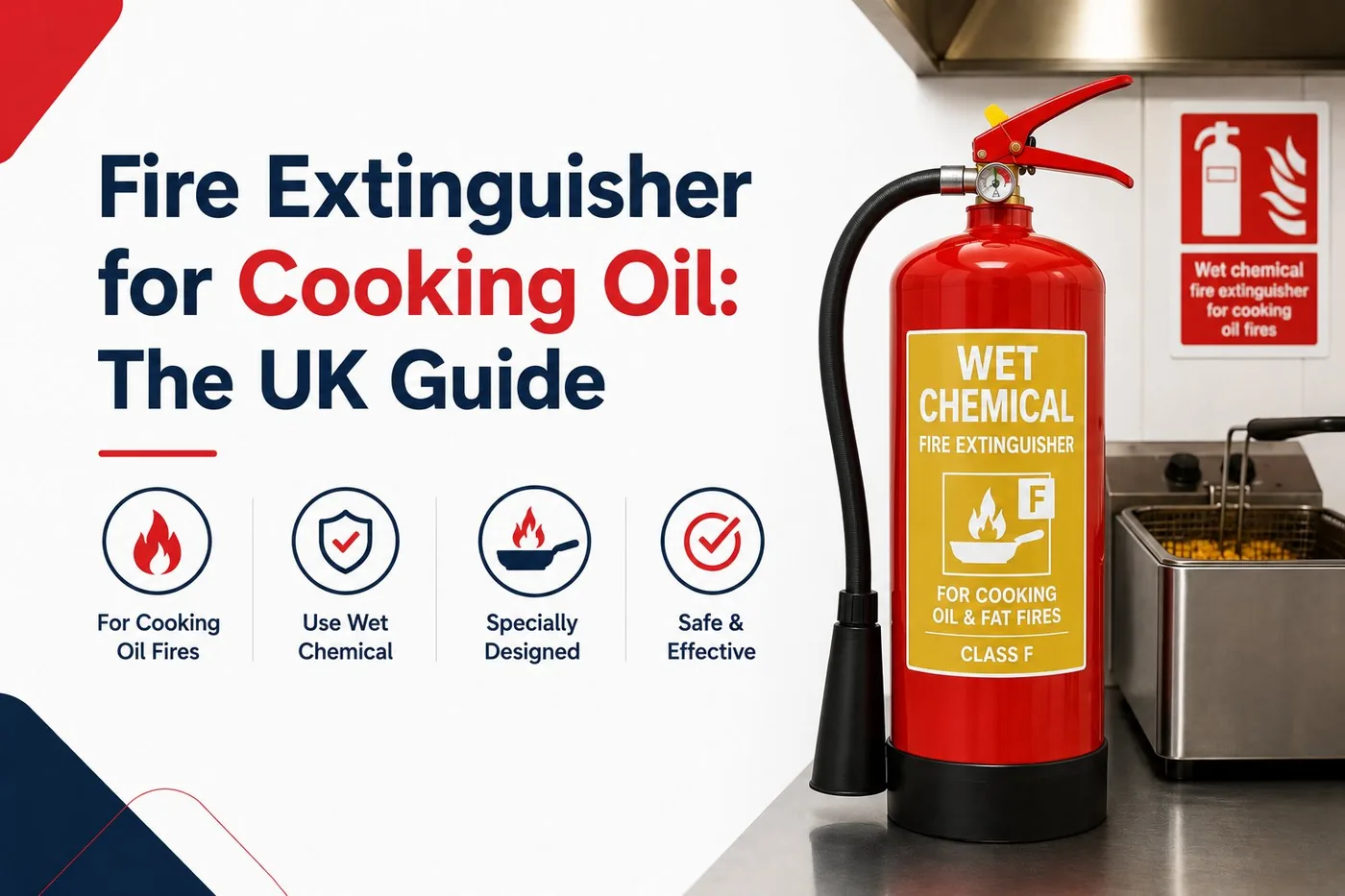
A cooking oil fire — the chip pan, the deep fat fryer, the forgotten pan of vegetable oil — is one of the most dangerous fire scenarios in any UK premises. Cooking is also the leading cause of accidental dwelling fires in England, accounting for around 44% of them in the most recent statistics. The first 30 seconds matter more than almost any other fire scenario, and the wrong response — particularly water — can turn a manageable incident into a life-threatening one.
This page sets out what to do if a cooking oil fire starts, what to never do, when a fire blanket is enough, and when you need a wet chemical extinguisher. It is written first for the moment of decision, not as a technical reference.
What to do if a cooking oil fire starts
If you can do so safely, in this order:
- Switch off the heat source. Turn off the hob, the gas, or the deep fat fryer’s power. The pan is on fire because the oil is above its ignition point; remove the heat input and the underlying problem starts to resolve.
- Do not move the pan. A burning pan moved across a kitchen sprays fire trail across every surface it passes. Leave it where it is.
- For a small contained fire, smother it with a fire blanket. Drape the blanket over the entire pan, sealing the surface from the air. Leave the blanket in place for at least 30 minutes for the oil to cool below its re-ignition temperature.
- For anything larger — or if you do not have a fire blanket — use a wet chemical extinguisher. Stand back, extend the lance, and discharge a fine mist over the burning oil from at least a metre away.
- If the fire has spread beyond the pan, evacuate. Close the kitchen door behind you to slow the spread, raise the alarm, and call 999.
That sequence is the entire decision tree. The detail is below.
What never to do
Three actions that turn a kitchen fire into a kitchen disaster.
Never use water. Water on burning cooking oil is the single most dangerous mistake in domestic fire safety. Water is denser than oil, so it sinks to the bottom of the pan. There it instantly turns to steam — and one volume of water becomes about 1,700 volumes of steam in the time it takes to vaporise. The steam expands violently upwards, ejecting burning oil out of the pan as a fireball that can reach the ceiling. Whatever was on fire is now everywhere, including potentially on the person who threw the water.
This is not a theoretical hazard. UK fire and rescue services run public information campaigns specifically to discourage water on chip-pan fires because the result is so reliably catastrophic. A bucket of water on a chip pan is the canonical bad decision.
Never move the pan
A burning pan picked up to be carried to the sink or out the back door spreads burning oil across every surface in between. The carrier almost always drops it. If the destination was outside, the door has now been opened to feed the fire fresh air on the way through. If it was the sink, the next instinct is to turn on the tap — see above.
Never use the wrong extinguisher
Foam, dry powder, and CO2 all do something unhelpful on a Class F cooking-oil fire. Foam splashes the burning oil. Dry powder cannot interact with the oil chemistry the way it does with petrol or gas, and the discharge force can splash burning oil. CO2 has the same splash problem and disperses too quickly to address the oil itself. None of these are kitchen options. The wet chemical extinguisher is the only common UK extinguisher whose chemistry actually addresses cooking oil — through saponification, the soap-forming reaction between the potassium-acetate agent and the burning fat.
Why water is so catastrophic on burning oil
Worth understanding briefly, because it is the basis for all of the above.
A pan of burning cooking oil sits at around 350°C — well above the boiling point of water (100°C) and well above water’s flash-vaporisation threshold. Pour water onto the surface and a few things happen instantly.
The water sinks beneath the burning oil because oil is less dense than water. So the water now sits at the bottom of the pan, with hot oil above it.
The water at the bottom of the pan starts boiling violently. Each drop of water expands roughly 1,700 times as it converts to steam. The expansion is faster than the oil above it can move out of the way.
The steam erupts upwards through the oil, throwing burning oil into the air. The burning oil meets fresh air on the way up, oxygenating the fire as it spreads. What was a 30 cm column of flame in a pan becomes a 2 m column of burning oil hitting the ceiling, the cabinets, and any person in the way.
UK fire and rescue services have demonstration videos of this — the controlled experiments produce flames 8 to 10 metres high from a small chip pan plus a small amount of water. The home version is rarely controlled.
Fire blanket — first response for small fires
A fire blanket is the simplest and fastest response for a contained pan fire. Most UK kitchens that take fire safety seriously have one mounted within easy reach of the cooker, in a pull-down pouch.
To use it:
- Switch off the heat if you can do so safely.
- Pull the blanket down by its tabs.
- Hold the blanket so it forms a curtain shielding your hands and arms from the rising heat.
- Drape it over the pan from the front edge to the back, ensuring the entire opening of the pan is covered.
- Leave the blanket in place. Do not lift it for at least 30 minutes — the oil must cool below its re-ignition temperature before air reaches it again.
A fire blanket works by smothering. With air sealed off, the fire suffocates within seconds. The blanket also contains the heat, preventing the fire from finding more fuel above the pan.
The limits of the fire blanket:
- It only works if it can fully cover the pan or fryer. A small blanket on a large commercial fryer cannot create the necessary seal.
- It only works for fires still contained in the cooking vessel. Once flames have escaped to walls, cabinets, or extraction hoods, the blanket cannot reach them.
- It is a single-use item once contaminated. After a fire, the blanket goes in the bin and is replaced.
Fire blankets in UK premises are typically tested to BS EN 1869 and sized at 1 m × 1 m for domestic, 1.2 m × 1.2 m for small commercial, or 1.8 m × 1.8 m for larger commercial settings. The blanket is rarely the wrong choice for a small fire. Where it falls short, the wet chemical extinguisher takes over.
Wet chemical extinguisher — for anything bigger
Wet chemical is the dedicated answer for cooking oil fires beyond what a blanket can handle. The yellow-labelled extinguisher contains a fine-mist solution of potassium salts that reacts with the burning oil to form an inert soapy foam layer — saponification. The mist also cools the oil below its re-ignition temperature, and the long lance design lets you apply the agent from a safe distance without splashing the oil.
The standard pattern:
- Stand at least 1 to 1.5 metres from the fire, with the lance fully extended.
- Aim the mist at the burning oil surface, sweeping slowly to lay a continuous foam blanket.
- Keep the discharge going until the visible flames are out and the oil is fully covered with the foam.
- Leave the foam blanket in place. Do not approach closely for 20 to 30 minutes — the oil is still hot, and disturbing the seal allows re-ignition.
Capacities and ratings should match the kitchen. A small domestic deep fat fryer is served by a 2 L unit rated 5F. A small commercial fryer needs a 6 L unit rated 25F. A full commercial kitchen line needs 75F or higher. The product detail is on our wet chemical fire extinguisher page.
Domestic vs commercial — different equipment
The right kitchen fire safety setup is different at home and at work.
For a domestic kitchen without a deep fat fryer, the priorities are working smoke alarms (interlinked, replaced every ten years), a fire blanket within easy reach of the cooker, and good cooking habits — never leaving a pan unattended on the hob, never overfilling pans, never combining oil with cold water. There is no UK law requiring a fire extinguisher in a private home; if you want one, a small water mist unit with an F-rating handles most household risks including small Class F fires.
For a domestic kitchen with a deep fat fryer, the setup is the same plus a small wet chemical extinguisher (2 L, rated 5F or 13F) within a few metres of the fryer.
For a commercial kitchen, the setup is more substantial. BS 5306-8:2023 sets out coverage and positioning rules; in practice you will need a wet chemical extinguisher of appropriate F-rating near each cooking station, a fire blanket beside each fryer or hob, plus general workplace cover (foam or water for Class A around the back of house, CO2 for electrical equipment, and possibly a fixed suppression system over the cooking line for higher-risk operations). A fire risk assessment by a competent person should specify the exact provision; environmental health and most insurers will check it.
For commercial settings, training matters as much as equipment. The kitchen team needs to know what to do in the first 30 seconds — and that knowledge has to be refreshed regularly. Our online fire safety awareness training course covers the basics every employee needs.
When to evacuate and call 999
The single most important rule: if you have any doubt, leave.
Specific triggers to evacuate:
- The fire has spread beyond the pan or fryer to walls, cabinets, or the extraction hood.
- Smoke is filling the kitchen and breathing is becoming difficult.
- Your fire blanket cannot fully cover the burning vessel, or you do not have one.
- You do not have a wet chemical extinguisher within easy reach.
- You used water and the fire is now much larger.
- You feel uncertain. Uncertainty under pressure is itself a signal.
To evacuate safely:
- Get out of the kitchen and close the door behind you. The closed door starves the fire of oxygen and slows the spread by minutes — vital minutes.
- Continue out of the building, telling anyone you pass to leave. Do not stop to collect possessions.
- Call 999 from a safe distance. Be specific about the address and the kitchen location within the building.
- Do not go back in for any reason. Re-entry into a fire is one of the leading causes of fire fatalities in UK dwelling fires.
The dwelling-fire fatality figures published by the Ministry of Housing, Communities and Local Government — 196 fatalities in dwelling fires in England in the year ending September 2025 — make the same point repeatedly. Most of those deaths happened in kitchens that started with a small fire, where someone tried to fight what they couldn’t fight or went back for something they shouldn’t have gone back for. Evacuation is the right answer when the answer isn’t obvious.
Frequently asked questions
What extinguisher do I need in my kitchen?
For a domestic kitchen without a deep fat fryer, a fire blanket and working smoke alarms are the priorities; an extinguisher is optional but a small water mist with an F-rating is a sensible choice. For a domestic kitchen with a deep fat fryer, add a small wet chemical extinguisher (2 L, rated 5F or 13F). For a commercial kitchen, a wet chemical extinguisher rated for the kitchen’s cooking-oil volume, plus a fire blanket beside each fryer.
Can I use a fire blanket on a chip pan fire?
Yes — for a small, contained fire, a fire blanket is the standard first response. Switch off the heat, drape the blanket over the entire pan to seal the surface, and leave it in place for at least 30 minutes.
Why doesn’t water work on cooking oil fires?
Water is denser than oil, so it sinks to the bottom of the pan and instantly turns to steam at the high temperatures involved. The steam expands explosively, ejecting burning oil upwards and outwards as a fireball. A small chip-pan fire becomes a kitchen-wide fire in seconds.
Do I need a wet chemical extinguisher at home?
Only if you have a deep fat fryer. For general domestic cooking, a fire blanket and working smoke alarms cover the realistic risks.
How big should my Class F extinguisher be?
Match the F-rating to the worst-case oil volume in the kitchen. 5F for small domestic, 13F for larger domestic, 25F for small commercial, 75F for full commercial, 100F+ for heavy commercial use. Your fire risk assessment should specify.
Where this connects
For the wet chemical extinguisher itself — chemistry, capacities, sizing — see our wet chemical fire extinguisher page. For the wider classification of fires (including Class F context), see our UK fire classes guide. For where these extinguishers fit in the wider type system, the fire extinguisher types hub is the place to start.
If you run a commercial kitchen and need to train your team on the basics of fire safety, the online fire safety awareness training course covers what every UK employee needs in 90 minutes — RoSPA-approved, CPD-accredited, and designed to satisfy the training duty under the Regulatory Reform (Fire Safety) Order 2005.
Related guides
- Wet chemical fire extinguisher: the UK guide
- Fire classes explained: the UK guide
- Types of fire extinguisher: the UK guide
Train your kitchen and workplace team on the fire safety basics every UK employee needs.
Explore the Fire Safety Awareness Training course →
Mark writes about workplace health & safety, fire safety awareness and accredited online training for Fire Safety Awareness Training, part of Online CPD Academy.