
Lithium-ion battery fires are the fastest-growing ignition cause in UK fire safety, driven by e-bikes, e-scooters, vapes and the batteries we throw in the bin. This page gathers the official and FOI-based UK lithium-ion battery fire statistics in one referenced place, anchored on the two annual series that count them: QBE European Operations’ Freedom of Information analysis of the UK fire and rescue services, and the Office for Product Safety and Standards (OPSS) notified-incidents report on e-bikes and e-scooters. Around them sit London Fire Brigade’s annual record figures and monthly London Datastore dataset, Material Focus’s bin-lorry battery-fire research and Zurich’s vape-fire FOI. The data period is stated next to every figure, and the two headline series are kept deliberately separate because they measure different things.
Key facts and figures
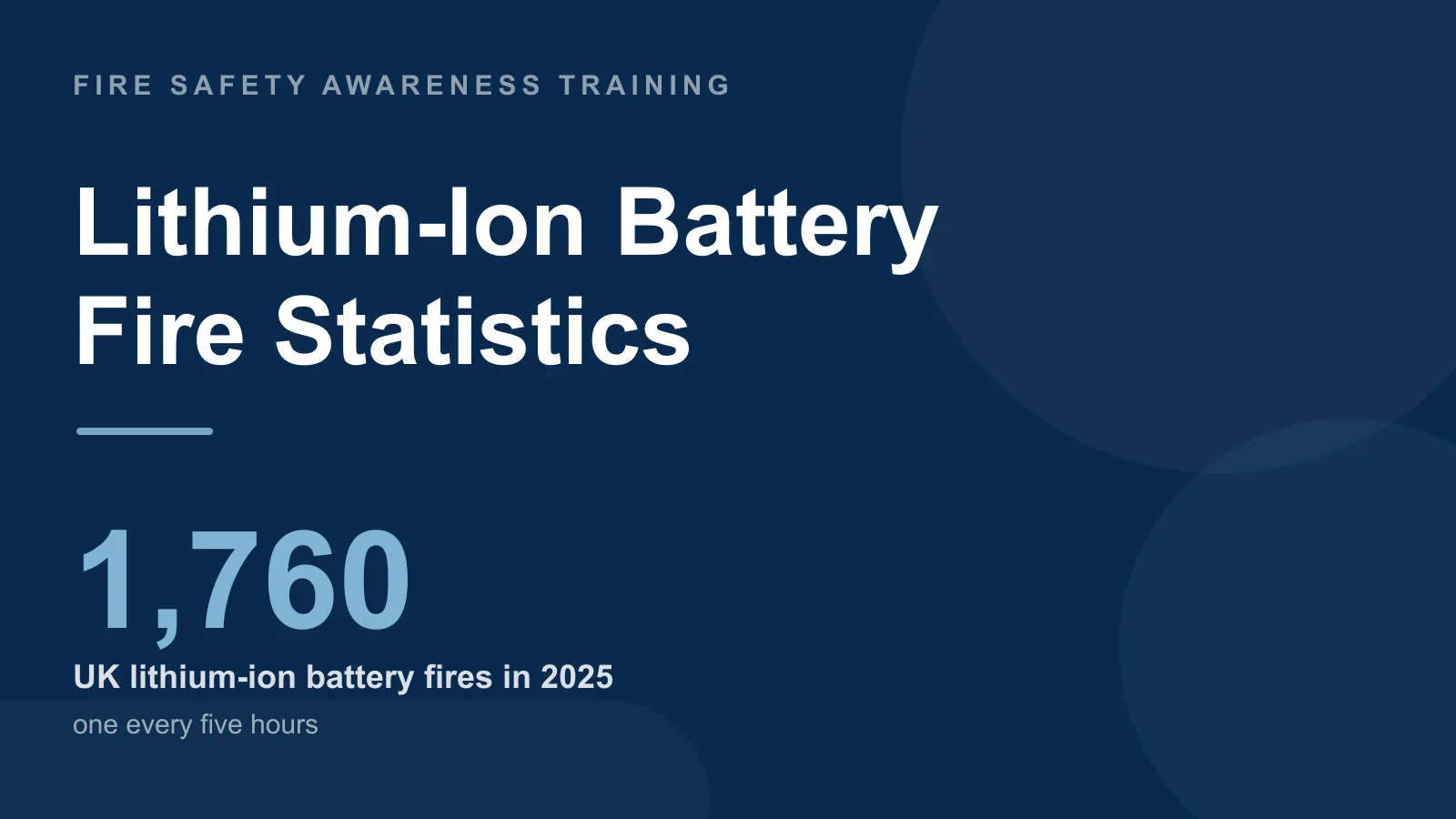
- 1,760 lithium-ion battery fires were attended by UK fire services in 2025 — one every five hours, about 4.8 a day, and a 147% rise in three years (QBE FOI).
- 520 of those fires involved e-bikes — more than tripled since 2022 and roughly 30% of all lithium-ion battery fires (QBE FOI, 2025).
- 46% of 2025 lithium-ion battery fires happened in homes, 31% outdoors and 23% in commercial properties (QBE FOI).
- 206 e-bike and e-scooter fires were attended by London Fire Brigade in 2025 — a record, roughly one every other day (LFB).
- 211 e-bike and e-scooter fires were notified to OPSS in 2024 (170 e-bikes, 39 e-scooters), causing 8 deaths and 86 casualties (OPSS).
- 45% of e-bike fires notified to OPSS in 2024 involved a post-market conversion kit; 39% of fires started while the product was charging (OPSS).
- 1,200+ battery fires hit UK bin lorries and waste sites in the year to May 2024 — up 71% from around 700 in 2022 (Material Focus).
- 172 vape and e-cigarette fires were recorded in 2025, up around 30% on 2024 and from just 31 in 2021 (Zurich UK FOI).
These are the latest published figures as of July 2026, and this page is updated when new data lands. London Fire Brigade releases its record figures each January, QBE publishes its FOI analysis each May, OPSS reports each June, Zurich’s vape FOI lands around June and the London Datastore refreshes monthly — so this page is refreshed each June/July once the QBE and OPSS rounds have been published.
How many lithium-ion battery fires are there in the UK each year?
UK fire and rescue services attended 1,760 lithium-ion battery fires in 2025 — one every five hours, about 4.8 a day, a 147% rise in three years, according to QBE European Operations’ Freedom of Information analysis published on 11 May 2026, which drew returns from 42 of the UK’s 49 fire services. That headline is the single most useful UK-wide figure available, because it is built from what individual services actually recorded rather than from a survey or a voluntary reporting scheme.
The climb is steep and consistent. QBE’s earlier round, published on 27 May 2025, tracked the same series upward year on year: 690 fires in 2022, 1,038 in 2023 and 1,330 in 2024 — a 93% rise in two years — before the 1,760 recorded for 2025. Note that QBE’s headline total is a count of all lithium-ion battery fires and includes a share of electric-vehicle fires; we quote the number as QBE reports it, but this page does not break out EV cars, which are a separate hazard covered below.
| Year | UK lithium-ion battery fires | Change |
|---|---|---|
| 2022 | 690 | Baseline |
| 2023 | 1,038 | +50% |
| 2024 | 1,330 | +93% on 2022 |
| 2025 | 1,760 | +147% on 2022 |
Source: QBE European Operations FOI analysis — 2022–2024 figures from the round published 27 May 2025; the 2025 figure from the round published 11 May 2026 (returns from 42 of 49 UK fire services).
How many e-bike fires happen in the UK?
E-bikes accounted for 520 UK fires in 2025 — more than triple the 2022 figure, and roughly 30% of all lithium-ion battery fires, per the QBE FOI analysis published in May 2026. E-bikes are the single biggest driver of the overall rise: a full-size traction battery holds far more energy than a phone or a vape, and when a cell fails it can vent, ignite and reignite with ferocious speed, often in a hallway or by a front door that blocks the only escape route.
The capital carries a large share of the national total. London Fire Brigade recorded 522 lithium-ion battery incidents in 2025 — about 30% of the UK total — including 230 e-bike fires, which is around 44% of all UK e-bike fires that year (QBE FOI, May 2026). That concentration reflects London’s density of gig-economy delivery riding, cheap imported batteries and conversion kits, and high-rise homes where a single hallway fire endangers many households.
Do most e-bike battery fires happen while charging?
Charging is the single most dangerous moment: 39% of the e-bike and e-scooter fires notified to OPSS in 2024 broke out while the product was being charged, and 66% happened in indoor or residential settings, according to the OPSS report on fires in e-bikes and e-scooters, published in June 2025. Batteries left charging overnight, on flammable surfaces, in hallways or blocking exits are the recurring pattern behind the most serious incidents.
The ignition source is overwhelmingly the battery itself. In 93% (196) of the e-bike and e-scooter fires notified to OPSS in 2024, the battery or generator was recorded as the source of ignition — not the charger lead, the socket or the surrounding wiring. That is why charging behaviour, not household electrics, is the prevention message: charge on a hard surface, never overnight or unattended, keep the escape route clear, and use only the manufacturer’s charger. A working alarm remains the backstop, and our companion page on smoke alarm statistics sets out the ownership and failure data.
How dangerous are conversion kits and cheap batteries?
Nearly half of e-bike fires notified to OPSS in 2024 — 45% (77 fires) — involved a post-market conversion kit rather than a bike sold and certified as a complete e-bike, per the OPSS June 2025 report. Conversion kits and their replacement batteries are frequently bought online from third-party sellers, mismatched to the bike, and fitted with incompatible chargers — a combination that repeatedly appears in the most destructive fires and in fire-service warnings.
It is worth being precise about what the two headline series count, because they are not measuring the same thing and must never be combined in one chart. OPSS figures are voluntary notifications — 175 of the 211 in 2024 came via London Fire Brigade — so they under-count nationally and skew towards London. QBE figures are FOI returns from 42 of 49 fire services, a broader but differently defined count. Treat OPSS as the richest source of detail on cause and product type, and QBE as the best guide to national scale and trend.
| Series | What it counts | Coverage | Latest |
|---|---|---|---|
| QBE FOI | All lithium-ion battery fires (includes EV share) | FOI returns, 42 of 49 UK services | 1,760 in 2025 |
| OPSS notifications | E-bike & e-scooter fires only, with cause detail | Voluntary notifications (175 of 211 via LFB) | 211 in 2024 |
| LFB record figures | London e-bike & e-scooter fires | London only | 206 in 2025 |
Source: QBE FOI (May 2026); OPSS report (June 2025); London Fire Brigade (January 2026). The three series are shown separately and should not be summed.
What do the London Fire Brigade figures show?
London Fire Brigade attended a record 206 e-bike and e-scooter fires in 2025 — 171 e-bikes (83%) and 35 e-scooters — roughly one every other day, according to the brigade’s press release of 28 January 2026, which renewed its call for tighter regulation. The trend is firmly upward: 179 such fires in 2023, 171 in 2024 and 206 in 2025. (The higher 230 e-bike and 522 lithium-incident figures cited earlier come from the QBE FOI dataset for London, which uses a wider lithium-ion category than the brigade’s own e-bike/e-scooter count — another reminder to keep sources separate.)
These fires kill. Two people died in London e-bike and e-scooter fires in 2025, taking the toll to five deaths since 2023 (LFB, January 2026). London’s figures matter beyond the capital because the brigade’s monthly dataset on the London Datastore — which runs from January 2017 and updated to April 2026 — is the most granular public record of these incidents anywhere in the UK. That dataset also carries electric-vehicle rows, which we exclude here; EV car fires are a distinct hazard.
| Year | LFB e-bike & e-scooter fires | Deaths (London) |
|---|---|---|
| 2023 | 179 | — |
| 2024 | 171 | — |
| 2025 | 206 (record) | 2 (5 since 2023) |
Source: London Fire Brigade press release, 28 January 2026; London Datastore lithium and electric-vehicle fires dataset (series from January 2017, data to April 2026).
Why are batteries setting bin lorries and recycling sites on fire?
Over 1,200 battery fires hit UK bin lorries and waste sites in the year to May 2024 — up 71% from around 700 in 2022, according to Material Focus’s Stop Battery Fires research, published on 10 May 2024, with 94% of surveyed local authorities calling them an increasing challenge. When a lithium-ion battery is thrown into a household bin, it gets crushed in the collection lorry or at the sorting plant, short-circuits and ignites — inside a moving vehicle or a building full of combustible waste.
The scale of what we discard explains the problem. UK households threw away 1.6 billion batteries in a year — over 3,000 every minute — including 1.1 billion hidden inside electricals such as disposable vapes, toys and cables (Material Focus, May 2024). Disposal behaviour is squarely a consumer fire-prevention issue: batteries and battery-containing electricals should go to a proper recycling point, never in the general or recycling bin. The National Fire Chiefs Council mirrors the same warning in its own campaigns.
Are vape and e-cigarette fires rising too?
Vape and e-cigarette fires rose around 30% to 172 in 2025, up from 132 in 2024 and just 31 in 2021, according to a Zurich UK Freedom of Information round covering 38 fire brigades, reported by Insurance Times on 4 June 2026 — and the rise continued despite the ban on single-use disposable vapes that took effect on 1 June 2025. Disposable vapes are the classic hidden battery: cheap, sealed, hard to recycle and routinely binned, which feeds straight into the waste-fire problem above.
The vape numbers are a smaller slice of the overall picture than e-bikes, but they show the same shape — a small base a few years ago climbing sharply as the products became ubiquitous. They also underline that the lithium-ion fire risk is not confined to big, obvious batteries; power banks, phones, laptops, cordless tools and children’s toys all carry cells that can fail if damaged, over-charged or of poor quality.
What about EV cars and household electrical fires?
Two related hazards sit deliberately outside this page. Electric-vehicle car fires are counted within QBE’s headline lithium-ion total and appear in the London Datastore dataset, but a battery pack in a car is a very different fire from an e-bike charging in a hallway; EV vehicle fires are covered by our sister site’s guide to vehicle fire statistics in the UK. Likewise, fires caused by fixed wiring, sockets, extension leads and mains appliances are a separate category from battery product fires, and belong with the electrical fire statistics page.
Big domestic appliances such as tumble dryers and washing machines are a further distinct product-fire story, gathered on our page of white goods fire statistics. Keeping these lanes separate is not pedantry: mixing an EV-inclusive FOI total with an e-bike-only notification count is exactly how the headline numbers in press coverage end up contradicting each other.
What does the data say about preventing battery fires?
The statistics point to a short, consistent prevention message. Charging is the danger moment (39% of OPSS-notified fires), the battery is almost always the ignition source (93%), conversion kits are disproportionately involved (45% of e-bike fires), and home is where nearly half of all incidents happen (46% in QBE’s 2025 data). That translates into practical rules: buy complete, certified products rather than conversion kits; use only the manufacturer’s charger; never charge unattended, overnight, or where a fire would block the exit; stop using and isolate any battery that is swollen, hissing or hot; and recycle every battery at a proper collection point rather than the bin.
For workplaces, universities and landlords, lithium-ion charging is now a standard entry in the fire risk assessment — where staff, students and tenants charge devices, whether delivery e-bikes are brought indoors, and how batteries are stored and disposed of. Fire awareness training keeps that risk visible to the people who actually charge the devices, which is where the data says the fires start.
Frequently asked questions
How many lithium-ion battery fires are there in the UK each year?
UK fire and rescue services attended 1,760 lithium-ion battery fires in 2025 — one every five hours, about 4.8 a day — according to QBE’s Freedom of Information analysis published in May 2026, drawing on returns from 42 of the UK’s 49 fire services. That is a 147% rise in three years, from 690 in 2022. The figure includes a share of electric-vehicle fires and is the best available guide to national scale.
How many e-bike fires happen in the UK?
E-bikes accounted for around 520 UK fires in 2025 — more than triple the 2022 figure and roughly 30% of all lithium-ion battery fires — per the QBE FOI analysis (May 2026). Around 230 of them were in London, about 44% of the UK e-bike total. London Fire Brigade separately recorded 171 e-bike fires in its own 2025 count, using a narrower definition.
Do most e-bike battery fires happen while charging?
Charging is the single most dangerous moment: 39% of the e-bike and e-scooter fires notified to OPSS in 2024 started while the product was being charged, and 66% happened indoors or in homes. In 93% of those fires the battery itself was the ignition source. The advice is to charge on a hard surface, never overnight or unattended, and never where a fire would block your escape.
Are e-scooter and e-bike fires still increasing?
Yes. London Fire Brigade attended a record 206 e-bike and e-scooter fires in 2025, up from 171 in 2024 and 179 in 2023, and two people died in London in 2025 (five since 2023). Nationally, QBE’s FOI series shows lithium-ion battery fires rising 147% in three years to 1,760 in 2025. Every source points the same way — sharply upward.
What is the difference between the QBE and OPSS figures?
They measure different things and must not be combined. QBE’s figures are Freedom of Information returns from 42 of 49 UK fire services and count all lithium-ion battery fires (including a share of EV fires) — best for national scale. OPSS figures are voluntary notifications of e-bike and e-scooter fires only (175 of 211 in 2024 came via London Fire Brigade) — best for detail on cause, charging and conversion kits.
Where do UK lithium-ion battery fire statistics come from?
The 1,760 headline comes from QBE’s annual FOI analysis of fire services. Cause detail on e-bikes and e-scooters comes from the OPSS notified-incidents report. London figures come from London Fire Brigade and its London Datastore dataset, waste and disposal figures from Material Focus, and vape-fire figures from Zurich’s FOI round reported by Insurance Times. Electrical Safety First provides wider policy and product-recall context.
Related guides
- White Goods Fire Statistics UK: Tumble Dryers, Washing Machines & Recalls
- Smoke Alarm Statistics UK: Ownership, Failures & Lives Saved
- Candle Fire Statistics UK: Incidents, Injuries & Safer Habits
- The Right Fire Extinguisher for an Electrical Fire
- Fire Classes Explained: A, B, C, D, F and Electrical Fires
Sources & references
- QBE European Operations — UK fire brigades tackling a lithium-ion battery fire every five hours (FOI analysis, 11 May 2026)
- QBE European Operations — Fires caused by lithium-ion batteries double in two years (prior FOI round, 27 May 2025)
- OPSS / GOV.UK — Fires in e-bikes and e-scooters, 2024 (report and 2017–2024 data tables, June 2025)
- London Fire Brigade — Record number of e-bike and e-scooter fires across London in 2025 (28 January 2026)
- London Datastore — LFB lithium and electric-vehicle fires dataset (series from January 2017, data to April 2026)
- Material Focus — Over 1,200 battery fires in bin lorries and waste sites across the UK in the last year (Stop Battery Fires, 10 May 2024)
- Insurance Times — E-cigarette fires increase by a third in 2025 despite disposable-vape ban (Zurich UK FOI, 4 June 2026)
- Electrical Safety First — Battery Breakdown campaign and report (product recalls and policy context, 2024)
UK lithium-ion battery fires now break out one every five hours — get every employee fire aware in around 90 minutes.
Explore the Fire Safety Awareness Training course →
Mark writes about workplace health & safety, fire safety awareness and accredited online training for Fire Safety Awareness Training, part of Online CPD Academy.