
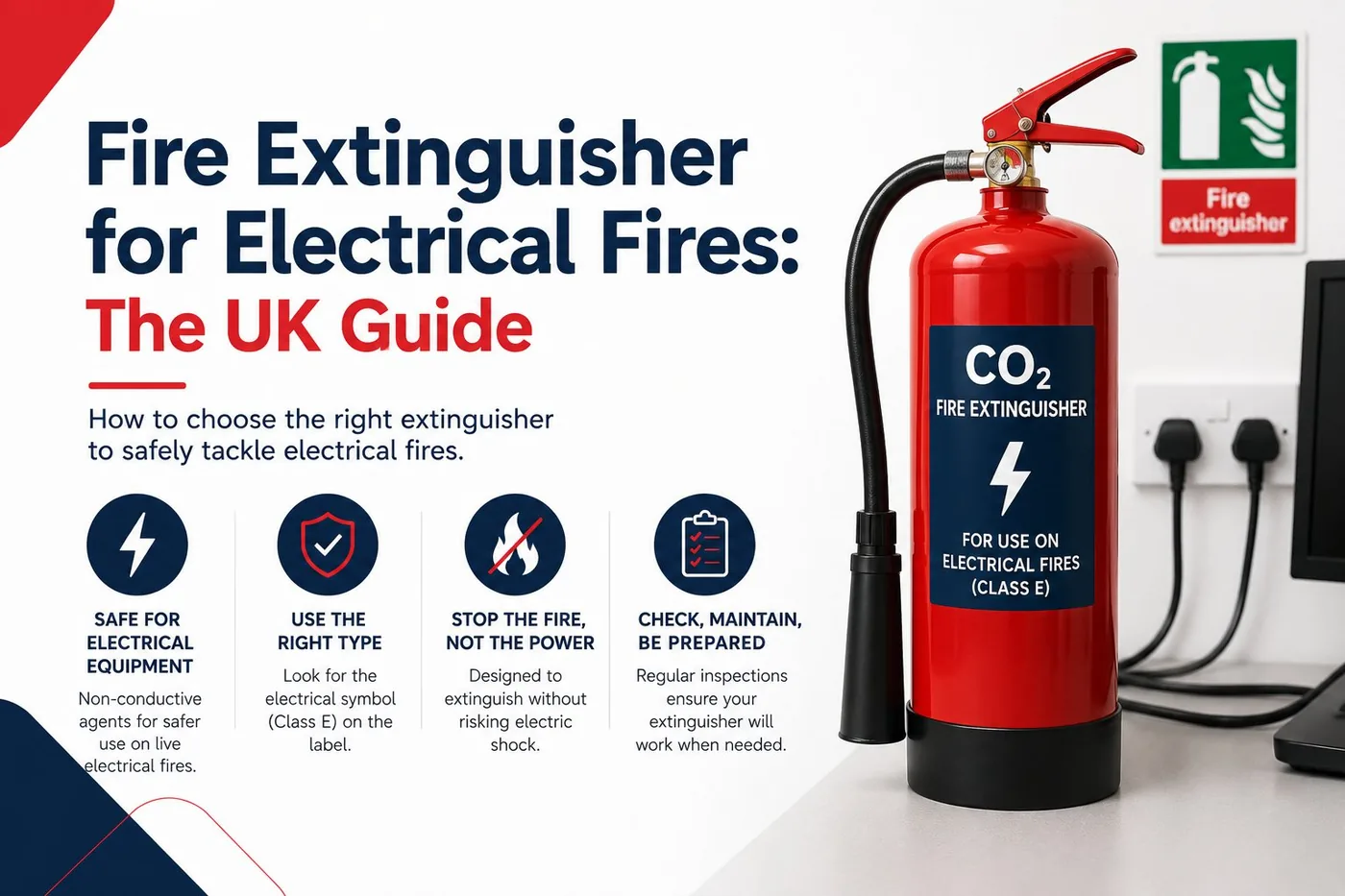
If a piece of electrical equipment catches fire — a server, a printer, a fuse board, a charger, a kitchen appliance — most of what makes it dangerous is not the flames. It is the live electricity behind them. The wrong extinguisher conducts current back to the user; the right one suppresses the fire without becoming an electrocution hazard.
This page sets out the right answer for fires involving live electrical equipment in UK premises, explains why some extinguishers work and others don't, and clears up two persistent points of confusion: that there is a "Class E" fire in the UK (there isn't), and that isolating the supply makes everything safe (it usually doesn't, because the fuse board stays live).
Why electrical fires are a different problem
When a phone charger overheats, what burns is the plastic, the cable insulation, and any combustible material around it. The electricity itself is not the fuel. But the supply remains energised through the fire, and that changes the rules for putting it out.
Two things follow. First, any extinguisher that conducts electricity — water, standard foam, wet chemical — risks creating a path for current back to the person holding it. Second, even after the obvious source is unplugged, parts of the circuit (the fuse board most importantly) often remain live until a complete supply failure. So a fire that started as electrical can keep its electrical hazard right through the response.
You will sometimes see this called a "Class E fire." It is not. Under BS EN 2, the British and European standard that classifies fires by fuel type, electrical isn't a class — because electricity itself doesn't burn. What modern extinguishers do instead is carry a separate marking to indicate they have been tested as safe to use on live electrical equipment up to a stated voltage and distance. The class system covers what is burning (paper, liquid, gas, metal, oil); the electrical marking covers whether the extinguisher is safe to point at a powered circuit.
That distinction matters when you read older guides or product listings that still talk about "Class E." If you see it on a UK page in 2026, treat the rest of what that page says with caution.
CO2 is the first answer for electrical fires
The standard recommendation for fires involving live electrical equipment in the UK is a CO2 (carbon dioxide) extinguisher. The reasons are straightforward.
CO2 is non-conductive, so there is no shock risk through the discharge stream. It works by displacing the oxygen around the fire, smothering it. And it leaves no residue — important when the burning thing is an expensive piece of electronics that you would rather not write off because someone covered it in dry powder.
CO2 has limits. It does not cool the burning material much, so if the underlying fault is still generating heat (a shorted wire glowing orange behind a wall socket), the fire can re-ignite once the gas disperses. It is also not effective on Class A fires of any size — the wood and paper around an electrical fire will go out under CO2, but only briefly. And it must not be used in confined spaces because the gas will displace the air the user is breathing.
For most UK offices, server rooms, retail spaces, and industrial settings, the practical implication is clear: a 2 kg or 5 kg CO2 extinguisher near electrical equipment, and a Class A extinguisher (water, foam, or water mist) nearby for everything else. The product detail on CO2 — capacities, the discharge horn, the 10-year overhaul — is on our CO2 fire extinguisher page.
Dry powder is an alternative — outdoors and below 1000 V
Standard ABC dry powder is also non-conductive and is rated for use on live electrical equipment up to 1000 volts. For an outdoor electrical fire — a vehicle, a substation perimeter, a forecourt fire near pumps or charge points — dry powder is often the more practical choice.
Indoors, powder runs into a problem that has nothing to do with electricity. Discharging a powder extinguisher in an enclosed space throws up a thick cloud that drastically reduces visibility and is a real respiratory hazard. BS 5306-8:2023 (the British Standard for the selection and positioning of portable fire extinguishers) specifically advises that powder extinguishers should generally not be specified for indoor use unless that risk is mitigated through a health and safety risk assessment.
So dry powder belongs in the electrical-fire conversation mainly for outdoor or vehicle scenarios, and for premises where the risk assessment has explicitly accepted the trade-offs. Above 1000 V — high-voltage installations, distribution-grade equipment — dry powder isn't rated, and CO2 takes over. The product detail is on our dry powder fire extinguisher page.
Modern water mist with de-ionised water
Water mist is the third option. Unlike a standard water extinguisher, a water mist unit uses de-ionised water and a supersonic nozzle to produce a fine cloud of microscopic droplets. The droplets cool the fire, displace some of the oxygen around it, and — crucially — don't conduct electricity in the way bulk water does.
A water mist extinguisher that has been dielectrically tested and is marked accordingly can be used on live electrical equipment up to 1000 V at a distance of at least 1 metre. Because the same unit is also rated for Class A and (with the right rating) Class F fires, it can sometimes do the job of two or three traditional extinguishers in a small premises.
Two reservations. Water mist is more expensive than the alternatives. And the dielectric rating only applies to the specific unit tested — not all water mist extinguishers are electrically rated, so the label is the only thing to trust.
Foam with a dielectric rating — sometimes
Some modern foam extinguishers are also dielectrically tested. If a foam extinguisher carries a clear marking stating it is suitable for use on live electrical equipment up to a stated voltage, with a stated minimum distance, then yes, it can be used on an electrical fire — within those limits.
Without that marking, foam is conductive enough to be dangerous, and standard foam should not be used on electrical fires. Even with the marking, foam carries water, which means the underlying water hazard hasn't gone away — distances and voltages must be respected. For routine electrical-fire cover, CO2 is still the cleaner, simpler choice.
What BS 5306-8:2023 actually says
The British Standard for the selection and positioning of portable fire extinguishers gives two clauses that matter directly to electrical-fire planning.
Clause 7.7.1 (fires involving live electrical equipment)
The standard states that only electrically non-conductive extinguishing media — non-conductive powder, carbon dioxide, or clean agent — should be used on live electrical equipment, and that extinguishers containing such media should be provided throughout premises for use on common electrical hazards (lighting, small appliances, and similar).
Clause 4 (provision of extinguishers — general recommendations)
This clause notes that water conducts electricity, and that even purified water (distilled, de-ionised or de-mineralised) can re-acquire its conductive properties when used on a fire — because the act of using it introduces CO2 from the air, impurities from the products of combustion, and a temperature increase. The original purification, in other words, doesn't survive contact with the fire.
That is the technical reason behind the dielectric rating system. A water mist or foam extinguisher with a current dielectric certificate has been tested under controlled conditions to behave safely within stated limits. Outside those limits — wrong distance, higher voltage, no current rating — the safety margin has not been verified.
The dielectric test itself uses a 35,000 V (35 kV) test voltage. Units that pass are then certified for use up to a maximum in-service voltage of 1000 V, with a minimum distance between the user and the live equipment of 1 metre.
The full standard lives behind the BSI paywall but is referenced in BAFE guidance and the FIA's published material — both of which are useful free sources for confirming exactly what the standard requires.
Always isolate the supply first — but the fuse board stays live
A standard piece of advice on every electrical-fire page is "switch off the supply at the wall before tackling the fire." That advice is correct, but it is incomplete in a way that matters.
Switching off the equipment removes the immediate ignition source for the local circuit. But the consumer unit (the fuse board), and the supply between the fuse board and the meter, will remain live unless you have a complete supply failure or you isolate at the meter or the cut-out — neither of which the average person can or should do without a qualified electrician.
So the practical implication: isolate at the wall, and any other socket or circuit-breaker you can safely reach. Then treat the wider area as still electrically active. That is part of why CO2's residue-free behaviour matters — even after the visible fire is out, the equipment may still be live, and you don't want a layer of conductive water draped across it for the electrician arriving to clear the scene.
Lithium-ion battery fires are now Class L
A growing share of "electrical" fires in modern premises are not really electrical fires in the traditional sense. They are lithium-ion battery fires — laptops, e-bikes, e-scooters, phone chargers, energy storage systems. The behaviour is fundamentally different: the cell goes into thermal runaway, generates heat from an internal electrochemical reaction, releases its own oxygen as it burns, and re-ignites readily even after the visible flames are out.
In January 2026, BS ISO 3941:2026 introduced Class L as a new fire classification for fires involving lithium-ion cells and batteries. The introduction of Class L matters for fire risk assessments — premises with significant lithium-ion exposure (BESS installations, e-bike charging rooms, EV charging) should now identify Class L explicitly.
What it does not yet do is change the extinguisher market. Class L sits in BS ISO 3941, the classification standard, not in BS EN 2 or BS EN 3, the standards used for portable extinguisher fire ratings. No portable extinguisher currently carries a Class L mark on its label. Specialist suppression products for battery fires exist (encapsulating agents, immersion bins for small devices), but they are not yet category-defined under BS EN 3.
The practical advice for a small lithium-ion fire is therefore evacuation and the fire and rescue service, not heroic extinguisher use. CO2 may slow a small fire briefly, but it will not stop the underlying chemistry, and re-ignition is the norm. There is more on the new classification on our fire classes guide.
Where electrical-fire extinguishers belong in a typical UK premises
A few sensible placements:
Server rooms and IT cabinets
A 2 kg or 5 kg CO2 extinguisher within a few metres, mounted at standard height, with clear signage. Avoid powder if at all possible — the clean-up will write off equipment that the fire didn't.
Office floors with general electrical equipment
A CO2 unit alongside a Class A extinguisher (water, foam, or water mist) at each fire point. Most office fires that look electrical are actually a Class A fire ignited by an electrical fault, so the Class A capacity matters too.
Electrical risers, plant rooms, electrical cupboards
CO2, often with dry powder if the room is large, ventilated, and the risk assessment supports it.
Domestic settings
A small water mist extinguisher rated for live electrical use is a good single-unit answer for most households. CO2 is also fine but is heavier and less versatile than water mist for everything else in the house.
Workshops, garages, vehicle yards
ABC dry powder, accepting the visibility trade-off in exchange for outdoor versatility.
The right number, size and placement comes from your fire risk assessment, with BS 5306-8:2023 providing the coverage and travel-distance benchmarks. If you are also responsible for training staff on what to do in the first minute of a fire, our online fire safety awareness training course covers the basics every UK employee needs.
Frequently asked questions
Can I use water on an electrical fire?
Not safely, and not standard water. Water conducts electricity. The exception is dielectrically tested water mist with de-ionised water, which is safe on live equipment up to 1000 V at 1 metre — but that rating must be on the label. A standard red water extinguisher is not safe on live electrical equipment.
What is the best extinguisher for electrical fires?
CO2 is the standard answer, especially indoors. Dry powder is acceptable below 1000 V, primarily outdoors. Modern water mist with a dielectric rating is an effective single-unit option for smaller premises.
Can I use a foam extinguisher on electrics?
Only if the specific foam unit carries a current dielectric rating, with stated voltage and distance limits. Standard foam without that marking should not be used on live electrical equipment.
Does CO2 damage electronics?
Not in the way water or powder do. CO2 leaves no residue and does not corrode circuitry. Equipment damaged in the original fire is still damaged, but CO2 itself doesn't add to the bill.
What voltage limit applies to dry powder?
Standard ABC dry powder is rated for live electrical equipment up to 1000 V. Above that — high-voltage installations and distribution-grade equipment — CO2 is the appropriate option.
What about lithium-ion battery fires?
These are Class L under BS ISO 3941:2026 and behave differently from conventional electrical fires. No portable extinguisher is currently certified for Class L. The right action for anything beyond a very small device fire is to evacuate and call 999.
Should I switch the power off before using an extinguisher?
Yes, isolate at the wall socket, the appliance switch, or a circuit-breaker if you can reach one safely. But assume the wider supply (especially the consumer unit) is still live until a qualified electrician confirms otherwise — which is part of why a residue-free agent like CO2 is preferred.
In short
For most UK premises, electrical-fire planning comes down to one decision: where does CO2 belong, and where does the alternative (dry powder outdoors, water mist as a multi-purpose option) make more sense? Build the answer into your fire risk assessment, position the units to BS 5306-8:2023, service them annually under BS 5306-3:2017, and make sure the people who might pick one up know what to do when the alarm sounds.
The full picture on the products themselves is on our CO2 page, our dry powder page, and our water fire extinguisher page (which covers water mist). For the wider context of how the law assigns these duties, see who is responsible for fire extinguishers in UK workplaces. And for the universal four-step extinguisher technique, see how to use a fire extinguisher (PASS) — relevant whichever of the above you end up reaching for.
Related guides
- Who Is Responsible for Fire Extinguishers in the UK?
- Fire Extinguisher Disposal: The UK Guide
- Fire Extinguisher Servicing and Inspection: The UK Guide
Make sure your team knows what to do in the first minute of a fire.
View course →
Mark writes about workplace fire safety, fire awareness and accredited online training for Fire Safety Awareness Training, part of Online CPD Academy.