
Portable and space heaters start well over a thousand house fires in England every year, and per fire they are among the most deadly ignition sources in the home — far more likely to kill than a cooking fire. This page gathers the official UK heater fire statistics in one referenced place: the space-heating-appliance figures from MHCLG’s fire statistics data tables (table FIRE0602), the wider fire and rescue incident statistics for England, Electrical Safety First’s March 2026 analysis of electric blanket fires, and cost-of-living heating behaviour data from the same charity. The data period is stated next to every figure, so you can cite any number on this page with confidence.
Key facts and figures
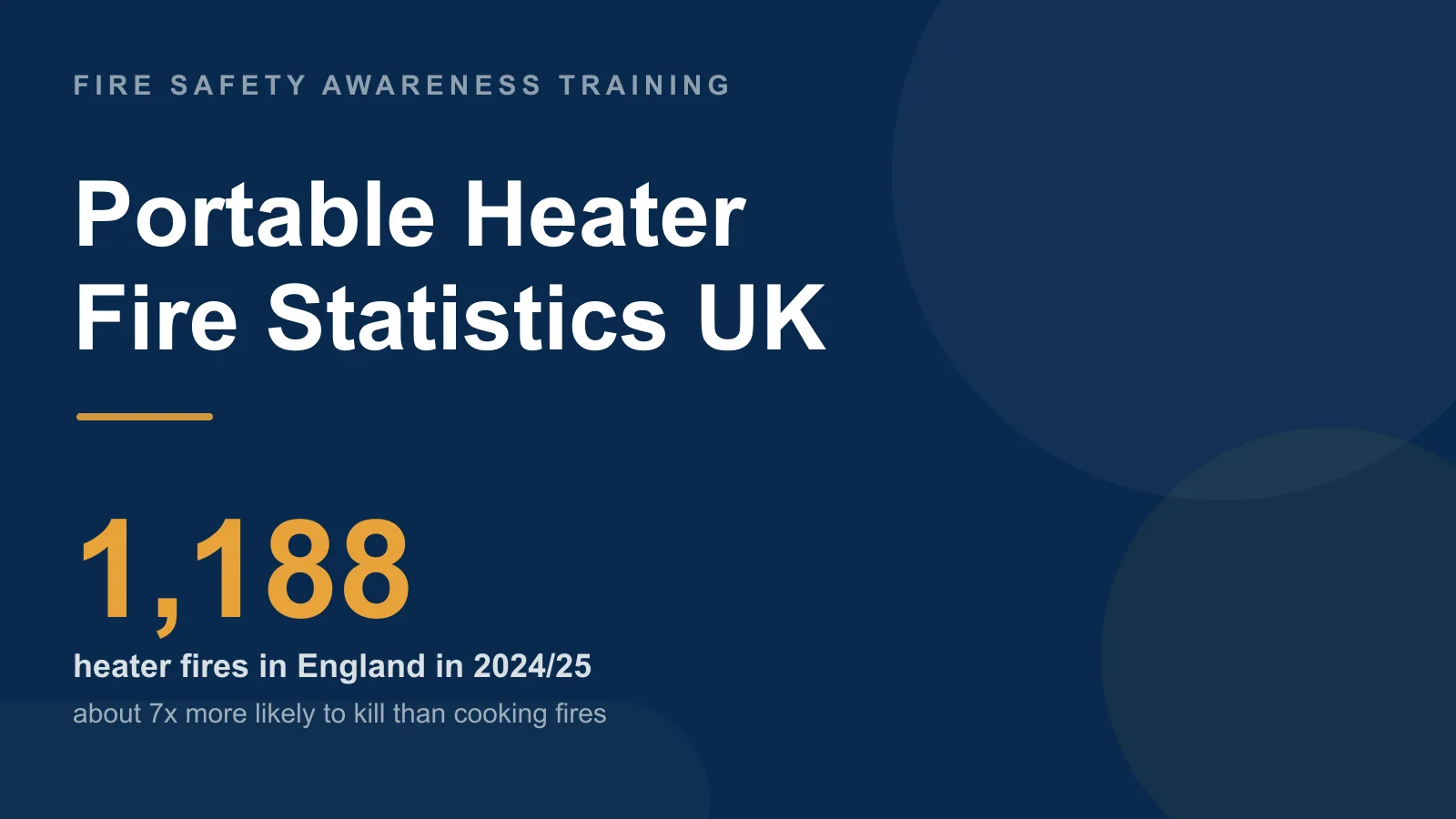
- 1,188 primary fires in England were started by space heating appliances in 2024/25, down slightly from 1,207 the year before (MHCLG FIRE0602).
- 13 people died in fires started by space heating appliances in England in 2024/25, and 221 suffered non-fatal casualties (MHCLG FIRE0602).
- ~7x — heater fires are around seven times more likely to kill than cooking fires per incident: about 11 deaths per 1,000 heater fires versus roughly 1.5 per 1,000 cooking-appliance fires in 2024/25.
- 46% — space-heating-appliance fires in England have nearly halved since 2010/11, from 2,204 a year to 1,188.
- 297 people have died in space-heating-appliance fires in England over the 15 years from 2010/11 to 2024/25.
- 31 accidental electric blanket fires were recorded in England in 2024/25 — a five-year high, up 24% on the 25 recorded in 2023/24 (Electrical Safety First, March 2026).
- ~4.3 million — an estimated 42% of UK adults were using or considering a single-room electric heater in winter 2022, an 8% year-on-year rise (Electrical Safety First / Censuswide, October 2022).
- 22,877 accidental dwelling fires occurred in England in the year ending March 2025, so heaters are a small share of fires but an outsized share of deaths (MHCLG detailed analysis).
These are the latest published figures as of July 2026, and this page is updated when new data is released — the core source, MHCLG’s fire-cause tables (FIRE0602), is refreshed every August as part of the annual detailed fire statistics for England.
How many fires do portable heaters cause in the UK each year?
1,188 primary fires in England were started by space heating appliances in 2024/25 (the year ending March 2025), according to MHCLG fire statistics table FIRE0602. That is down slightly on the 1,207 recorded in 2023/24, and continues a long, steady decline: there were 2,204 such fires back in 2010/11, so the annual total has nearly halved — a fall of about 46% over 15 years.
“Space heating appliances” is the official ignition-source category that captures portable and fixed heaters — electric bar and fan heaters, oil-filled radiators, halogen and convector heaters, gas fires and paraffin heaters among them. “Primary fires” are the more serious incidents in the statistics: broadly, fires in buildings, vehicles or other structures, plus any fire involving casualties, rescues or attendance by five or more appliances. In practice the great majority of heater fires are dwelling fires, because a heater is a concentrated heat source placed inside someone’s home — often close to clothing left to dry, bedding, curtains or a sofa.
Put simply: on an average day in England, three or more house fires are started by heaters — a figure the Home Office used in its winter fire safety guidance, and one the falling FIRE0602 series still broadly supports.
How many people die in heater fires in the UK?
13 people died in fires started by space heating appliances in England in 2024/25, down from 18 the year before, with a further 221 suffering non-fatal casualties (FIRE0602, year ending March 2025). Over the 15 years from 2010/11 to 2024/25, heater fires have killed 297 people in England — an average of around 20 deaths a year, though the annual figure swings on small numbers. Over the most recent five years (2020/21 to 2024/25), heaters caused 6,187 primary fires and 81 deaths in England.
For context, there were 22,877 accidental dwelling fires in England in the year ending March 2025 (MHCLG’s detailed analysis of fires attended). Heaters cause only a small fraction of those fires, but a strikingly high share of the deaths — the point the next section pins down. The wider picture of who dies in UK fires is covered on our sister site’s guide to fire deaths in the UK.
Why are heater fires so much more dangerous than other fires?
Heater fires are around seven times more likely to kill than cooking fires, per incident. In 2024/25, space heating appliances caused 1,188 fires and 13 deaths — roughly 11 deaths per 1,000 fires. Cooking appliances, by contrast, caused far more fires (about 11,665) but 18 deaths — roughly 1.5 deaths per 1,000 fires. Cooking is the most common cause of dwelling fires; heaters are nowhere near as common, but the fires they do start are far more likely to be fatal.
The reasons sit in how heaters are used. A heater runs unattended for long stretches, frequently overnight and often in a bedroom, so a fire can take hold and fill a room with smoke while the occupant sleeps. Heaters are also routinely placed too close to combustibles — washing draped over an oil-filled radiator, a bar heater near a bed, a portable heater knocked onto a rug. Many are used precisely because a home is cold, so the exposure concentrates among the most vulnerable: older people heating a single room, households cutting central-heating use to save money. That combination of unattended running, contact with soft furnishings and vulnerable users turns a comparatively rare cause of fire into a disproportionate cause of death.
Heater fire statistics at a glance
The table below summarises the key UK heater fire figures, with the data period and direction of travel for each measure.
| Measure | Figure | Period and trend |
|---|---|---|
| Space-heating-appliance fires (England) | 1,188 | 2024/25 — down from 1,207 in 2023/24; 2,204 in 2010/11 (−46%) |
| Deaths in heater fires (England) | 13 | 2024/25 — down from 18 in 2023/24 |
| Non-fatal casualties (England) | 221 | 2024/25 |
| Deaths per 1,000 fires — heaters vs cooking | ~11 vs ~1.5 | 2024/25 — heaters ~7x more likely to kill per fire |
| Heater-fire deaths, 15-year total (England) | 297 | 2010/11 to 2024/25 |
| Heater fires / deaths, last five years (England) | 6,187 / 81 | 2020/21 to 2024/25 |
| Accidental electric blanket fires (England) | 31 | 2024/25 — five-year high, up 24% on 25 in 2023/24 |
| Accidental dwelling fires, all causes (England) | 22,877 | Year ending March 2025 |
Are electric blanket fires increasing?
Yes — 31 accidental electric blanket fires were recorded in England in 2024/25, a five-year high and a 24% rise on the 25 recorded the year before, according to Electrical Safety First’s analysis of government fire data published in March 2026. The charity also found that those fires produced 11 casualties or fatalities in the year. Electric blankets are a small slice of the overall heater picture in raw numbers, but the upward direction runs against the long-term downward trend in heater fires generally, which is why the charity flagged it.
Older guidance is worth reading with care here. The Home Office’s winter fire safety guidance (last updated in May 2022) cites around 43 fires a year caused by faulty electric blankets in England, and three fires a day caused by heaters overall — useful round figures, but ones that predate the latest series and should be quoted with their 2022 vintage attached. Electric blankets age badly: worn wiring, scorch marks and folding all raise the risk, which is why fire services urge annual testing of older blankets and replacement of any showing damage.
Is the cost-of-living squeeze pushing up heater use?
An estimated 42% of UK adults were using or considering a single-room electric heater in winter 2022 — equivalent to roughly 4.3 million people, an 8% rise on the year before (Electrical Safety First / Censuswide survey of 3,010 UK adults, 17–19 October 2022). The same survey found that 37% of those planning to use an electric heater had never used one before, and 90% were worried about heating costs, up from 78% a year earlier. These are survey figures from October 2022, at the peak of the energy-price crisis, and are labelled as such — the charity re-runs winter surveys, so newer numbers may supersede them — but they capture a behavioural shift that has not fully reversed.
The safety concern is the mismatch between exposure and experience: millions heating one room with a portable appliance, many for the first time, in the coldest months when clothes dry indoors and heaters run for longer. It is the pattern behind the disproportionate death rate above, and why energy charities, fire services and insurers push heater safety messaging every winter.
What do fire brigades say about electric heaters?
Over 160 fires a year in London are caused by electric heaters, and around a third of fatal electrical fires in the capital involve heaters, according to London Fire Brigade’s home fire safety guidance. The brigade’s recurring advice is blunt and practical: keep heaters at least a metre away from anything that can burn, never use one to dry clothes, always sit them on a hard level surface where they cannot be knocked over, and never leave a portable heater running while you are out or asleep. The same page warns against daisy-chaining heaters through extension leads, which can overload the flex and start a fire of its own.
These London figures are rolling averages rather than a dated annual series, but they line up with the national FIRE0602 pattern: a minority cause of fires, yet a major cause of the fatal ones.
What about chimney, electrical and appliance fires?
This page covers portable and fixed space heaters, electric heaters, electric blankets and open-fire ignition in the home. A few closely related topics sit elsewhere so the numbers stay clean. Fixed solid-fuel and chimney fires — the roughly 3,800 chimney fires a year in England — are a separate ignition category covered on their own page, not here. General electrical faults and wiring fires are covered by our sister site’s guide to electrical fire statistics in the UK. And fires started by white goods and other household appliances — washing machines, tumble dryers, fridge-freezers — are counted under different FIRE0602 categories again, covered in our white goods fire statistics. If you are quoting a figure, check it belongs to the space-heating-appliance category before attributing it to “heaters”.
Do these figures cover the whole of the UK?
The headline figures on this page cover England, which publishes the most detailed fire-cause data in the UK through MHCLG’s FIRE0602 tables (fires, fatalities and non-fatal casualties by source of ignition). There is no single published UK-wide heater fire table. Scotland’s figures are published separately by the Scottish Fire and Rescue Service, whose 2024/25 statistics reported house fires at a record low; Wales publishes its own incident statistics, which track space heating appliances as a source of ignition in accidental dwelling fires; and Northern Ireland reports separately again.
Because England accounts for the large majority of UK households, the England series is the standard proxy used when people cite “UK heater fire statistics” — but if you are quoting figures for Scotland, Wales or Northern Ireland specifically, use the devolved publications rather than scaling the English numbers.
How do you prevent a heater fire?
Given that heaters kill far out of proportion to how many fires they start, the prevention advice from UK fire and rescue services is consistent. Keep heaters at least one metre from curtains, bedding, furniture and anything else that can burn. Never use a heater to dry clothes or drape washing over it. Sit portable heaters on a hard, level surface where they cannot be knocked over, and keep them clear of walkways. Switch heaters off before you leave the room, leave the house or go to sleep — the overnight-running habit is behind a large share of fatal heater fires. Buy from reputable retailers, register for recall alerts, and check older electric blankets for wear and scorching every year.
The other half of the equation is early warning. A working smoke alarm turns a smouldering heater fire — often starting in soft furnishings while someone sleeps — from a tragedy into an anecdote; our companion page on smoke alarm statistics sets out the ownership and failure data. Where gas fires and paraffin heaters are used, a carbon monoxide alarm matters too: see our carbon monoxide poisoning statistics. For workplaces — offices, care homes, workshops and any premises where portable heaters appear in winter — heater risk belongs in the fire risk assessment, and staff fire awareness training is part of the control measures the Responsible Person must provide.
Frequently asked questions
How many fires do portable heaters cause in the UK each year?
In England, 1,188 primary fires were started by space heating appliances in 2024/25 (year ending March 2025), per MHCLG table FIRE0602 — down from 1,207 in 2023/24 and about 46% below the 2,204 recorded in 2010/11. Scotland, Wales and Northern Ireland publish separate figures.
How many people die in heater fires in the UK?
There were 13 deaths in fires started by space heating appliances in England in 2024/25, plus 221 non-fatal casualties. Over the 15 years to 2024/25, heater fires killed 297 people in England; over the last five years they caused 6,187 fires and 81 deaths.
Is it safe to leave an electric heater on overnight?
No. Fire services advise switching portable heaters off before you sleep. Running a heater unattended overnight, often in a bedroom and close to bedding, is behind a large share of fatal heater fires — which is a big part of why heaters are around seven times more likely to kill per fire than cooking appliances.
Are electric blanket fires increasing?
Yes. Electrical Safety First found 31 accidental electric blanket fires in England in 2024/25 — a five-year high and a 24% rise on the 25 recorded in 2023/24 (analysis published March 2026), producing 11 casualties or fatalities. The charity urges annual checks of older blankets and replacement of any that are worn or scorched.
Are heaters a common cause of house fires?
No — heaters cause a small share of fires. There were 22,877 accidental dwelling fires in England in the year ending March 2025 from all causes, and cooking appliances alone caused several times more fires than heaters. What makes heaters stand out is the death rate per fire, not the number of fires.
Where do UK heater fire statistics come from?
The core source is MHCLG’s fire statistics data tables for England — table FIRE0602 gives fires, fatalities and non-fatal casualties by source of ignition, including “space heating appliances”. It is an Accredited Official Statistics series, refreshed every August; the current edition covers the year ending March 2025. Electrical Safety First adds the electric blanket and cost-of-living detail.
Related guides
- Smoke Alarm Statistics UK: Ownership, Failures & Lives Saved
- Carbon Monoxide Poisoning Statistics UK: Deaths, Incidents & Alarms
- Candle Fire Statistics UK: Fires, Deaths & Seasonal Trends
- UK Fire Classes Explained: A, B, C, D, F (and L)
- How to Use a Fire Extinguisher: The PASS Method Explained
Sources & references
- MHCLG — Fire statistics data tables, table FIRE0602: primary fires, fatalities and non-fatal casualties by source of ignition, including space heating appliances (year ending March 2025 edition, published 14 August 2025)
- MHCLG — Detailed analysis of fires attended by fire and rescue services, England, April 2024 to March 2025
- Electrical Safety First — Concerns as electric blanket fires hit five-year high (March 2026)
- Electrical Safety First / Censuswide — Cost-of-living electric heater survey, n=3,010 UK adults, October 2022
- London Fire Brigade — Portable heaters, gas fires and open fires safety guidance
- Home Office — Fire safety in the winter (accessible version, updated 25 May 2022)
- Scottish Fire and Rescue Service — Fire and Rescue Incident Statistics 2024-25
- Welsh Government — Fire and rescue incident statistics, April 2024 to March 2025
Heaters cause a small share of house fires but a disproportionate share of the deaths — get every employee fire aware in around 90 minutes.
Explore the Fire Safety Awareness Training course →
Mark writes about workplace health & safety, fire safety awareness and accredited online training for Fire Safety Awareness Training, part of Online CPD Academy.