
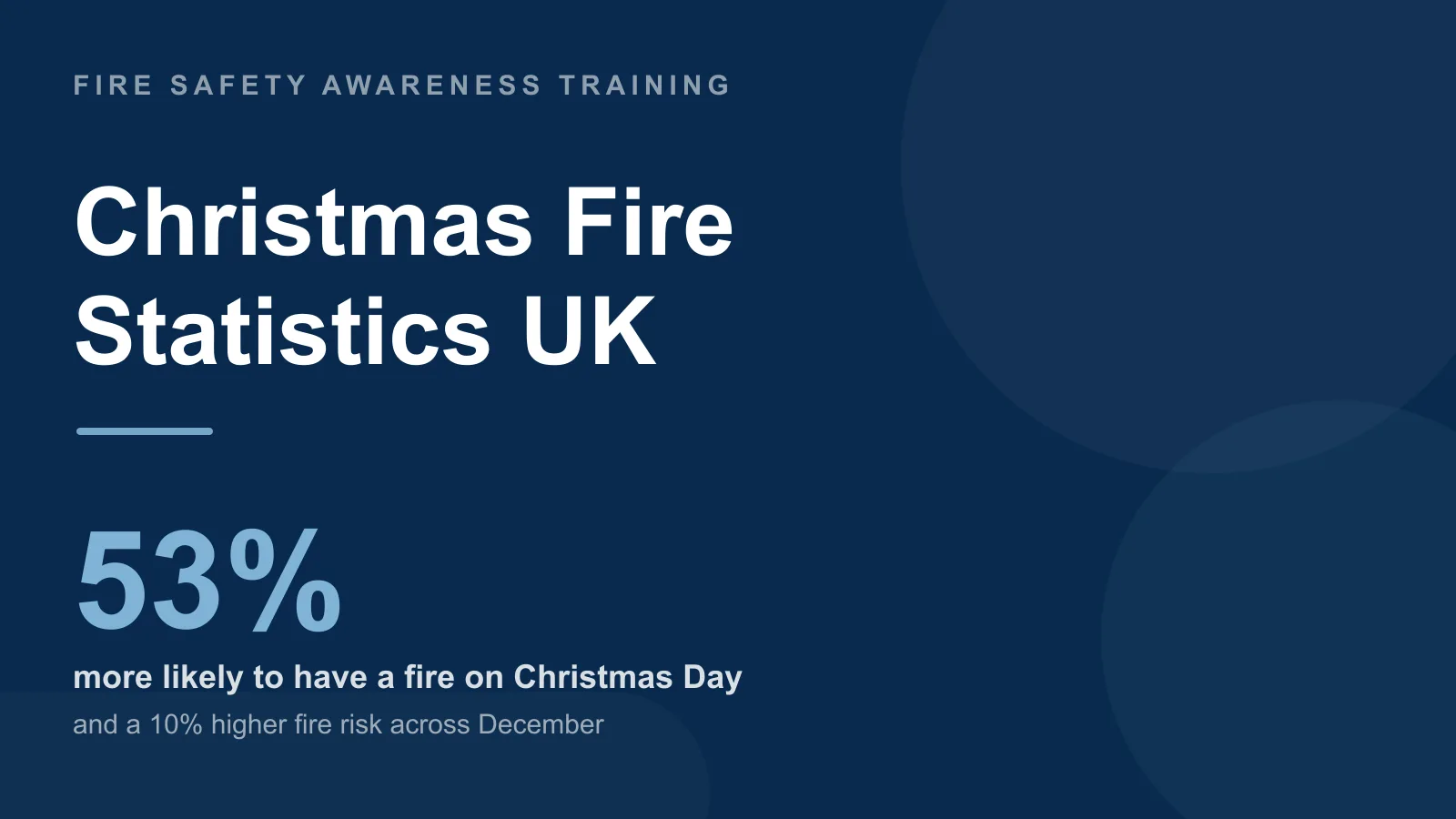
Christmas is measurably the most dangerous time of year for home fires in the UK. The National Fire Chiefs Council, drawing on ten years of Home Office data, reports that a home fire is roughly 10% more likely in December than in any other month, and that people are 53% more likely to have a fire on Christmas Day itself than on an average day. This page gathers the official and fire-service figures behind those headlines — the seasonal fire pattern from Home Office / MHCLG statistics, festive incident data from London Fire Brigade and the Scottish Fire and Rescue Service, and festive claims analysis from Aviva — with the data period stated next to every figure so you can cite any of them with confidence.
Key facts and figures
- 53% more likely — the increase in the chance of having a fire on Christmas Day compared with an average day of the year (NFCC, 10-year Home Office data analysis, December 2024).
- 10% higher risk of an accidental home fire in December than in any other month of the year (NFCC, 10-year Home Office data analysis, December 2024).
- 527 accidental house fires were recorded in Scotland over one festive period, 11 December to 15 January (Scottish Fire and Rescue Service).
- 381 of Scotland's 4,174 accidental house fires in 2022/23 — around a tenth — happened in December (Scottish Fire and Rescue Service, 2022/23).
- 60% of home fires start in the kitchen, the room that comes under most pressure over Christmas (London Fire Brigade, cited in Aviva's festive bulletin, 2025).
- 395 incidents were attended by London Fire Brigade over one Christmas period — around 11 times the national average (LFB, December 2024).
- £25,000+ is the average cost of a UK festive home fire insurance claim (Aviva home-insurance claims, 2021–2024).
- Under 1 minute — how quickly a dry Christmas tree or a sub-standard set of fairy lights can turn a small flame into a major fire (GOV.UK Fire Kills festive campaign).
These are the latest published figures as of July 2026, and this page is refreshed each November so it is current for the December press cycle — the seasonal spine, the Home Office / MHCLG monthly fire-rate tables (FIRE0802), is updated as part of the quarterly fire statistics for England.
How many house fires happen at Christmas in the UK?
Around a tenth of Scotland's accidental house fires in a year happen in December — 381 of 4,174 in 2022/23, according to the Scottish Fire and Rescue Service — and across the wider festive window the numbers are higher still. The Scottish Fire and Rescue Service recorded 527 accidental house fires over one festive period, defined as 11 December to 15 January. December consistently sits at or near the top of the monthly table because the things that start home fires — cooking, decorations, heating and electrics — all peak at once.
England does not publish a single "Christmas fires" total, but the shape of the year is clear in the Home Office / MHCLG monthly rate tables (FIRE0802), which record the daily rate of fire incidents by month. December stands out, and the National Fire Chiefs Council's ten-year analysis of that Home Office data distils it into the two figures everyone cites: a roughly 10% uplift in accidental home fire risk in December, rising to a 53% jump on Christmas Day itself. In other words, the festive fortnight is not a minor seasonal wobble — it is the single riskiest stretch of the UK calendar for fire in the home.
Are you more likely to have a fire on Christmas Day?
Yes — 53% more likely than on an average day, according to the National Fire Chiefs Council's analysis of ten years of Home Office data (December 2024). Christmas Day concentrates almost every domestic fire risk into a single day: multiple hobs and an oven running for hours, a full house of distracted cooks, tired hosts, alcohol, extra guests, and a living room packed with a tree, lights, cards and wrapping paper. The result is a spike far sharper than the already-elevated December baseline.
London Fire Brigade's incident figures put the same pattern in raw numbers: the brigade attended 395 incidents over one Christmas period — around 11 times its usual daily average — reflecting how much the festive day compresses risk (LFB, December 2024). The lesson from the data is not to abandon Christmas cooking, but to treat the kitchen, the decorations and the heating with the same care on 25 December that a workplace would demand every day of the year.
What causes the most fires at Christmas?
Cooking is the single biggest cause of festive house fires, with around 60% of all home fires starting in the kitchen (London Fire Brigade, cited in Aviva's 2025 festive bulletin). The Christmas dinner concentrates that everyday risk: the Scottish Fire and Rescue Service attended 1,542 accidental dwelling fires caused by cookers in 2022/23 — more than any other single cause in Scotland — and cooking is where fire services focus their festive messaging for exactly that reason.
Distraction is the mechanism. Aviva's festive research found that over 30% of UK adults admit to sometimes leaving the kitchen while food is cooking, and 23% do so regularly or always (Aviva claims and survey data, 2025) — habits that are worse, not better, on a chaotic Christmas Day with guests to entertain. Nationally, the scale of appliance-related fire is stark: Fire and Rescue Services attended 23,008 fires in English homes in the year ending March 2024, and 54% of them (12,492) involved domestic appliances (Home Office / MHCLG fire statistics, year ending March 2024). Oven and cooker fires alone caused 958 casualties in England in 2023/24.
Heating and electrics do the rest. Longer, colder evenings mean more heaters running near soft furnishings and decorations, and festive lighting means more load on domestic sockets and extension leads than at any other time of year. Chimneys and open fires add a further seasonal strand — Aviva found chimneys and fireplaces account for 6% of all its fire claims during December (Aviva claims, 2021–2024). Candle and firework fires are a distinct festive risk with their own detailed pages, cross-linked below rather than restated here.
Are Christmas tree and fairy light fires common in the UK?
Christmas tree fires are relatively rare but escalate frighteningly fast, and the peak is January rather than December. London Fire Brigade found that over a five-year period it attended almost twice as many Christmas-tree fires in January as in December, with over 60% of them occurring outdoors — driven by people burning old trees rather than recycling them (LFB, five-year period to 2020). A dried-out real tree is effectively kindling: the GOV.UK Fire Kills festive campaign warns that a dry tree can go up in under a minute, and December is historically the peak month for accidental fire deaths in the home.
Fairy lights are the other decoration hazard. A sub-standard or poorly maintained set can start a significant fire in under a minute (GOV.UK Fire Kills), and the risk multiplies when cheap imported lights, daisy-chained extension leads and overloaded sockets combine on a tree standing next to curtains and wrapping paper. The practical takeaways from the data are straightforward: keep real trees watered, buy lights that carry a recognised safety mark, never overload a socket, switch decorations off at night and before leaving the house, and recycle trees through a proper collection rather than burning them.
Christmas fire statistics at a glance
The table below summarises the key UK festive fire figures, with the data period and source for each measure.
| Measure | Figure | Period and source |
|---|---|---|
| Extra fire risk on Christmas Day vs an average day | +53% | NFCC, 10-year Home Office data analysis (Dec 2024) |
| Extra accidental home fire risk in December | +10% | NFCC, 10-year Home Office data analysis (Dec 2024) |
| Accidental house fires over one festive period (Scotland) | 527 | SFRS — 11 December to 15 January |
| December share of Scotland's accidental house fires | 381 of 4,174 (~9%) | SFRS, 2022/23 |
| Incidents attended by LFB over one Christmas period | 395 | London Fire Brigade (Dec 2024) |
| Home fires that start in the kitchen | ~60% | LFB, cited in Aviva festive bulletin (2025) |
| English home fires involving domestic appliances | 12,492 of 23,008 (54%) | Home Office / MHCLG, year ending March 2024 |
| Average UK festive home fire insurance claim | Over £25,000 | Aviva claims, 2021–2024 |
What do the Scottish festive figures show?
Scotland gives the clearest single-nation picture, and it points squarely at the kitchen. The Scottish Fire and Rescue Service attended 1,542 accidental dwelling fires caused by cookers in 2022/23 — the single biggest cause of house fires in Scotland — and recorded 381 of its 4,174 accidental house fires that year in December alone (SFRS, 2022/23). Across the wider festive window of 11 December to 15 January, the service logged 527 accidental house fires in one recorded period, which is why its festive campaign leans so heavily on unattended cooking, overloaded sockets and decorations near heat.
Scotland publishes this detail separately from England because fire statistics are devolved: the Scottish Fire and Rescue Service maintains its own incident series, as do the fire services in Wales and Northern Ireland. When you see a "UK Christmas fire" figure quoted in the press, it is almost always an England or Scotland number, or an insurer's UK-wide claims sample, rather than a single unified national total — so cite the source and nation alongside the figure.
How much do Christmas fires cost?
The average UK festive home fire insurance claim runs to over £25,000, according to Aviva's analysis of home-insurance claims made between 2021 and 2024. That headline figure captures why a "small" festive fire is anything but: a kitchen or living-room fire routinely means a gutted room, smoke damage carried through the house, and weeks or months living elsewhere while repairs are done — often straddling the Christmas and New Year period itself.
The claims data also shows where the festive money goes. Chimneys and fireplaces account for 6% of all fire claims during December (Aviva, 2021–2024), reflecting the seasonal return of open fires and wood burners — a topic covered in full on our chimney fire statistics page. The single largest driver, though, remains the kitchen, which is where roughly 60% of home fires start and where the most expensive festive claims tend to originate.
How can you prevent a fire this Christmas?
Because cooking causes the most festive fires, the single most effective step is simply to stay in the kitchen while food is on the heat — the habit that over 30% of UK adults admit they sometimes skip. Beyond that, fire services' festive advice is consistent year to year: never leave cooking unattended, keep tea towels and packaging away from the hob, and take the pan off the heat before you go to answer the door or check on guests.
For decorations and electrics, the rules are equally blunt: buy fairy lights carrying a recognised safety mark, never connect too many to one socket, switch all lights and decorations off before bed and before leaving the house, keep real trees watered so they do not dry out, and keep everything flammable well clear of heaters and open fires. Above all, test your smoke alarms at the start of the festive season — a working alarm is what turns a smouldering festive fire into an anecdote rather than a tragedy, as set out on our smoke alarm statistics page.
For workplaces that stay busy over the festive period — hospitality venues, retail, care settings and offices running Christmas events — the same risks apply and belong in the fire risk assessment, with staff fire awareness training forming part of the control measures the Responsible Person must provide.
Frequently asked questions
How many house fires happen at Christmas in the UK?
There is no single UK-wide total, but December is consistently the worst month. The Scottish Fire and Rescue Service recorded 527 accidental house fires over one festive period (11 December to 15 January), and 381 of Scotland's 4,174 accidental house fires in 2022/23 happened in December. The National Fire Chiefs Council's analysis of Home Office data finds accidental home fires are around 10% more likely in December than in any other month.
Are you more likely to have a fire on Christmas Day?
Yes. People are 53% more likely to have a fire on Christmas Day than on an average day of the year, according to the NFCC's ten-year analysis of Home Office data (December 2024). The day concentrates cooking, heating, decorations and electrics — and a house full of distracted people — into a single date.
What causes the most fires at Christmas?
Cooking. Around 60% of home fires start in the kitchen (London Fire Brigade), and the Christmas dinner amplifies that everyday risk — the Scottish Fire and Rescue Service attended 1,542 cooker fires in 2022/23. Heating, overloaded sockets and decorations add further seasonal risk. Candle and firework fires are covered separately on their own pages.
Are Christmas tree and fairy light fires common in the UK?
They are relatively rare but escalate fast. London Fire Brigade found almost twice as many Christmas-tree fires in January as in December over a five-year period, with over 60% outdoors — mostly from people burning old trees. A dry tree or a sub-standard set of fairy lights can start a serious fire in under a minute (GOV.UK Fire Kills).
How much does a Christmas house fire cost?
The average UK festive home fire insurance claim exceeds £25,000, according to Aviva's analysis of claims made between 2021 and 2024 — before counting smoke damage and the disruption of living elsewhere while the home is repaired.
Where do UK Christmas fire statistics come from?
The seasonal spine is the Home Office / MHCLG fire statistics — the monthly fire-rate tables (FIRE0802) and the annual incident statistics for England — analysed over ten years by the National Fire Chiefs Council. Fire-service releases from London Fire Brigade and the Scottish Fire and Rescue Service add festive incident detail, and Aviva's claims analysis supplies the cost and behaviour figures.
Related guides
- Cooking Fire Statistics UK: The No.1 Cause of House Fires
- Candle Fire Statistics UK: Fires, Deaths & Seasonal Trends
- Chimney Fire Statistics UK: How Many Per Year, Causes & Sweeping Data
- Smoke Alarm Statistics UK: Ownership, Failures & Lives Saved
- Carbon Monoxide Poisoning Statistics UK: Deaths, Incidents & Alarms
- How to Use a Fire Extinguisher: The PASS Method Explained
Sources & references
- MHCLG — Fire statistics data tables, table FIRE0802: daily rate of fire incidents by month and location (year ending December 2025 edition)
- National Fire Chiefs Council — Councils and fire chiefs issue reminder on home fire safety ahead of the festive season (December 2024, 10-year Home Office data analysis)
- London Fire Brigade — Christmas fire safety: festive incidents, Christmas tree and cooking fire warnings
- Scottish Fire and Rescue Service — Festive safety campaign and statistics
- Aviva plc — Households urged to take caution during the festive season (festive home-insurance claims, 2021–2024, published December 2025)
- GOV.UK / Fire Kills — It only takes a minute for Christmas to go up in smoke (festive fire-safety campaign)
- Hampshire & Isle of Wight Fire and Rescue Service — Turn off the heat before you eat this Christmas (festive kitchen-safety release)
Christmas is the riskiest time of year for home fires — and cooking, heating and decorations put every UK workplace on alert too. Get your team fire aware in around 90 minutes with RoSPA-approved, CPD-certified training.
Explore the Fire Safety Awareness Training course →
Mark writes about workplace health & safety, fire safety awareness and accredited online training for Fire Safety Awareness Training, part of Online CPD Academy.