
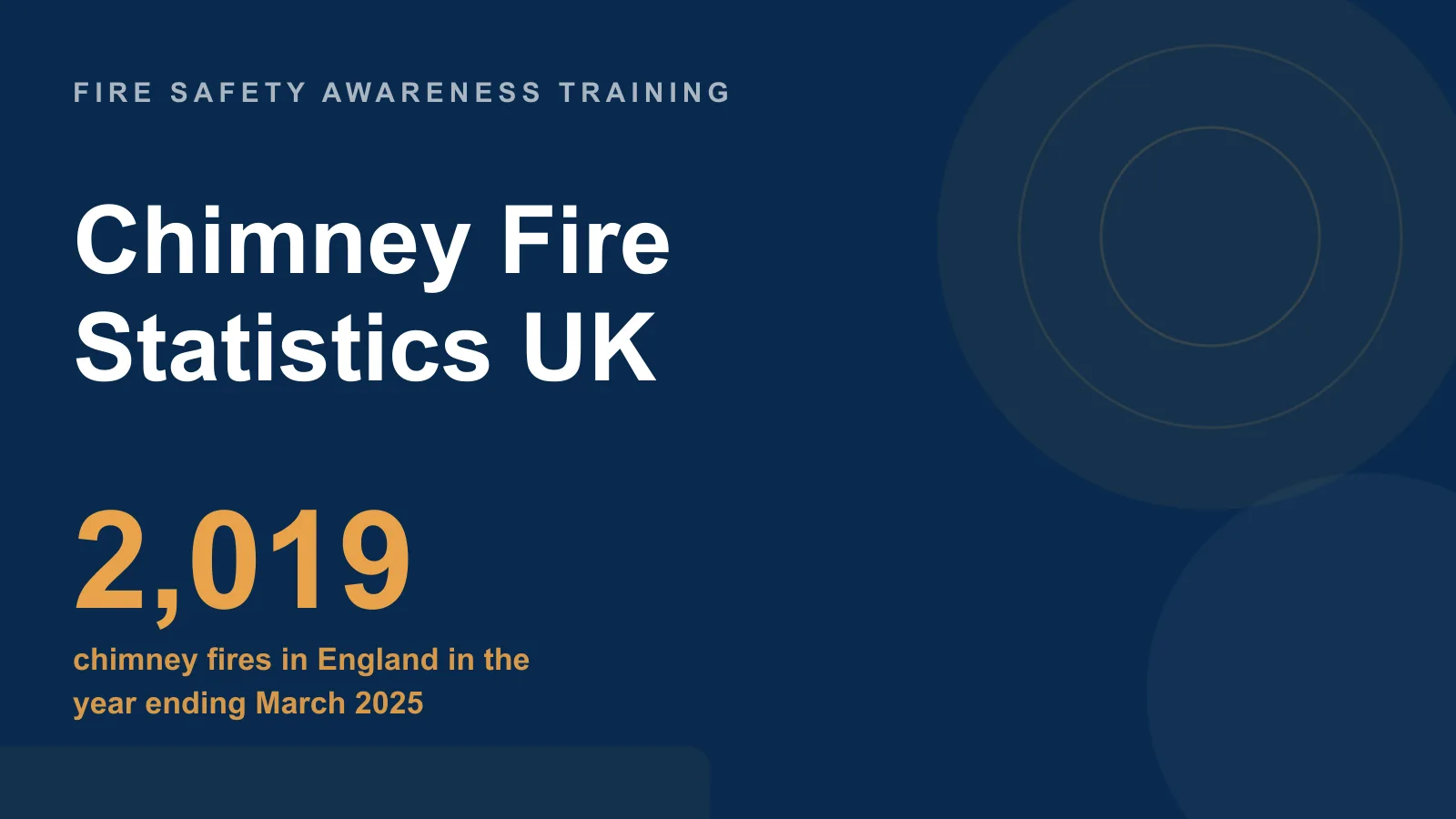
England recorded 2,019 chimney fires in the year ending March 2025 — down 5.5% on the year before and 61% over the decade — even as wood-burning stoves have surged back into fashion. This page gathers the key UK chimney fire statistics on how many happen each year, what causes them, where they cluster and how sweeping behaviour explains the ones that still occur, with every figure cited to its source. The data comes principally from MHCLG’s detailed analysis of fires attended by fire and rescue services in England and its wider fire statistics data tables, alongside maintenance-behaviour survey findings published by HETAS for Chimney Fire Safety Week and household wood-burning data analysed by UCL.
Key facts and figures
- 2,019 chimney fires were attended in England in the year ending March 2025.
- Down 5.5% year-on-year, from 2,136 chimney fires in the year ending March 2024.
- Down 61% over the decade, from 5,190 chimney fires in the year ending March 2015.
- Around 0.33% of all fires attended in England are chimney fires — a small but stubborn share.
- 181 chimney fires were attended by Devon & Somerset — the most of any English fire service in 2024/25.
- Around 40% of chimney fires across England, Scotland and Wales occur in January to March, when stoves work hardest.
- Nearly 1 in 10 stove owners leave it two years or more to sweep the chimney, or never sweep it at all.
- 10.3% of UK households owned a wood-burning stove in 2024, up from 9.4% in 2022.
Figures are the latest available as of July 2026, and this page is updated when new data is released — principally MHCLG’s detailed analysis of fires each August, and HETAS’s fresh regional analysis published every Chimney Fire Safety Week in the first week of September.
How many chimney fires are there in the UK per year?
England recorded 2,019 chimney fires in the year ending March 2025, according to MHCLG’s detailed analysis of fires attended by fire and rescue services, published in August 2025. That is the official count for chimney fires in England for the most recent full statistical year.
Chimney fires are a small slice of the overall fire picture. England’s fire and rescue services attended 142,494 fires of all kinds in the year ending March 2025 — up 2.5% on the year before — with 271 fire-related fatalities, according to MHCLG’s fire and rescue incident statistics. Chimney fires make up roughly 0.33% of that total. They rarely dominate the headline numbers, but as a preventable, seasonal, well-understood category they remain a useful barometer of how carefully households maintain their solid-fuel heating.
The figures above are for England, where the detailed breakdown is published. Fire statistics are devolved, so Scotland and Wales report their own totals separately; the HETAS regional analysis discussed below draws its seasonal pattern from across England, Scotland and Wales combined.
What causes most chimney fires?
Most chimney fires are caused by a build-up of soot and creosote in an unswept or poorly maintained flue, ignited by the heat of the appliance below. When wood or solid fuel is burned, unburnt particles condense on the inside of the flue as soot and tarry creosote. As that deposit thickens, a spark or sustained high temperature can set it alight inside the chimney — a fierce, roaring fire that can crack the flue liner and spread into the surrounding structure.
Three ignition factors dominate this category on the domestic side:
- Infrequent sweeping — letting soot and creosote accumulate is the single biggest driver, which is why the sweeping-frequency data below matters so much.
- Burning the wrong fuel — wet or unseasoned wood produces far more creosote than dry, certified fuel because the extra moisture cools the flue and lets particles condense rather than burn off.
- Overnight slumber burning and poor airflow — running a stove low and starved of air for long periods keeps flue temperatures down and accelerates creosote deposition.
HETAS’s survey work points squarely at fuel and maintenance habits as the levers. Just over 10% of stove users never check, or only sometimes check, that their fuel is certified ‘Ready to Burn’, according to the HETAS Chimney Fire Safety Week survey published in September 2025. Ready to Burn certification signals wood dried to below 20% moisture content and manufactured solid fuels that burn cleanly; using it, and sweeping regularly, removes most of the fuel a chimney fire needs.
Carbon monoxide is the silent companion risk to the visible flames — a blocked or poorly maintained flue can push CO back into the room even without a fire. We keep the CO incidents, deaths and alarm data on our dedicated carbon monoxide poisoning statistics UK page rather than restating them here.
How often should you have your chimney swept?
HETAS advises sweeping a chimney at least twice a year when burning wood, and at least once every 12 months when burning smokeless fuels. Wood produces more creosote than manufactured smokeless fuel, so a wood-burning flue needs the more frequent schedule. The sweep’s job is not only to clear deposits but to check the flue’s condition and confirm it is drawing safely.
The maintenance gap is where the remaining fires come from. Nearly 1 in 10 wood-burner and solid-fuel stove owners leave it two years or more to sweep the chimney, or never sweep it at all, according to the HETAS 2025 survey. Given that soot and creosote build-up is the primary ignition source, that under-swept minority is doing most of the heavy lifting behind the annual chimney-fire count.
The practical routine is simple and cheap relative to the damage a chimney fire causes: book a qualified sweep before the heating season, burn only certified low-moisture fuel, and never run the appliance harder or longer on a flue that has not been cleared. A swept flue and dry fuel between them remove almost everything a chimney fire needs to start.
Are chimney fires becoming more or less common?
Chimney fires are becoming far less common: they fell 5.5% in the latest year and 61% over the past decade in England. The count dropped from 5,190 in the year ending March 2015 to 2,136 in the year ending March 2024 and then to 2,019 in the year ending March 2025, per MHCLG’s detailed analysis. The decline is long and consistent, not a one-year blip.
Look further back and the fall is more dramatic still. On the historic national series, UK chimney fires exceeded 18,000 in 1998 and were around 11,000 in 2006 — roughly 15% of home fires at the time, according to the long-running compilation on Stovesonline. From more than 18,000 fires two decades ago to around 2,000 today is a fall of close to 90%.
What makes the trend striking is that it runs against the direction of solid-fuel heating itself. UK household wood-burning-stove ownership rose from 9.4% in 2022 to 10.3% in 2024, according to UCL analysis reported via Charlton & Jenrick, and around 1.9 million UK households use wood fuel indoors. More stoves but fewer fires points to better appliances, cleaner certified fuel and steadier maintenance habits rather than any retreat from open flames. The decade-long picture at a glance:
| Measure | Figure | Data period |
|---|---|---|
| Chimney fires attended in England | 2,019 | Year ending March 2025 |
| Chimney fires the previous year | 2,136 | Year ending March 2024 |
| Year-on-year change | Down 5.5% | 2023/24 to 2024/25 |
| Chimney fires a decade earlier | 5,190 | Year ending March 2015 |
| Change over the decade | Down 61% | 2014/15 to 2024/25 |
| Historic UK baseline | Around 11,000 | 2006 (~15% of home fires) |
| Historic UK baseline | Over 18,000 | 1998 |
| Wood-burning-stove ownership | 10.3% of households | 2024 (up from 9.4% in 2022) |
Where are the UK’s chimney fire hotspots?
Devon & Somerset Fire and Rescue Service attended 181 chimney fires in 2024/25 — the most of any fire service in England, according to the HETAS regional analysis reported by the Fire Industry Association and the International Fire & Safety Journal. The pattern is heavily rural: chimney fires cluster where open fires and solid-fuel stoves are most common and mains gas is least available.
The next-highest services in 2024/25 were Dorset & Wiltshire with 113 chimney fires, Hereford & Worcester with 95, North Yorkshire with 90 and Norfolk with 86 — all rural or semi-rural counties with high concentrations of period properties and solid-fuel heating. The regional leaders for the latest year:
| Fire and rescue service | Chimney fires | Data period |
|---|---|---|
| Devon & Somerset | 181 | Year ending March 2025 |
| Dorset & Wiltshire | 113 | Year ending March 2025 |
| Hereford & Worcester | 95 | Year ending March 2025 |
| North Yorkshire | 90 | Year ending March 2025 |
| Norfolk | 86 | Year ending March 2025 |
The rural skew has a straightforward explanation. Homes off the gas grid rely on wood, coal and smokeless fuel far more than urban homes on mains gas, so they have more flues in regular use — and more chimneys to sweep. It is coverage and usage, not carelessness, that puts these counties at the top of the table.
When do most chimney fires happen?
Around 40% of chimney fires across England, Scotland and Wales occur in January to March, when stoves and open fires are used most intensively, according to the HETAS 2025 analysis. The seasonality is sharp and predictable: chimney fires are overwhelmingly a cold-weather, heating-season phenomenon.
The reason is simple exposure. The colder the weather, the longer appliances run, the more fuel is burned and the faster soot and creosote accumulate on a flue that may not have been swept since the previous winter. A chimney that was cleared in early autumn and then run hard through a long, cold January is exactly the scenario the maintenance advice is designed to prevent. The single most effective safeguard is to have the flue swept before the heating season starts, not after the fires begin.
That concentrated winter window is why HETAS times Chimney Fire Safety Week for early September — ahead of the burning season — and why this page is rebuilt each September on the fresh HETAS and MHCLG figures.
Frequently asked questions
How many chimney fires are there in the UK per year?
England recorded 2,019 chimney fires in the year ending March 2025, according to MHCLG’s detailed analysis of fires. That was down 5.5% on the previous year and 61% over the decade. Scotland and Wales report their chimney-fire totals separately as fire statistics are devolved.
What causes most chimney fires?
A build-up of soot and creosote in an unswept flue, ignited by the heat of the appliance below. Burning wet or unseasoned wood and running a stove slow and starved of air both accelerate that build-up. Just over 10% of stove users rarely or never check their fuel is certified ‘Ready to Burn’, according to HETAS.
How often should you have your chimney swept?
HETAS advises at least twice a year for wood-burning appliances and at least once every 12 months for smokeless fuels. Nearly 1 in 10 stove owners leave it two years or more, or never sweep at all — the maintenance gap behind most remaining fires.
Are chimney fires becoming more or less common?
Much less common. Chimney fires in England fell 61% over the decade, from 5,190 in 2014/15 to 2,019 in 2024/25, and are down from more than 18,000 across the UK in 1998. The fall continues even though wood-burning-stove ownership rose from 9.4% to 10.3% of households between 2022 and 2024.
Where do the most chimney fires happen in England?
Devon & Somerset attended the most of any English fire service in 2024/25 with 181 chimney fires, followed by Dorset & Wiltshire (113), Hereford & Worcester (95), North Yorkshire (90) and Norfolk (86). The pattern is heavily rural, tracking areas off the mains-gas grid where solid-fuel heating is most common.
What time of year are chimney fires most common?
Around 40% of chimney fires across England, Scotland and Wales occur in January to March, when appliances are used most. Having the flue swept before the heating season, rather than after fires begin, is the most effective safeguard.
Related guides
- Carbon Monoxide Poisoning Statistics UK: Deaths, Incidents & Alarms
- Smoke Alarm Statistics UK: Ownership, Failures & Lives Saved
- Candle Fire Statistics UK: Fires, Deaths & Seasonal Trends
- UK Fire Classes Explained: A, B, C, D, F (and L)
- Who Is Responsible for Fire Extinguishers in the UK?
Sources & references
All statistics on this page are drawn from the following official and industry sources:
- MHCLG — Detailed analysis of fires and response times to fires attended by fire and rescue services, England, April 2024 to March 2025
- MHCLG — Fire and rescue incident statistics, England, year ending March 2025
- MHCLG — Fire statistics data tables (underlying time series)
- HETAS — Chimney Fire Safety Week 2025 (survey findings and sweeping guidance)
- International Fire & Safety Journal — England’s chimney fire hotspots revealed (HETAS regional analysis)
- Fire Industry Association — Devon and Somerset reports the highest number of chimney fires in England
- Charlton & Jenrick / UCL EPC research — Wood-burning stoves soar in popularity (household ownership trend)
- Stovesonline — Chimney fire statistics for the UK (historic baseline series)
Chimney fires are preventable — but the wider fire risk in any workplace or property still needs trained people who know what to do. Get every employee fire aware in around 90 minutes, RoSPA approved and CPD certified.
Explore the Fire Safety Awareness Training course →
Mark writes about workplace health & safety, fire safety awareness and accredited online training for Fire Safety Awareness Training, part of Online CPD Academy.