
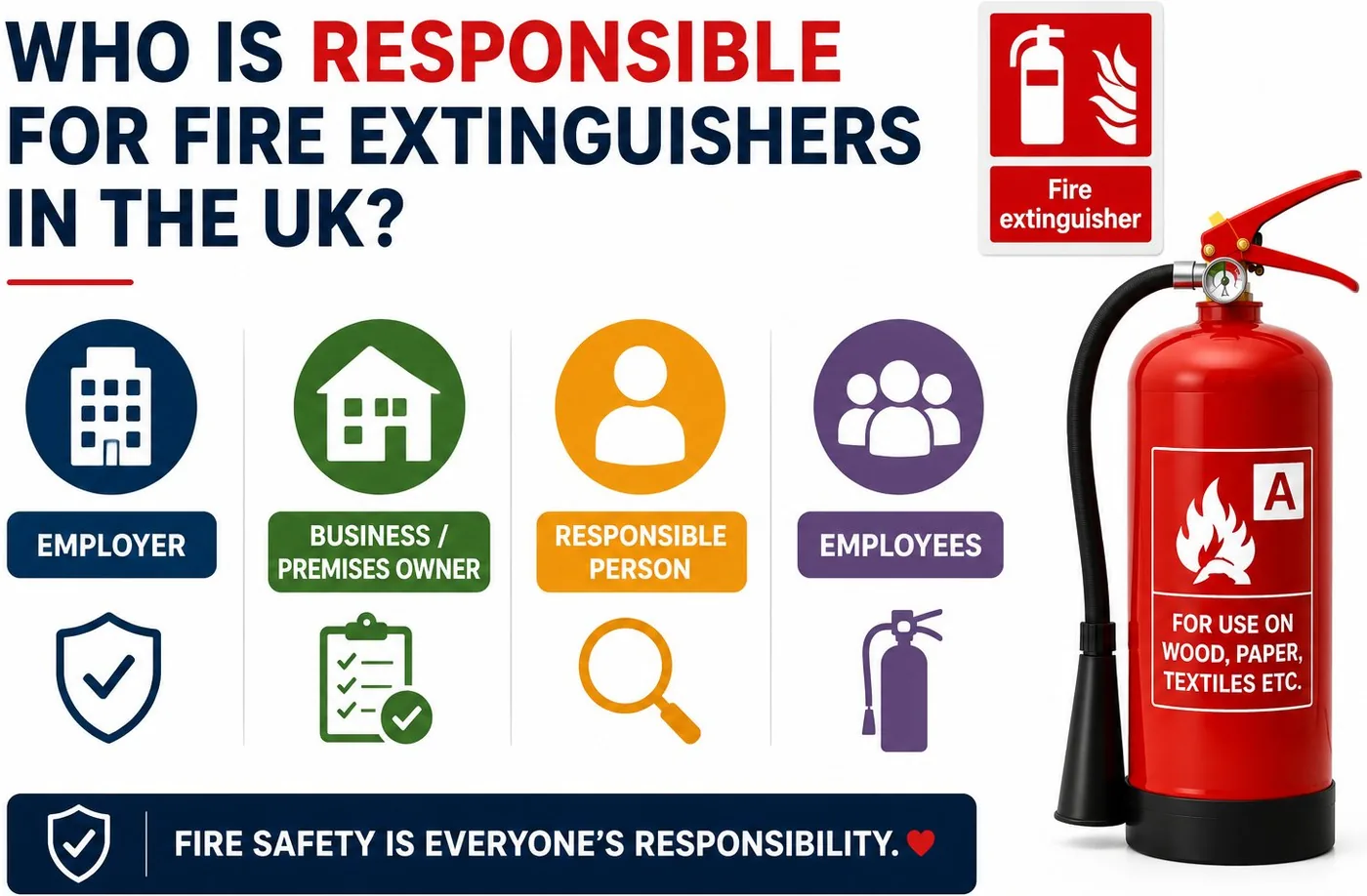
In any UK premises that isn’t a private dwelling, fire safety law assigns the legal duty for fire extinguishers — providing them, maintaining them, ensuring people are trained to use them — to a specific role: the Responsible Person. The role is defined under the Regulatory Reform (Fire Safety) Order 2005, and its scope has been extended and clarified by the Fire Safety Act 2021, the Fire Safety (England) Regulations 2022, and the Building Safety Act 2022.
This page sets out who counts as the Responsible Person in different premises, what the role requires regarding fire extinguishers specifically, who actually uses them in a fire, and how the recent legislative changes have reshaped the picture for higher-risk buildings. It closes with the duties on training — the part of the role that most often gets neglected, and the part that most directly determines whether the extinguishers on the wall are useful when they’re needed.
The headline answer
In every UK workplace, business premises, multi-occupied residential building, or other non-domestic premises:
- Fire extinguisher provision is the duty of the Responsible Person under article 13 of the Regulatory Reform (Fire Safety) Order 2005.
- The Responsible Person must determine, on the basis of a fire risk assessment, what fire-fighting equipment is needed; provide it; ensure it is maintained; and ensure relevant employees are trained.
- Maintenance must be carried out by a competent person — someone with the necessary training and experience.
- For higher-risk residential buildings (broadly, those over 18 metres or seven storeys with two or more dwellings), additional duties under the Building Safety Act 2022 fall on the Accountable Person.
The framework matters because non-compliance has consequences — both regulatory (improvement notices, prohibition notices, prosecution) and civil (insurer denial, liability following a fire). Recent prosecutions across UK fire and rescue authorities have produced fines into the hundreds of thousands of pounds for serious failures, and prison sentences for the most serious cases.
Who is the Responsible Person?
Article 3 of the Fire Safety Order defines the Responsible Person as:
- In a workplace, the employer, if the workplace is to any extent under their control.
- In premises that are not a workplace, the person who has control of the premises, in connection with carrying on any trade, business or other undertaking.
- The owner of the premises, where the person in control is not in control in connection with a trade, business or undertaking.
In practice, that means:
- For a business operating from premises it owns, the directors or senior management of the business are the Responsible Person.
- For a business operating from premises it leases, the tenant business is normally the Responsible Person for the parts it occupies, with the landlord (or managing agent) responsible for shared and common areas.
- For a multi-occupied office building, the building owner or managing agent is the Responsible Person for the common parts (corridors, stairwells, plant rooms); each tenant business is the Responsible Person for its own demised area.
- For a residential block of flats, the freeholder, head leaseholder, or managing agent is the Responsible Person for the common parts. Individual flats inside are private dwellings and outside the scope of the Fire Safety Order.
- For a self-employed individual operating from rented premises, the individual is the Responsible Person for their own activities.
Multiple Responsible Persons can exist for a single building — and where they do, each has duties only in respect of the parts they control, with article 22 requiring them to cooperate and coordinate so that the building as a whole is fire-safe.
What the Responsible Person must do about fire extinguishers
Several articles of the Fire Safety Order combine to set the duty:
Article 9 — Risk Assessment
The Responsible Person must carry out a suitable and sufficient assessment of the risks to which relevant persons (employees, visitors, the public, anyone lawfully on the premises) are exposed for the purpose of identifying the general fire precautions needed. The risk assessment must be reviewed regularly, kept up to date, and recorded in writing where the employer has five or more employees.
Article 13 — Fire-fighting and Fire Detection
Where necessary in order to safeguard the safety of relevant persons, the Responsible Person must ensure premises are equipped with appropriate fire-fighting equipment and fire detectors and alarms; and ensure that any non-automatic fire-fighting equipment is easily accessible, simple to use and indicated by signs.
Article 17 — Maintenance
The Responsible Person must ensure that the premises and any facilities, equipment and devices provided in respect of the premises are subject to a suitable system of maintenance and are maintained in efficient working order and in good repair.
Article 21 — Capability and Training
The Responsible Person must ensure that employees are provided with adequate fire safety training: when they first start work, when they are exposed to new or increased risks, and at regular intervals. Training must be repeated periodically where appropriate, take place during working hours, and be in a manner appropriate to the risk identified.
Article 23 — General Duties of Employees
Employees must take reasonable care for their own safety and that of others, cooperate with the employer on fire safety, and inform the employer of any matter representing a serious and immediate danger or a shortcoming in protection arrangements.
For fire extinguishers specifically, those articles together require the Responsible Person to:
- Identify the fire-fighting equipment needed through the fire risk assessment, against the recognised standard BS 5306-8:2023 for selection and positioning.
- Provide the equipment in the right places, in the right capacities, with appropriate signage.
- Ensure the equipment is maintained — monthly visual checks, annual basic service by a competent person, extended service every 5 or 10 years per BS 5306-3:2017 (covered in detail on our fire extinguisher servicing and inspection page).
- Ensure relevant employees are trained on what to do in a fire — including, for nominated users, how to use the extinguishers; and for everyone else, the principle that evacuation comes before fire-fighting.
The duties are not optional, are not delegable to a third party (a contractor can carry out the work, but the legal duty remains with the Responsible Person), and are not conditional on having sufficient time or budget.
Who is responsible for actually using a fire extinguisher?
This is the question that most often gets answered wrongly, and the wrong answer matters because it can produce serious harm.
No employee is required to fight a fire
The duty under the Fire Safety Order is to evacuate safely. Article 21’s training requirement covers what to do in the event of fire — primarily the alarm, the evacuation, the assembly point — not how to use an extinguisher. For most employees in most UK workplaces, the right answer to seeing a fire is to raise the alarm, leave by the nearest safe route, close doors behind them, and let the fire and rescue service handle it.
Fire wardens and fire marshals are different
A nominated fire warden or fire marshal is a designated employee who has accepted (and been trained for) additional fire safety responsibilities — typically including basic extinguisher use on incipient fires, evacuation leadership, and post-incident roll calls. Fire wardens are normally trained through a separate, more detailed course than the general workforce.
Even fire wardens are not required to fight a fire
The training they receive explicitly covers the decision not to engage — when the fire is too big, when the room is filling with smoke, when the escape route is compromised, when the right type of extinguisher is not to hand. The expectation is that fire wardens make the engage-or-evacuate decision in a more informed way than untrained staff, not that they always engage.
The practical consequence: a UK employer that creates a culture of “you should be ready to put the fire out yourself” is creating a significant safety risk. The standard model — fire safety awareness for all staff, additional training for nominated fire wardens, fire and rescue service for everything beyond — is the right framework, and is what fire and rescue authorities expect to see when they inspect.
For training the general workforce, our online fire safety awareness training course covers exactly the ground article 21 requires for employees: the alarm, evacuation, the principle of when (and when not) to use an extinguisher, the basic understanding of fire classes and equipment types. It is RoSPA-approved, CPD-accredited, and designed for the 90-minute training slot most UK employers can accommodate.
Fire wardens and fire marshals — the trained users
In any premises where extinguisher use is part of the fire safety plan, the people designated to consider using them are the fire wardens (sometimes called fire marshals — the terms are largely interchangeable in UK usage). The Responsible Person designates these people; the responsibility for ensuring they are trained for the role is article 21’s duty, in the form most relevant to their additional duties.
A fire warden’s responsibilities typically include:
- Conducting weekly or monthly walk-arounds to check fire safety provisions, including extinguisher locations and accessibility.
- Recording monthly visual checks of fire extinguishers in the fire logbook.
- Leading evacuation in their designated area when the alarm sounds — typically clearing toilets, sweeping the floor or zone, and ensuring no one is left behind.
- Checking attendance at the assembly point against an employee list.
- Liaising with the fire and rescue service on arrival.
- Considering use of an extinguisher on an incipient fire only when it is safe to do so and within their training.
Fire warden training is typically delivered as a half-day or full-day course, often refreshed every two to three years, and includes practical extinguisher handling. The number of fire wardens needed is determined by the fire risk assessment — most premises aim for at least one warden per floor or zone, with cover for absences.
The Fire Safety Act 2021
The Fire Safety Act 2021 came into force in 2022 (across England and Wales) and clarified the application of the Fire Safety Order to multi-occupied residential buildings. Specifically, it confirmed that the Order applies to:
- The structure and external walls of any building containing two or more sets of domestic premises (including cladding, balconies and windows).
- All doors between domestic premises and common parts.
The change matters because, before the 2021 Act, the application of the Fire Safety Order to external walls and structure of residential blocks was contested. The Grenfell Tower Inquiry recommendations identified the gap; the 2021 Act closed it.
For fire extinguisher purposes specifically, the Fire Safety Act 2021 does not change the day-to-day picture — extinguishers in a residential block sit in common parts (corridors, stairwells, plant rooms), and the Responsible Person for those areas was already covered by the original Fire Safety Order. What the 2021 Act changes is the enforcement reach: a Responsible Person who has been neglecting fire safety in a residential block has fewer arguments available about which parts of the building the duty applies to.
The Fire Safety (England) Regulations 2022
The Fire Safety (England) Regulations 2022 came into force on 23 January 2023 and added further specific duties on Responsible Persons of multi-occupied residential buildings in England. Key points:
- Higher-risk buildings (over 18 m or seven storeys, two or more dwellings). New duties to provide information to fire and rescue services, install secure information boxes, mark floor numbers visibly, ensure wayfinding signage, and submit electronic floor plans annually.
- Buildings over 11 m. Annual checks of flat entrance doors and quarterly checks of fire doors in common parts.
- All multi-occupied residential buildings of any height with two or more dwellings. The Responsible Person must provide residents with relevant fire safety information.
For fire extinguisher provision specifically, the Regulations do not introduce new equipment duties — but the wider duty environment they create means that Responsible Persons in residential blocks need a more comprehensive fire safety management framework, of which extinguisher provision and maintenance is one element.
The Building Safety Act 2022 and section 156
The Building Safety Act 2022 introduced the most significant changes to UK fire and building safety regulation in a generation. For higher-risk buildings (HRBs — broadly, residential buildings at least 18 m tall or with at least seven storeys, containing at least two dwellings), the Act established a new regulatory regime under the Building Safety Regulator (a function of the Health and Safety Executive).
Section 156 of the Building Safety Act 2022 amended the Regulatory Reform (Fire Safety) Order 2005 in several ways relevant here:
- The Responsible Person must record their fire risk assessment in full (the previous “five or more employees” threshold no longer applies).
- The Responsible Person must record their fire safety arrangements.
- Where multiple Responsible Persons exist for a single building, they must take reasonable steps to identify each other and share contact information.
- A Responsible Person stepping out of the role must take reasonable steps to provide their successor with the relevant fire risk assessment and arrangements information.
- Penalties for non-compliance with article 9 (risk assessment) and article 11 (fire safety arrangements) duties have been increased.
The cumulative effect is a substantially raised bar for fire safety documentation in UK premises. The phrase “we did the risk assessment but didn’t write it down” is no longer a defence; the documentation requirement is explicit.
Higher-risk buildings — the Accountable Person
For higher-risk buildings as defined in the Building Safety Act 2022, an additional role applies: the Accountable Person. The Accountable Person has duties under the building safety regime (rather than the Fire Safety Order) and is broadly responsible for managing the structural and fire safety risks of the building over its operational life.
Where multiple Accountable Persons exist for a single HRB (typical, given freehold and leasehold complexities), one is designated as the Principal Accountable Person, with overall coordination duties.
For fire extinguisher purposes specifically, the Accountable Person is normally the same legal entity as (or closely connected to) the Responsible Person under the Fire Safety Order. The two regimes operate in parallel rather than replacing each other: the Fire Safety Order continues to govern the day-to-day fire safety arrangements (including extinguishers); the Building Safety Act regime adds an overarching building safety case requirement.
The Accountable Person regime applies to roughly 13,000 buildings in England (registered with the Building Safety Regulator). For most UK premises — workplaces, smaller residential buildings, non-residential premises — the Fire Safety Order remains the primary framework and the Responsible Person is the only role that matters.
Enforcement and penalties
Non-compliance with the Fire Safety Order is a criminal offence. Enforcement is led by the local fire and rescue authority for most premises (the Health and Safety Executive for some specialist sites, the Office for Nuclear Regulation for nuclear sites, and so on).
Enforcement powers include:
- Alterations notices — requiring the Responsible Person to notify the enforcing authority of changes that may affect fire safety.
- Enforcement notices — requiring specific actions to bring the premises into compliance, with a stated deadline.
- Prohibition notices — restricting or prohibiting use of premises (or parts of premises) that pose an imminent risk to life. A prohibition notice can be served immediately and can effectively close a business.
- Prosecution — for serious or persistent non-compliance, in the Crown Court (for indictable offences) with unlimited fines and up to two years’ imprisonment for individuals.
Recent UK prosecutions have produced fines in the high hundreds of thousands of pounds for businesses with serious failings, and custodial sentences for individuals where the failings were egregious or where a fire resulted in fatalities. The cost of compliance — fire risk assessment, equipment, maintenance, training — is substantially less than the cost of non-compliance, even before factoring in the human cost.
The training duty — and where this leads
Article 21 of the Fire Safety Order requires fire safety training for all employees, on commencement of employment, when exposed to new or increased risks, and at regular intervals afterwards. The training must be:
- Adequate. Sufficient in content and delivery to address the risks identified in the fire risk assessment.
- In a manner appropriate to the risk. Higher-risk environments (commercial kitchens, fuel handling, lithium-ion battery storage) need training that reflects those specific risks.
- During working hours. Training time is paid time, not employee-funded time.
- Repeated periodically. The Order doesn’t specify a frequency, but most fire risk assessments specify annual or biennial refresher training.
The training duty is the part of the Responsible Person’s role most often neglected — equipment gets bought and serviced, but the people who would actually need to know what to do in a fire have either never been trained or were trained once, three years ago, and haven’t seen the material since.
Putting fire safety training on a proper footing
For a UK workplace, the foundation of fire safety training is fire safety awareness for all employees: what the alarms mean, where the escape routes are, where the assembly point is, who the fire wardens are, the principle of when to use an extinguisher and when to evacuate, and the basic understanding of fire classes and equipment types.
Our online fire safety awareness training course is built for exactly that purpose. It is RoSPA-approved, CPD-accredited, takes around 90 minutes per learner, and produces a certificate the Responsible Person can keep on file as evidence of compliance with article 21. The course is suitable for every employee — office-based, retail, industrial, hospitality — and is updated to reflect current UK regulation, including the recent Building Safety Act 2022 changes and the new Class L for lithium-ion fires.
For nominated fire wardens and fire marshals, additional practical training (typically face-to-face, including live extinguisher handling) is appropriate alongside the online awareness course. For most premises, the structure that meets article 21 is: online awareness for everyone, fire warden training for the designated few, refresher training every 1-3 years.
If you are the Responsible Person for a UK premises and you do not currently have a documented fire safety training programme — start with the online awareness course for the workforce, then build the rest of the framework around it. The training duty is the one that fire and rescue authorities ask about first, and it is the one that most directly determines whether the rest of your fire safety provision is useful when it matters.
Frequently asked questions
Who is the Responsible Person under UK fire safety law?
The employer in any workplace; the person in control of premises connected with a trade, business or undertaking elsewhere; the owner where the person in control is not in control in connection with a business. Defined under article 3 of the Regulatory Reform (Fire Safety) Order 2005. Multiple Responsible Persons can exist for a single building, each with duties for the parts they control.
Do employees have to fight fires?
No. The legal duty under the Fire Safety Order is to evacuate safely, raise the alarm, and let the fire and rescue service handle the fire. Only nominated fire wardens or fire marshals — designated and trained — are expected to consider use of an extinguisher on an incipient fire, and even they are trained in when not to engage.
What’s the difference between a Responsible Person and an Accountable Person?
The Responsible Person is the role under the Fire Safety Order, governing day-to-day fire safety in any non-domestic UK premises. The Accountable Person is the role under the Building Safety Act 2022, governing the overall safety case for higher-risk residential buildings (over 18 m / seven storeys with two or more dwellings). The two regimes operate in parallel; for most premises, only the Responsible Person role applies.
What does the Fire Safety Act 2021 change?
It clarifies that the Fire Safety Order applies to the structure, external walls, and flat entrance doors of multi-occupied residential buildings in England and Wales. It closed a gap identified in the Grenfell Tower Inquiry. For day-to-day fire extinguisher duties, it does not change the picture significantly.
Are workplace fines for fire safety failures common?
Yes — UK fire and rescue authorities pursue prosecution regularly, and recent cases have produced fines into the hundreds of thousands of pounds for serious failings. Prison sentences have been imposed on individuals for the most serious cases, particularly where failings contributed to fatalities.
How often should staff fire training be refreshed?
The Fire Safety Order requires “regular intervals” without specifying a frequency. Most fire risk assessments specify annual or biennial refresher training for the general workforce, and annual refresher training for nominated fire wardens. The right interval should be set in the fire risk assessment for the specific premises.
Make the training duty straightforward
If you are the Responsible Person for any UK workplace, business premises, or non-domestic premises, fire safety training for your employees is one of the duties you must discharge — and it is the one that most directly affects whether your fire extinguishers, alarms and evacuation arrangements are useful when needed.
The online fire safety awareness training course covers what every UK employee needs to know: the alarms, the evacuation, the principle of when to use an extinguisher and when not to, the basic understanding of fire classes and equipment types, and the role of fire wardens. It is RoSPA-approved, CPD-accredited, takes around 90 minutes, and produces an instant certificate you can keep on file as evidence of compliance with article 21 of the Regulatory Reform (Fire Safety) Order 2005.
For a single learner, the course is £14. For larger teams, group rates are available. The course is current with UK regulation as of 2026, including the changes from the Fire Safety Act 2021, the Fire Safety (England) Regulations 2022, the Building Safety Act 2022, and the new Class L classification for lithium-ion battery fires.
The training duty is not optional. The right way to discharge it is to put proper training in place and keep the records. Start with the awareness course for your team — it is the simplest route from “we should sort fire training out” to “fire training is sorted, on file, and refreshed annually.”
Where this connects
For the maintenance regime that sits alongside the Responsible Person’s duties, see our fire extinguisher servicing and inspection page. For end-of-life and disposal, see our fire extinguisher disposal page. For the universal four-step technique that fire wardens are trained on, see how to use a fire extinguisher (PASS). For where this all sits in the wider product picture, the fire extinguisher types hub is the place to start.
Related guides
- Fire Extinguisher Servicing and Inspection: The UK Guide
- Fire Extinguisher Disposal: The UK Guide
- UK Fire Classes Explained: A, B, C, D, F (and L)
Discharge your article 21 training duty — get every employee fire aware in around 90 minutes.
Explore the Fire Safety Awareness Training course →
Mark writes about workplace health & safety, fire safety awareness and accredited online training for Fire Safety Awareness Training, part of Online CPD Academy.