
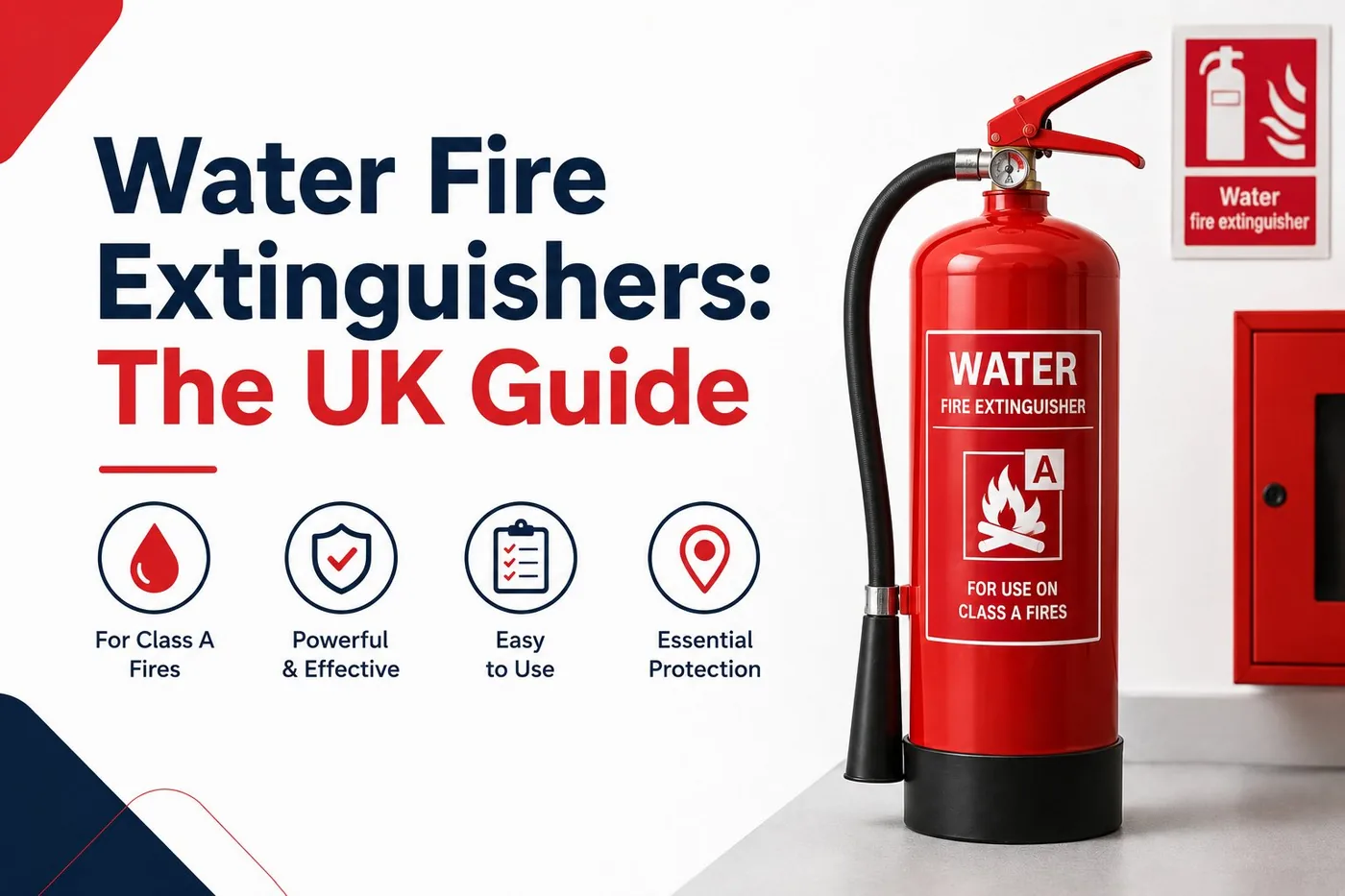
The red-labelled water fire extinguisher is the simplest and most common type in UK premises. It tackles Class A fires — wood, paper, fabric, and most plastics — and it does so by removing the heat side of the fire triangle. No clever chemistry, no chemical residue, no expensive servicing complications. It is the default choice for offices, schools, hotels, hospitals and dwellings, and it is usually the first extinguisher someone reaches for when they think “fire extinguisher.”
This page covers what a water extinguisher actually does, where it belongs, the boundaries that genuinely matter (electrical, flammable liquids, cooking oil), and how water mist fits in as a modern variant.
What a water fire extinguisher is
A standard water extinguisher is a stored-pressure unit containing water — sometimes plain water, sometimes water with an additive that lowers the surface tension and lets it penetrate burning material more effectively. The body is signal red. The label is also red, sometimes with a white “WATER” panel.
Note one detail that confuses people: the contrasting colour panels on other extinguisher types (cream for foam, blue for powder, black for CO2, yellow for wet chemical) sit on a red body. Water extinguishers are red without a contrasting colour panel — the absence of a colour panel is itself the marker. That is why you sometimes hear water extinguishers described as having “no panel” or “just the red label.”
Water extinguishers are tested and rated under BS EN 3, the British and European product standard, and their selection and positioning is governed in UK premises by BS 5306-8:2023.
How water extinguishers work
Water puts out a fire by cooling. When you spray water onto a burning solid, the water absorbs heat from the fuel and turns into steam. Each kilogram of water that vaporises absorbs roughly 2,260 kilojoules of energy in the process — that is the latent heat of vaporisation, and it is by far the largest energy sink involved.
In practice that means a water extinguisher works by getting water onto the fuel surface fast enough that the fuel temperature drops below its ignition point, breaking the fire’s chain reaction. The steam generated also displaces some of the air around the fire, contributing a small smothering effect, but cooling is doing most of the work.
The mechanism is why water is so effective on Class A fires: solid combustibles — wood, paper, fabric — absorb water readily and cool quickly when wetted. It is also why water is so dangerous on the things it shouldn’t be used on, where the same physics goes wrong.
What water extinguishers tackle
Class A fires only. The standard list of fuels covered:
- Wood, timber, plywood
- Paper, cardboard, files, books
- Textiles — clothing, upholstery, curtains, bedding
- Most soft plastics and rubber
- Coal and similar solid fuels
- Furniture, packing materials, general office combustibles
In a typical UK office or domestic setting, that covers something like 80% of the fire risk by volume. Which is why a water extinguisher (or in many premises a foam extinguisher, which also covers Class A) is the standard primary unit.
The fire rating to look for is something like 13A — a 9 L water extinguisher typically achieves 13A, meaning it has been tested to handle a stack of timber of a specified size in controlled conditions. Larger numbers mean larger fires; the rating is a calibrated benchmark, not a guarantee that any given fire will be put out.
What water extinguishers must never be used on
This is where the rules tighten. Water is not a universal extinguisher, and using it outside its lane is genuinely dangerous.
Live electrical equipment
Water conducts electricity. Spray a standard water extinguisher onto a live circuit and you have created a path back to the user — electrocution risk is real and immediate. The exception is dielectrically tested water mist (covered below); a standard water extinguisher should be assumed unsafe on anything energised.
Flammable liquids (Class B)
Water is denser than petrol, diesel, and most other flammable liquids. Spray water onto a burning pool of fuel and the water sinks below the burning layer, where it instantly turns to steam. The steam expansion ejects the burning fuel upwards and outwards in a fireball — what was a contained fire becomes a much larger one. The right answer for flammable liquid fires is foam, CO2, or dry powder; see our guide on the right extinguisher for flammable liquids.
Cooking oil (Class F)
The same physics, much worse. A pan of cooking oil is hot — often above 300°C when burning. Water hitting it vaporises explosively, throwing burning oil across the room. Chip pan fires fed water are the classic UK kitchen disaster; the resulting flames can reach the ceiling. Use a fire blanket for small fires, or a wet chemical extinguisher for anything bigger. The detail is on our guide for cooking oil fires.
Combustible metal fires (Class D)
Water can react chemically with hot metal — magnesium, sodium, lithium — generating hydrogen gas and worsening the fire. Class D needs specialist L2 or M28 dry powder.
In summary: water for Class A only. For everything else, the right answer is somewhere else in the five UK fire extinguisher types.
Water with additive (sometimes called hydrospray)
Some water extinguishers contain water plus a chemical additive that lowers the water’s surface tension. This makes the spray “stickier” — it adheres to vertical surfaces more readily and penetrates burning fabrics, upholstery and wood more effectively than plain water. The agent inside is sometimes called a hydrospray or water-with-additive.
The fire rating is normally higher than for an equivalent volume of plain water — a 6 L water-with-additive extinguisher might match the rating of a 9 L plain water unit. That means a smaller, lighter unit can do the same job, which is useful where space or accessibility matters.
For Class A fires, the difference between plain water and water-with-additive is mostly about effectiveness per litre. Both are still water at the chemistry level; both are still unsafe on electrics, oil and flammable liquids.
Water mist — the modern variant
Water mist is the most significant development in water-based extinguishers in the last twenty years. Instead of a bulk water jet, a water mist extinguisher uses de-ionised water and a supersonic nozzle to produce a cloud of microscopic droplets.
Three things change as a result. First, the droplets evaporate faster and absorb more heat per volume of water — cooling improves. Second, the rapid steam generation displaces oxygen around the fire, adding a smothering component. Third, and most importantly, the de-ionised water plus the dispersed droplet pattern means the discharge does not conduct electricity in the way bulk water does.
That third point unlocks a new use case. A water mist extinguisher that has been dielectrically tested can be used on live electrical equipment up to 1000 V at a distance of at least 1 metre. Some models are also rated for small Class F (cooking oil) fires. A single water mist unit with the right rating can therefore handle Class A, live electrical, and small Class F — a multi-purpose option that suits offices, holiday lets, small retail premises, and domestic kitchens.
Two reservations. Water mist costs more than a plain water unit. And the dielectric and Class F ratings only apply to specific tested models — not all water mist extinguishers carry both, so the label is the only thing to trust. Always check.
Where water extinguishers belong
Typical UK placements:
Offices
A water extinguisher (or foam, which also covers Class A) at each fire point, paired with a CO2 unit for electrical risk. The Class A capacity matters: paper and furniture make up most of the fuel.
Schools, hospitals, hotels
Same pattern — water for Class A, CO2 for electrical, with wet chemical added in catering kitchens.
Warehouses storing organic materials
Larger water extinguishers (typically 9 L, 13A), supplemented as the fire risk assessment requires.
Dwellings
Water extinguishers are uncommon in domestic settings — a fire blanket in the kitchen and working smoke alarms are the priorities. If you do want a domestic extinguisher, water mist or a small dry powder unit is more versatile.
UK capacities are typically 3, 6 and 9 litres. Higher-capacity wheeled units exist for industrial premises. Freeze-protected models are available where extinguishers are kept in unheated buildings or outdoors — relevant in stable yards, agricultural buildings and similar.
How to use a water extinguisher
The standard PASS technique applies — Pull, Aim, Squeeze, Sweep — but a few water-specific notes:
- Aim at the base of the fire, where the fuel is, not at the flames above.
- Sweep across the burning area, then concentrate on hot spots after the visible flames go out. Wood and fabric retain heat and can re-ignite from embers if the cooling is incomplete.
- For a fire spreading vertically (curtains, wall panel) start at the base and work upwards as the fire diminishes.
- Expect water on the floor afterwards. A 9 L extinguisher empties about 9 litres of water in roughly 40 seconds.
- After use, replace or recharge. A discharged extinguisher with no residual pressure is no use to anyone, and partial use still requires a recharge under BS 5306-3:2017.
For the full step-by-step, see our PASS technique guide.
Servicing
Water extinguishers fall into the same maintenance schedule as foam, dry powder and wet chemical: monthly visual checks by the responsible person on site, an annual basic service by a competent person (typically BAFE SP101-registered), and an extended service every 5 years. The detail is on our fire extinguisher servicing and inspection page.
The one water-specific watch-point: corrosion. Water extinguishers spend their service life full of liquid, and the inside of the cylinder is exposed to it. A unit that has been knocked, or that shows external corrosion, should be flagged at the next service. Internal corrosion is one of the more common end-of-life findings.
Frequently asked questions
What fires can a water extinguisher tackle?
Class A only — solid combustibles like wood, paper, textiles and most plastics. It works by cooling the fuel below its ignition temperature.
Can I use a water extinguisher on an electrical fire?
A standard water extinguisher, no — water conducts electricity. The exception is a dielectrically tested water mist extinguisher, which can be used on live equipment up to 1000 V at 1 metre, but only if the dielectric rating is on the label.
What’s the difference between water and water mist?
A water extinguisher fires bulk water as a jet or spray. A water mist extinguisher uses de-ionised water and a fine mist of microscopic droplets. The mist evaporates faster, doesn’t conduct electricity, and (in tested units) can be used on live electrical equipment and small Class F fires — a single multi-purpose option.
What size water extinguisher do I need?
For most UK premises, a 6 L or 9 L water extinguisher per fire point, with the exact mix dictated by your fire risk assessment and BS 5306-8:2023 coverage rules. Smaller (3 L) units suit smaller premises and tighter spaces.
How often does a water extinguisher need servicing?
Monthly visual checks by the responsible person, an annual basic service by a competent person, an extended service every 5 years. Same schedule as foam, powder and wet chemical.
How long does a water fire extinguisher last?
With proper servicing, a water extinguisher typically remains in service for at least 20 years, replaced as the cylinder shows wear or corrosion. The 5-year extended service is the main checkpoint; a unit that fails a discharge test or shows internal corrosion is replaced rather than recharged.
Where this connects
If you are working out which extinguisher mix your premises needs, the hub guide on fire extinguisher types gives the full picture, and our page on the foam fire extinguisher covers the closest alternative for Class A coverage. For the surrounding compliance picture, see fire extinguisher servicing and who is responsible for fire extinguishers in UK workplaces.
If your team needs the basics of fire safety — what to do when the alarm sounds, when to use an extinguisher, when not — the online fire safety awareness training course covers it in 90 minutes.
Related guides
- Who Is Responsible for Fire Extinguishers in the UK?
- Fire Extinguisher Disposal: The UK Guide
- Fire Extinguisher Servicing and Inspection: The UK Guide
Make sure your team knows what to do when the alarm sounds — and when to reach for an extinguisher.
Explore the Fire Safety Awareness Training course →
Mark writes about workplace fire safety, fire awareness and accredited online training for Fire Safety Awareness Training, part of Online CPD Academy.