
Barbecues start thousands of fires across the UK every summer, and a stubborn share of them are caused by the cheap disposable trays sold for a few pounds at petrol stations and supermarkets. This page gathers the UK barbecue fire statistics in one referenced place, drawing on the sources that actually count these incidents: MHCLG’s official incident-level “Fires by barbecue” dataset for England (published July 2025), the quarterly FIRE0303 outdoor-fire tables, Freedom of Information rounds compiled by Safety Group UK and Vonhaus, London Fire Brigade’s annual spring warning, and the RoSPA / Children’s Burns Trust child-burns figures. The data period is stated next to every figure, and — importantly — we keep the official England count and the UK-wide FOI counts clearly separate, because they use different respondents and definitions and must never be added together.
Key facts and figures
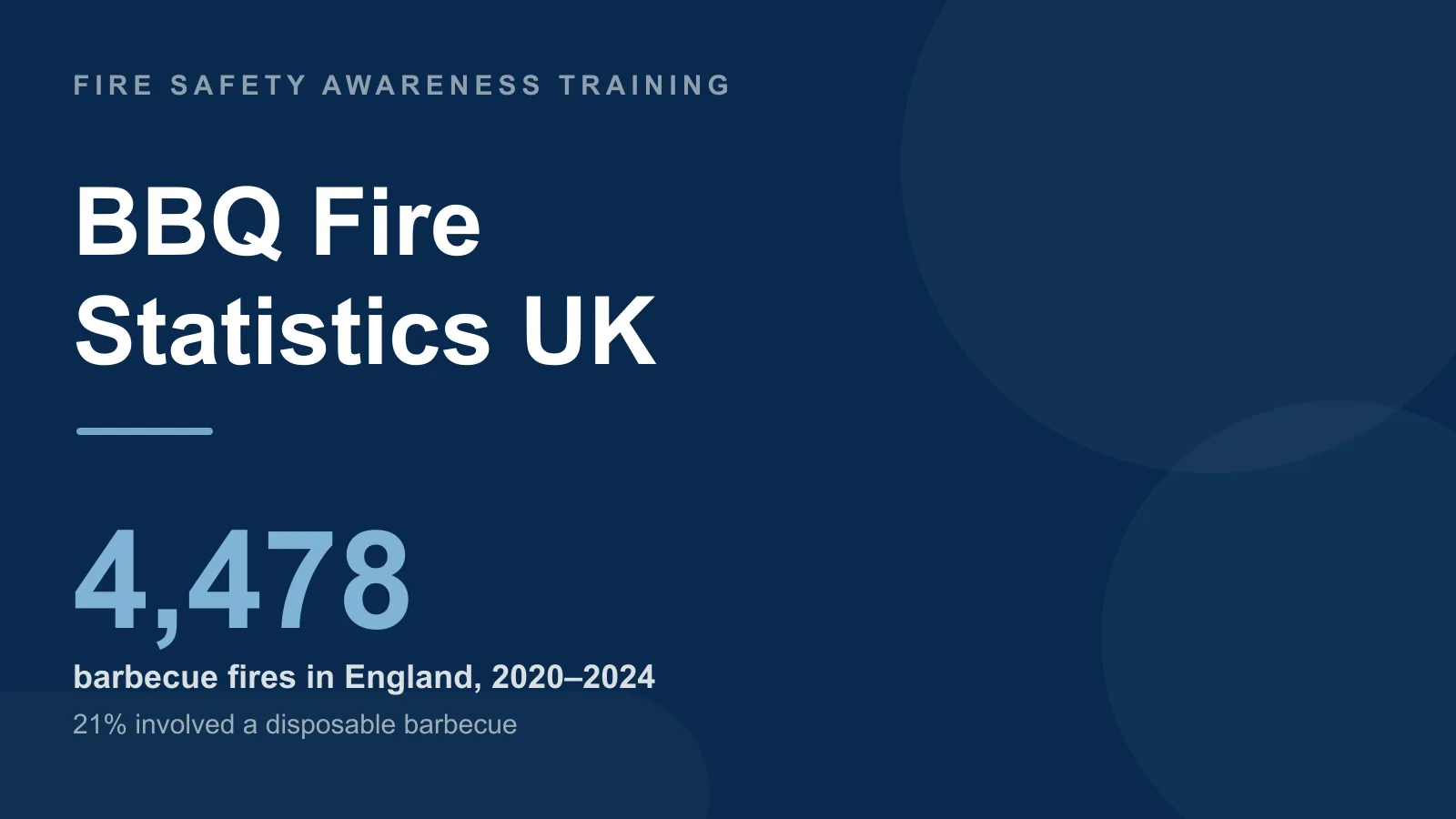
- 4,478 barbecue-caused fires were attended by fire and rescue services in England between 2020 and 2024 (MHCLG incident-level dataset).
- 46% fall in annual barbecue fires in England, from the 1,186 lockdown peak in 2020 to 640 in 2024.
- 21% of those England fires (952 incidents) had “disposable barbecue” recorded in the incident text, 2020–2024.
- 3,983 barbecue-related fires were logged UK-wide in a separate FOI round covering 2022–2025, within 6,451 BBQ-related emergency incidents.
- 309 hospital admissions and 160 ambulance call-outs were linked to barbecue injuries across responding UK areas, 2022–2025.
- 215 under-19s were hospitalised in 2025 with serious barbecue-related burns — a 7% rise on 2024 (RoSPA & Children’s Burns Trust).
- 67 council fines were issued for barbecue misuse across responding UK councils — 37 of them by a single council — against roughly 4,000 fires.
- 166 of the England barbecue fires (3.7%) involved a fatality or casualty, 2020–2024.
These are the latest published figures as of July 2026. The core England source — MHCLG’s incident-level barbecue dataset — is an ad hoc release re-pulled each summer (the current edition covers calendar years 2020 to 2024, published 10 July 2025); the FIRE0303 outdoor-fire tables update quarterly, London Fire Brigade issues its barbecue warning each April, and journalists run fresh FOI rounds each July. This page is updated when new data lands.
How many fires are caused by barbecues in the UK each year?
4,478 barbecue-caused fires were attended in England over the five years 2020 to 2024, according to MHCLG’s incident-level “Fires by barbecue” dataset — an average of roughly 900 a year, though the trend is firmly downwards. Annual fires fell 46% across the period: 1,186 in 2020, 917 in 2021, 981 in 2022, 754 in 2023 and 640 in 2024. The 2020 spike reflects the first Covid lockdown, when household barbecuing surged during a hot, confined spring and summer; the figure has more than halved since.
That England count is the most robust barbecue-fire figure available, because it is built from individual incident records rather than a survey. It should not be confused with the UK-wide FOI numbers further down this page: a separate Freedom of Information round put UK barbecue fires at 3,983 between 2022 and 2025, but that draws on a different set of responding services and a different time window, so the two cannot be summed or directly compared.
Why are disposable barbecues so dangerous?
952 of the 4,478 England barbecue fires — 21% — had “disposable barbecue” recorded in the incident text between 2020 and 2024. Disposable trays run hotter and longer than people expect, stay dangerous well after the food is cooked, and are routinely dumped while still smouldering. Fire services report them setting light to decking, dry grass, wheelie bins and balconies, and they are a repeat cause of countryside and moorland ignitions.
The balcony risk is stark: disposable barbecues were directly responsible for 21 balcony fires across the UK in the twelve months from 1 August 2020 to 31 July 2021, which — alongside repeated wildfire scares — prompted major retailers including M&S, Aldi and the Co-op to withdraw them from sale (the Co-op first pulled them from around 130 stores in and near national parks in June 2021). London’s Fire Commissioner has repeatedly called for an outright ban, and the National Fire Chiefs Council worked with the British Retail Consortium on voluntary retailer guidelines in 2023.
One cross-reference worth flagging: as a countryside ignition source, discarded disposable barbecues are a significant cause of grass, heath and moorland wildfires — but those wildfire and moorland fire counts belong on our dedicated UK wildfire statistics page rather than here. This page covers garden and domestic barbecue incidents and BBQ burn injuries.
How many people are injured in BBQ accidents in the UK?
Barbecue injuries were behind 309 hospital admissions and 160 ambulance call-outs across responding UK areas between 2022 and 2025, according to the Safety Group UK Freedom of Information round reported by the International Fire & Safety Journal. The admissions cluster heavily in a few trusts — Sandwell and West Birmingham Hospitals NHS Trust alone admitted 49 patients — a reminder that these are serious injuries, not scorched fingers.
Children are hit hardest. The RoSPA and Children’s Burns Trust annual Bank-Holiday warning reported that 215 under-19s were hospitalised in 2025 with serious barbecue-related burns needing specialist treatment — a 7% rise on 2024, with hundreds more treated for less severe injuries. Young children are burned not only by the flames but by the barbecue itself long after cooking: metal grills and disposable trays stay hot enough to cause deep contact burns for a considerable time after the coals appear to have died down. Within the official England dataset, 166 barbecue fires (3.7%) involved a fatality or casualty over 2020–2024 — the fire-attended subset, separate from the wider hospital and ambulance figures above.
What kind of fires do barbecues actually cause?
2,506 of the 4,478 England barbecue fires — 56% — were secondary fires: grass, rubbish and bin fires with no significant property loss, per the MHCLG dataset (2020–2024). But a substantial minority reach buildings: 693 barbecue fires hit dwellings, 613 struck other buildings, and 85 involved road vehicles. That split matters, because it shows barbecue fires are not only an outdoor nuisance — around one in six reached someone’s home.
The most-damaged property types across 2020–2024 were outdoor fittings and storage (504 incidents), garden sheds (294), wheelie bins (236) and fences (117), according to Norton Insurance Brokers’ analysis of the MHCLG records. In other words, the typical barbecue fire is a garden fire that catches a shed, a fence or a bin — occasionally spreading to the house behind it.
| Measure | Figure | Period and source |
|---|---|---|
| Barbecue fires attended (England) | 4,478 | 2020–2024 — down 46% peak to 2024 (MHCLG dataset) |
| Fires involving a disposable barbecue | 952 (21%) | 2020–2024 (MHCLG dataset) |
| Secondary fires (grass, bins, rubbish) | 2,506 (56%) | 2020–2024 (MHCLG dataset) |
| Fires reaching dwellings | 693 | 2020–2024 (MHCLG dataset) |
| Fires with a fatality or casualty | 166 (3.7%) | 2020–2024 (MHCLG dataset) |
| UK barbecue fires (FOI, separate) | 3,983 | 2022–2025 (Safety Group UK FOI) |
| Hospital admissions for BBQ injuries | 309 | 2022–2025 (Safety Group UK FOI) |
| Under-19s hospitalised with BBQ burns | 215 | 2025 — up 7% on 2024 (RoSPA / Children’s Burns Trust) |
Which UK areas have the most barbecue fires?
The answer depends on which dataset you use — and they genuinely disagree, for reasons worth understanding. On the official England incident data (all rows, 2020–2024), the areas with the most barbecue fires were Greater Manchester (472), West Yorkshire (407), Lancashire (267) and Merseyside (224). Ranked by the single most recent year (2024), the top areas were Greater London (61), Greater Manchester (58), West Yorkshire (51), Lancashire (37), and Hampshire & Isle of Wight (33). Greater Manchester’s barbecue fires actually fell 56% over the period, from 132 in 2020 to 58 in 2024 (Norton Insurance analysis).
The FOI league tables tell a different story. In the Vonhaus round (2022–2024, fewer services responding), South Yorkshire topped the table with 155 BBQ call-outs, ahead of West Yorkshire (115) and the West Midlands (86); Tyne & Wear logged 37 disposable-barbecue call-outs, 8 of them from barbecues dumped in bins. And in the Safety Group UK FOI, the Scottish Fire and Rescue Service attended the most BBQ fires of any single service (627, with 8 casualties), while London Fire Brigade recorded the most casualties (17 across 332 fires).
| Ranking basis | Top areas | Source and period |
|---|---|---|
| Official England, all rows | Greater Manchester 472, West Yorkshire 407, Lancashire 267, Merseyside 224 | MHCLG dataset, 2020–2024 |
| Official England, latest year | Greater London 61, Greater Manchester 58, West Yorkshire 51, Lancashire 37 | MHCLG dataset, 2024 |
| UK FOI (partial response) | South Yorkshire 155, West Yorkshire 115, West Midlands 86 | Vonhaus FOI, 2022–2024 |
| Single service, most fires | Scottish Fire & Rescue 627 fires (8 casualties) | Safety Group UK FOI, 2022–2025 |
Why the rankings clash — the methodology caveat you should always state. The official MHCLG figures come from a free-text search of incident records, and only 33 of the 44 English fire and rescue services returned a result for the “disposable barbecue” search. Crucially, Greater London does not populate that free-text field, so the official dataset undercounts London on the disposable-BBQ measure specifically — which is exactly why the FOI tables (which capture London and Scotland directly) rank regions so differently. Neither is “wrong”; they measure slightly different things. The honest presentation is to show both and explain the gap, rather than silently pick the ranking that reads best.
When do barbecue fires happen?
London firefighters attended 127 barbecue-caused fires in April and May alone across 2020–2025 — the steepest seasonal spike of the year, according to London Fire Brigade’s spring warning (issued 23 April 2026). Barbecue fires are overwhelmingly a warm-weather phenomenon: the first sunny Bank Holiday weekend, an unexpected heatwave, or a dry spell that leaves grass and heath tinder-ready all send the incident count sharply upward. That is why the brigade times its warning for April, ahead of the season, and why RoSPA and the Children’s Burns Trust run their child-burns campaign around the late-May Bank Holiday. Councils with popular parks and beaches also introduce Public Spaces Protection Orders banning barbecues in dry conditions — though enforcement is thin, as the next section shows.
Is anyone being fined for barbecue fires?
Against roughly 4,000 barbecue fires, responding UK councils issued just 67 fines for barbecue misuse — and 37 of those came from a single authority, Brighton & Hove. Police made 35 arrests over the same period (Safety Group UK FOI, 2022–2025). Set beside 309 hospital admissions and thousands of fires, that is a striking enforcement gap: barbecue misuse is widespread, seasonal and damaging, yet formal penalties are rare and heavily concentrated in a handful of councils that actively patrol their parks and seafronts. It helps explain why fire services and burns charities lean so hard on prevention — and why the policy debate keeps returning to the point of sale, where retailer withdrawals and the voluntary NFCC / British Retail Consortium guidelines aim to cut the risk before a disposable barbecue is ever lit.
Do these figures cover the whole of the UK?
No single published figure covers the whole UK on a consistent basis — which is the single most important thing to understand about barbecue statistics. The official incident-level dataset (4,478 fires) covers England only, 2020–2024, and is built from individual fire records. The UK-wide numbers (3,983 fires, 6,451 incidents) come from Freedom of Information requests to individual fire services, where not every service responds and definitions vary between forces. A partial-response FOI can therefore report far fewer fires than the official England count for an overlapping period — one 2022–2024 FOI logged only a few hundred disposable-BBQ incidents against the official England figure of thousands — simply because fewer services answered.
The rule this page follows, and the one you should apply when citing barbecue statistics: label each figure as either England-official (MHCLG, 2020–2024) or UK-wide FOI (2022–2025), state the period, and never add or blend the two. They are different measurements of an overlapping problem.
What do fire services advise?
Given that disposable barbecues alone accounted for one in five England barbecue fires, the advice from UK fire and rescue services is consistent. Never use a barbecue indoors, in a tent or awning, or on a balcony — even a cooling barbecue gives off carbon monoxide, which is why fire services and coroners repeatedly warn against bringing one inside to keep warm. Site it on level ground away from sheds, fences, decking and dry grass; keep children, pets and loose clothing well back; and never leave it unattended. Disposable barbecues in particular must be cooled completely — poured over with water until cold — before they go anywhere near a bin.
The carbon monoxide angle deserves emphasis in its own right: our companion page on carbon monoxide poisoning statistics sets out how many people are harmed each year by CO, including from barbecues brought into tents and homes. And because a barbecue fire that reaches the house is a fast-moving event, a working smoke alarm remains the difference between a scare and a tragedy — see our page on smoke alarm statistics.
Full home barbecue safety guidance sits outside the scope of this statistics page — for the how-to, the practical fire-prevention behaviours that cut everyday ignition risk are exactly what our online Fire Safety Awareness Training course is built around. For workplaces — pubs and restaurants with beer-garden grills, holiday parks, event caterers and hospitality venues — barbecue and outdoor-cooking risk belongs in the fire risk assessment, and trained staff are part of the control measures the Responsible Person must provide.
Frequently asked questions
How many fires are caused by barbecues in the UK each year?
In England, barbecues caused 4,478 fires over 2020–2024 — an average of around 900 a year, falling from 1,186 in 2020 to 640 in 2024 (MHCLG incident-level dataset). A separate UK-wide FOI round logged 3,983 barbecue fires across 2022–2025, but that uses different respondents and a different period, so the two figures should not be added or directly compared.
How many people are injured in BBQ accidents in the UK?
Barbecue injuries were linked to 309 hospital admissions and 160 ambulance call-outs across responding UK areas in 2022–2025 (Safety Group UK FOI). Separately, 215 under-19s were hospitalised in 2025 with serious barbecue-related burns needing specialist treatment — a 7% rise on 2024 (RoSPA / Children’s Burns Trust).
Why are disposable barbecues so dangerous?
They run hotter and longer than people expect, stay dangerous after cooking, and are often dumped while smouldering. Disposable barbecues appeared in 21% of England’s barbecue fires (952 of 4,478) over 2020–2024, caused 21 UK balcony fires in a single year, and are a repeat wildfire ignition source — which is why M&S, Aldi and the Co-op withdrew them from sale and London’s Fire Commissioner has called for a ban.
Which UK areas have the most barbecue fires?
It depends on the dataset. On official England data (2020–2024), Greater Manchester (472), West Yorkshire (407) and Lancashire (267) top the list. FOI rounds rank areas differently — South Yorkshire led one round (155), and the Scottish Fire and Rescue Service attended the most of any single service (627). The official data undercounts London because Greater London does not populate the free-text disposable-barbecue field, so the rankings legitimately diverge.
Are barbecue fires rising or falling?
Falling, on the official England series: annual barbecue fires dropped 46% from the 2020 lockdown peak (1,186) to 640 in 2024. The 2020 spike reflected the first Covid lockdown; the trend since has been steadily downward, though warm Bank Holidays and heatwaves still drive sharp seasonal spikes.
Where do UK barbecue fire statistics come from?
The core source is MHCLG’s ad hoc “Fires by barbecue” incident-level dataset for England (2020–2024, published July 2025), supported by the quarterly FIRE0303 outdoor-fire tables. UK-wide detail comes from FOI rounds (Safety Group UK, Vonhaus), London Fire Brigade’s annual spring warning, and the RoSPA / Children’s Burns Trust child-burns figures. Each is labelled by period and respondent set on this page.
Related guides
- Wildfire Statistics UK: Grass, Heath & Moorland Fires
- Carbon Monoxide Poisoning Statistics UK: Deaths, Incidents & Alarms
- Cooking Fire Statistics UK: Kitchen & Hob Fires
- Smoke Alarm Statistics UK: Ownership, Failures & Lives Saved
- UK Fire Classes Explained: A, B, C, D, F (and L)
- How to Use a Fire Extinguisher: The PASS Method Explained
Sources & references
- MHCLG — Fires by barbecue dataset, England, 2020 to 2024 (incident-level release, published 10 July 2025)
- MHCLG — Fire statistics data tables, table FIRE0303: outdoor primary and secondary fires (year ending December 2025 edition)
- International Fire & Safety Journal — Safety Group UK FOI: over 3,900 barbecue incidents since 2022 (July 2025)
- NationalWorld — Vonhaus FOI: top UK areas most affected by BBQ-related fires (July 2025)
- Norton Insurance Brokers — UK regions with the most barbecue accidents (analysis of MHCLG IRS data, July 2025)
- London Fire Brigade — Barbecue fires expected to spike in spring: firefighters’ tips (April 2026)
- London Fire Brigade — Ban disposable BBQs now, says London fire chief (July 2022)
- National Fire Chiefs Council & British Retail Consortium — Voluntary retailer guidelines on disposable barbecues (July 2023)
- Scottish Fire and Rescue Service — Barbecue safety guidance
Barbecues cause thousands of fires and hundreds of hospital admissions a year — get every employee fire aware in around 90 minutes.
Explore the Fire Safety Awareness Training course →
Mark writes about workplace health & safety, fire safety awareness and accredited online training for Fire Safety Awareness Training, part of Online CPD Academy.