
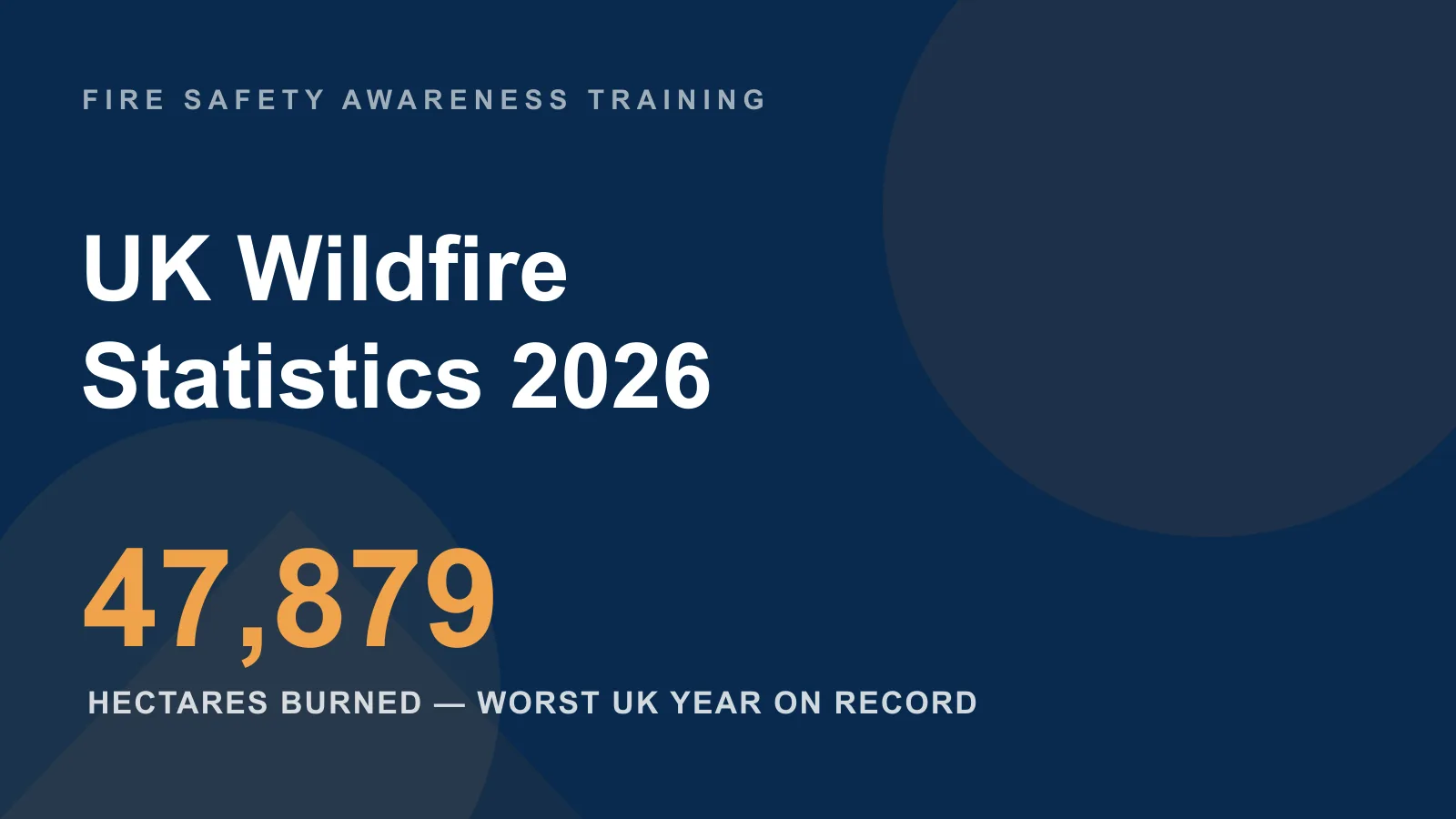
2025 was confirmed as the worst wildfire year on record in the UK, with 47,879 hectares of countryside burned — an area more than twice the size of Glasgow, and over 19,000 hectares beyond the previous record set in 2019. This page gathers the key UK wildfire statistics on incidents, burned area, causes and records in one place, with every figure cited to its source. The data comes principally from the EU Joint Research Centre’s satellite monitoring (GWIS/EFFIS), the National Fire Chiefs Council (NFCC), MHCLG’s fire and rescue incident statistics for England, the Scottish Fire and Rescue Service, and analysis by Carbon Brief and the House of Lords Library.
Key facts and figures
- 47,879 hectares burned across the UK in 2025 — the worst wildfire year on record, more than 19,000 ha above the previous 2019 record (GWIS satellite data, reported November 2025).
- 996 wildfires had been attended in England & Wales by 4 September 2025, passing 2022’s full-year record of 994 (NFCC, September 2025).
- 717% increase in early-season wildfires: 564 attended in England & Wales to 19 June 2025, up from 69 in the same period of 2024 (NFCC, June 2025).
- 181 UK fires larger than 30 hectares were recorded in 2025 — 30 more than the previous record set in 2022 (GWIS data, reported November 2025).
- Almost 12,000 hectares burned in the Carrbridge and Dava Moor fires of late June 2025 — the largest wildfire event ever recorded in the UK (SFRS / Scottish Government, 2025-26).
- “Most” to “virtually all” UK wildfires are caused by human activity, both accidental and deliberate — natural ignitions such as lightning are rare (NFCC, June 2025; Natural England, September 2025).
- 99.5% of England’s wildfires burn less than one hectare, and 53% are 5 square metres or smaller (Forestry Commission, February 2023).
- 230+ separate wildfires and more than 100 firefighting days made 2025 Scotland’s most severe wildfire season on record (SFRS, March 2026).
Figures are the latest available as of July 2026, and this page is updated when new data is released — principally MHCLG’s quarterly outdoor-fire statistics for England, NFCC updates during each summer heatwave, and near-real-time GWIS/EFFIS burned-area data through the season, with SFRS publishing an annual Scottish season review.
How many wildfires were there in the UK in 2025?
Fire and rescue services in England & Wales had attended 996 wildfires by 4 September 2025, passing 2022’s previous full-year record of 994 incidents with almost four months of the year still to run, according to the National Fire Chiefs Council. It was a record broken not late in a long hot summer but by early autumn, after a fire year that started abnormally early.
The early-season surge was extraordinary. 564 wildfires were attended in England & Wales between 1 January and 19 June 2025 — up from 69 in the same period of 2024, a 717% increase, per NFCC figures released in June. A warm, dry spring left vegetation tinder-dry months ahead of the usual peak, and the burned-area record for the whole of 2025 was overtaken as early as late April, according to Carbon Brief’s analysis, which flagged the milestone alongside NFCC’s urgent public warnings in April.
The satellite record tells the same story from orbit. The EU’s Global Wildfire Information System (GWIS) recorded 47,879 hectares burned across the UK in 2025 — the worst on record and more than 19,000 hectares above the 2019 high — with 181 fires larger than 30 hectares, 30 more than the previous record of 2022, according to GWIS/EFFIS data reported in November 2025. That is an area roughly twice the size of Glasgow reduced to ash in a single fire year.
What causes most wildfires in the UK?
Most wildfires in the UK are caused by human activity, some accidental and some deliberate — that is the settled position of the National Fire Chiefs Council, echoed by the House of Lords Library in its June 2025 briefing. Natural England puts it more strongly still, stating that “virtually all” wildfires in England are started by people, in its September 2025 analysis of the role of nature in resisting the spark. Natural ignitions such as lightning are rare in the UK’s temperate climate.
The headline preventable causes are the familiar ones of a British day out in the countryside: disposable barbecues, discarded cigarettes, campfires and glass left to focus the sun. These are the accidental sparks that a dry spell turns into a moorland fire. Preventing them is a matter of individual awareness far more than firefighting capacity — which is why NFCC’s record-year statements pair the incident counts with direct public safety advice.
A share of wildfires are set deliberately. Deliberate fire-setting — the arson dimension of the cause split — is tracked separately from these ignition statistics; for the wider picture on deliberate fires and prosecutions, see the arson coverage on our sister site Fire Marshal Training. On this page the frame is prevention of the accidental spark, which the official sources agree is where most UK wildfires begin.
Two related domestic-ignition topics sit on their own pages rather than here. Garden and back-yard barbecue fires — as opposed to open-countryside blazes — are covered in our BBQ fire statistics UK page, and the seasonal indoor-ignition story is on our candle fire statistics UK page.
What is the largest wildfire ever recorded in the UK?
The Carrbridge and Dava Moor fires of 28 June to 2 July 2025 burned almost 12,000 hectares of moorland, peatland and woodland in the Scottish Highlands — the largest wildfire event ever recorded in the UK, according to the Scottish Fire and Rescue Service and the Scottish Government. Firefighters reported flame lengths of up to 20 metres, and the fire drew in crews and resources from across the region over several days.
The scale of a single fire like Dava Moor is what pushes an entire year into record territory. It also underlines why the burned-area figure and the incident count tell different stories: the overwhelming majority of UK wildfires are tiny, but a handful of large moorland and peatland fires account for most of the hectares. The Forestry Commission’s wildfire statistics for England quantify that skew: 99.5% of England’s wildfires burn less than one hectare, and 53% are 5 square metres or smaller. (That report, published in February 2023, covers 2009-10 to 2020-21 and is the most recent in the series — the dedicated England wildfire series has since stalled, so it is used here for structure and long-run seasonality rather than for current annual totals.)
How do England and Scotland compare?
Wildfire statistics are devolved, and the two nations report the record year through different lenses. In England, primary outdoor fires rose 62% to 7,037 in the year ending December 2025 (from 4,352 the year before), and secondary fires — mostly small outdoor grass, refuse and vegetation fires — rose 46% to 107,283, according to MHCLG’s fire and rescue incident statistics for England. Across all fire types, English services attended 175,918 fires in the year ending December 2025, up 29% year on year, driven by the hot, dry summer.
Scotland had its most severe wildfire season on record. Scottish firefighters spent more than 100 days responding to more than 230 separate wildfires in 2025, according to SFRS, which in March 2026 unveiled a collaborative Strategic Action Plan on Wildfires in response. The Carrbridge and Dava Moor event alone accounted for a large share of the Scottish burned area. Wales, reported within the England & Wales NFCC totals above, followed the same record trajectory.
The headline UK wildfire measures for 2025 in one place:
| Measure | Figure | Data period / source |
|---|---|---|
| UK area burned (satellite) | 47,879 ha — worst on record | 2025 full year (GWIS) |
| Previous UK burned-area record | ~28,000 ha | 2019 (GWIS) |
| Wildfires attended, England & Wales | 996 (record) | To 4 Sep 2025 (NFCC) |
| Early-season wildfires, England & Wales | 564 (up 717% on 2024) | 1 Jan–19 Jun 2025 (NFCC) |
| UK fires larger than 30 ha | 181 (record) | 2025 full year (GWIS) |
| Largest single UK wildfire event | ~12,000 ha (Carrbridge / Dava Moor) | 28 Jun–2 Jul 2025 (SFRS) |
| Primary outdoor fires, England | 7,037 (up 62%) | Year ending Dec 2025 (MHCLG) |
| Secondary fires, England | 107,283 (up 46%) | Year ending Dec 2025 (MHCLG) |
The 2019 comparison figure is derived from the “more than 19,000 ha above the previous record” margin reported alongside the 2025 total; treat it as approximate.
When is UK wildfire season?
April is England’s peak wildfire month by area burned — over 25,000 hectares, or 31.9% of the 12-year total from 2009-10 to 2020-21, burned in Aprils, ahead of July on 22.2%, according to the Forestry Commission. The UK effectively has two wildfire peaks: a spring peak in March and April, when last year’s dead vegetation is dry and this year’s green growth has not yet come through, and a summer peak in high-heat, low-rainfall spells.
2025 shows why the spring peak matters so much. The 717% early-season jump and the late-April overtaking of the full-year burned-area record both fell in the spring window, before the conventional summer season had even begun. A wildfire season, in other words, is not fixed to July and August: it is whenever the ground is dry, and in a changing climate that window is widening at both ends.
Over the long run, the Forestry Commission recorded more than 360,000 wildfire incidents in England across the 12 years to 2020-21 — an average of over 30,000 a year — burning just over 79,000 hectares in total. That long-run baseline is what makes the single-year 2025 UK figure of 47,879 hectares so striking: one bad year came close to two-thirds of England’s entire burned area across the preceding twelve.
How can wildfires be prevented?
Because virtually all UK wildfires start with a human spark, prevention is overwhelmingly a matter of behaviour rather than firefighting. The measures the fire and rescue services and countryside bodies repeat every record season are simple: do not use disposable barbecues or light campfires on or near open countryside, moorland or heath, especially in dry conditions; take cigarettes and glass home rather than leaving them; and heed local fire severity warnings and any temporary bans during heatwaves.
For land managers and employers whose sites border open land, the same logic applies at scale — firebreaks, controlled fuel-load management, and staff who understand how a countryside ignition starts and spreads. Early detection matters too: the faster a small grass fire is spotted and reported, the smaller the chance it becomes another Dava Moor. Awareness is the cheapest and most effective line of defence, which is where basic fire safety training earns its place.
Frequently asked questions
How many wildfires were there in the UK in 2025?
Fire services in England & Wales attended 996 wildfires by 4 September 2025, passing 2022’s full-year record of 994, according to the NFCC. Satellite monitoring recorded 47,879 hectares burned across the UK over the year — the worst on record — including 181 fires larger than 30 hectares.
What causes most wildfires in the UK?
Human activity, both accidental and deliberate. The NFCC states that most UK wildfires are human-caused, and Natural England says virtually all are started by people — disposable barbecues, discarded cigarettes, campfires and glass are the headline preventable causes. Natural ignitions such as lightning are rare.
What is the largest wildfire ever recorded in the UK?
The Carrbridge and Dava Moor fires of 28 June to 2 July 2025, which burned almost 12,000 hectares of moorland, peatland and woodland in the Scottish Highlands with flame lengths up to 20 metres — the largest wildfire event ever recorded in the UK, according to SFRS and the Scottish Government.
When is UK wildfire season?
The UK has two peaks: a spring peak in March and April, when dead vegetation is dry, and a summer peak during hot, dry spells. April is England’s single highest month by area burned (31.9% of the 12-year total). In 2025 the season started abnormally early, with the full-year burned-area record overtaken by late April.
Are UK wildfires getting worse?
On the record so far, yes. 2025 set new highs for UK burned area (47,879 ha), for fires over 30 hectares (181), for England & Wales incidents (996) and for Scotland’s season severity. The 2025 total came close to two-thirds of England’s entire burned area across the preceding twelve years, and the record has been broken repeatedly in recent years (2019, then 2022, then 2025).
Related guides
- BBQ Fire Statistics UK: Fires, Injuries & Seasonal Trends
- Candle Fire Statistics UK: Fires, Deaths & Seasonal Trends
- Smoke Alarm Statistics UK: Ownership, Failures & Lives Saved
- Carbon Monoxide Poisoning Statistics UK: Deaths, Incidents & Alarms
- UK Fire Classes Explained: A, B, C, D, F (and L)
Sources & references
All statistics on this page are drawn from the following official and industry sources:
- GWIS / EFFIS (EU Joint Research Centre) — UK burned-area satellite data
- National Fire Chiefs Council — wildfire incident counts and public-safety statements
- MHCLG — Fire and rescue incident statistics, England, year ending December 2025 (outdoor fires)
- Carbon Brief — Analysis: Record UK wildfires have burned an area twice the size of Glasgow in 2025
- House of Lords Library — Wildfires: reducing the risks and mitigating the effects
- Forestry Commission — Wildfire statistics for England, report to 2020-21
- Scottish Fire and Rescue Service — Scotland wildfire statistics & Strategic Action Plan on Wildfires
- Natural England — Wildfires: nature’s role in resisting the spark (causes and protected-sites impact)
Most wildfires start with a preventable human spark — and awareness is the cheapest defence. Get every employee fire aware in around 90 minutes, RoSPA approved and CPD certified.
Explore the Fire Safety Awareness Training course →
Mark writes about workplace health & safety, fire safety awareness and accredited online training for Fire Safety Awareness Training, part of Online CPD Academy.