
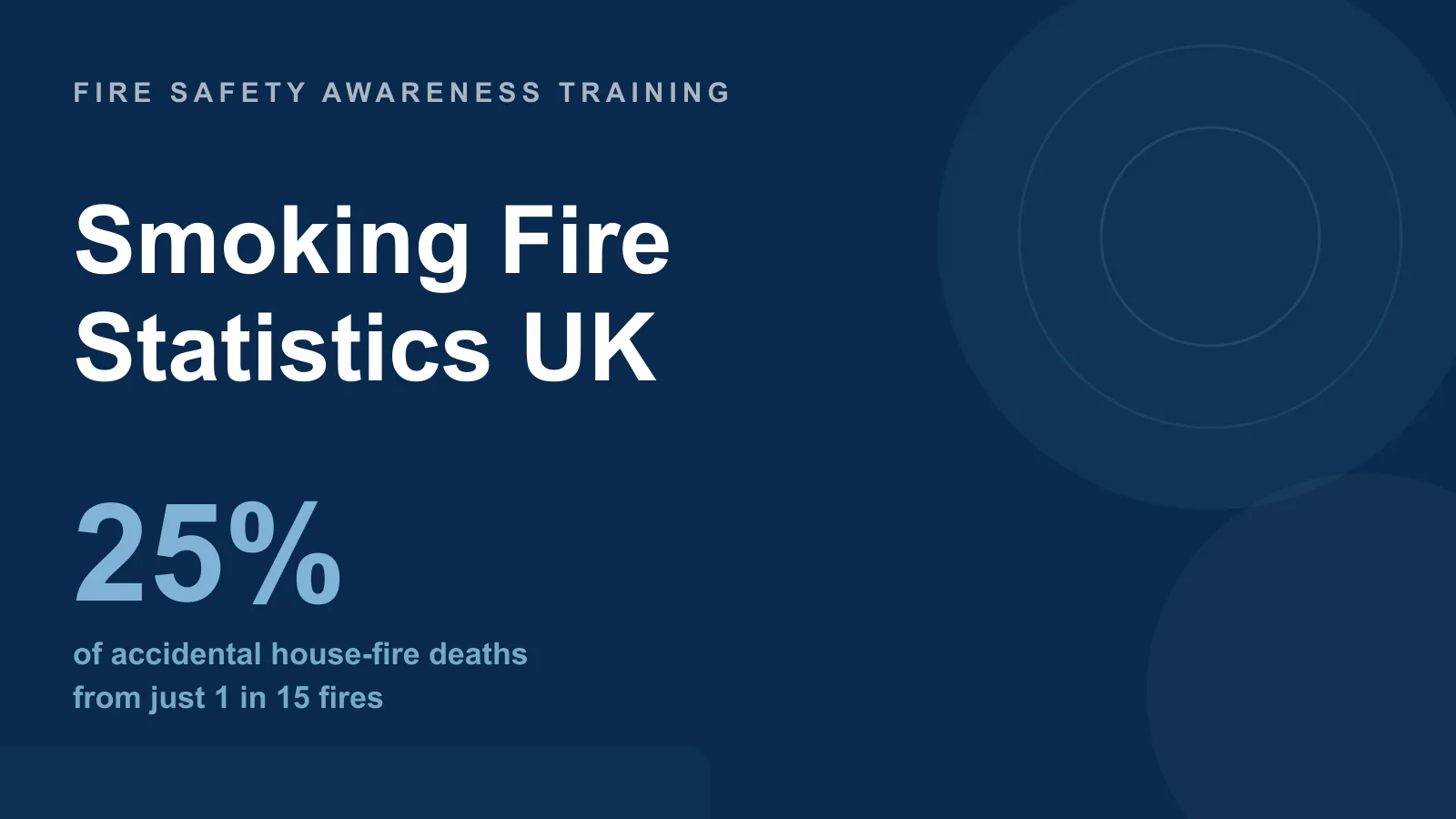
Smoking is now at a record low in the UK — only about one adult in ten still smokes cigarettes — yet a discarded cigarette remains the single deadliest way a house fire starts. Smokers’ materials cause a small fraction of accidental house fires but a quarter of the people killed in them, a disproportion that has held every year for well over a decade. This page gathers the key UK smoking fire statistics — fires, deaths, smoking in bed and the prevalence paradox — in one place, with every figure cited to its source. The data comes principally from the Ministry of Housing, Communities & Local Government (MHCLG) detailed analysis of fires in England and its FIRE0602 data tables, alongside the Welsh Government and Scottish Fire and Rescue Service incident statistics and the Office for National Statistics (ONS) adult smoking bulletin.
Key facts and figures
- 6.7% of accidental dwelling fires in England were started by smokers’ materials in the year ending March 2025 — roughly 1 in 15.
- 25% of accidental dwelling-fire deaths in England were caused by smokers’ materials — the largest single ignition source for fatalities.
- 48 people died in primary fires started by smokers’ materials in England in 2024/25, out of 271 fire-related deaths overall.
- Almost 880 people have died in smokers’-materials fires in England across the 15 years from 2010/11 to 2024/25.
- 44% vs 9.3% — cooking appliances cause 44% of accidental dwelling fires but only 9.3% of the deaths, the mirror image of smoking.
- 10.6% of UK adults — around 5.3 million people — still smoked cigarettes in 2024, the lowest proportion on record.
- +44% — smokers’-materials dwelling fires rose 44% in Wales in 2024-25 against the previous year.
- 36% — the share of accidental house-fire deaths the government blamed on cigarettes back in 2011, when it called them “the single biggest killer”.
Figures are the latest available as of July 2026, and this page is updated when new data is released — principally MHCLG’s detailed analysis of fires and the FIRE0602 data tables each autumn, with the Welsh Government and Scottish Fire and Rescue Service statistics and the ONS adult smoking bulletin in between.
How many fires are caused by smoking in the UK each year?
Smokers’ materials were the source of ignition in 6.7% of accidental dwelling fires in England in the year ending March 2025 — around 1,530 of the roughly 22,900 accidental dwelling fires that year (the count is derived from the percentage and should be treated as approximate), according to MHCLG’s detailed analysis of fires attended by fire and rescue services. Put another way, roughly one accidental house fire in fifteen starts with a cigarette, a cigar, a pipe or the paraphernalia around them.
That makes smoking a comparatively rare cause of fires. Cooking dominates the ignition-cause table by a wide margin, and misuse of electrical equipment and appliances accounts for far more incidents too. Smokers’ materials sit well down the list of how often fires start — which is exactly what makes their position at the top of the fatality table so striking. The reason for that gap is the subject of the next section.
The official series behind these numbers sits in MHCLG’s fire statistics data tables — table FIRE0602 records primary-fire fatalities and non-fatal casualties by source of ignition, and is refreshed through the year as quarterly updates land.
Why do smoking fires kill more people than cooking fires?
Smokers’ materials accounted for 25% of accidental dwelling-fire deaths in England in the year ending March 2025 — the largest single ignition source for fatalities, on MHCLG’s detailed analysis. So a cause behind roughly 1 in 15 fires is behind 1 in 4 of the deaths. The contrast with cooking is the clearest way to see the danger: cooking appliances caused 44% of accidental dwelling fires but only 9.3% of the deaths — 18 primary-fire fatalities in 2024/25, against 48 from smokers’ materials.
The mechanism is about how and where these fires start, not bad luck. A cooking fire usually ignites while someone is in the kitchen, awake and standing over it, so it is caught in its first seconds. A smoking fire behaves in the opposite way. A cigarette dropped into an armchair or bedding smoulders slowly and silently, often for a long time, and often while the smoker has fallen asleep or has impaired awareness. By the time it breaks into open flame it has a hold on upholstery and produces thick, toxic smoke fast — and the most common cause of death in fires is not burns but being overcome by gas or smoke, which killed 93 people (34% of all fire fatalities) in England in the year ending March 2025.
The people most exposed to that pattern are older smokers living alone, particularly those with reduced mobility, and anyone whose alertness is impaired — which is why fire and rescue services target “smoking at home” safe-and-well visits at exactly those households.
How many people die in smoking-related house fires in the UK?
48 people died in primary fires started by smokers’ materials in England in 2024/25, out of 271 fire-related fatalities in England overall that year, according to MHCLG’s FIRE0602 data table. It is not a one-off spike: the year before, smokers’ materials were again the largest single ignition source for fire deaths, with 45 fatalities in the year ending March 2024. The pattern holds in every single year of the series.
Widen the lens and the toll is sobering. Almost 880 people (879) have died in smokers’-materials fires in England across the 15 years from 2010/11 to 2024/25 — a figure derived by summing the annual FIRE0602 death counts. That is an average of nearly 60 lives a year lost to fires that a fully extinguished cigarette would have prevented.
A note on scope: the 271 total fire-related deaths and the wider national fatality trend are used here only as the denominator that makes the smoking share meaningful. We do not re-tell the national fire-death story on this page — our sister site covers the overall totals and long-run trend in its fire deaths UK statistics guide.
Is smoking still the leading cause of fatal house fires?
Yes — smokers’ materials remain the largest single ignition source for accidental dwelling-fire deaths in England, as they have been throughout the FIRE0602 series. The London Fire Brigade’s smoking safety guidance puts it plainly: smoking is the leading cause of fire fatalities in the home.
This is where the paradox bites. Smoking has been falling for years, and the fire-death share has stayed stubbornly high anyway. Back in 2011 the government’s Fire Kills campaign issued a “smoking time bomb” warning that cigarettes were behind 36% of all accidental house-fire deaths — “the single biggest killer in house fires”. That 36% is a 2011-era figure and the methodology has since changed, so it is not directly comparable with today’s 25%; but the headline conclusion — that smoking kills more people in their homes than any other single ignition cause — has survived more than a decade of falling smoking rates.
The key numbers in one place:
| Measure | Figure | Data period |
|---|---|---|
| Accidental dwelling fires started by smokers’ materials | 6.7% (~1,530 fires) | Year ending March 2025 |
| Accidental dwelling-fire deaths from smokers’ materials | 25% (largest single source) | Year ending March 2025 |
| Smokers’-materials primary-fire deaths, England | 48 deaths | Year ending March 2025 |
| Smokers’-materials primary-fire deaths, England | 45 deaths | Year ending March 2024 |
| Cooking appliances: share of fires vs deaths | 44% of fires / 9.3% of deaths (18) | Year ending March 2025 |
| Deaths from being overcome by gas or smoke | 93 deaths (34% of all) | Year ending March 2025 |
| Smokers’-materials fire deaths, England, 15-year total | Almost 880 (879) | 2010/11 to 2024/25 |
How do Scotland and Wales compare?
Fire statistics are devolved, and the picture across Great Britain is not uniform. In Wales, accidental dwelling fires caused by smokers’ materials rose 44% in 2024-25 against the previous year, taking them to 7% of accidental dwelling fires, according to the Welsh Government’s fire and rescue incident statistics. Over the longer run the same disproportion shows through: smokers’ materials have accounted for 33% of accidental-dwelling-fire fatalities in Wales since 2009-10 (and 9% of the non-fatal casualties) — a full third of the deaths from a small share of the fires.
Scotland does not publish a directly comparable smokers’-materials breakdown in its headline release, but its overall fatality context is useful. The Scottish Fire and Rescue Service recorded 36 fatal fire casualties in 2024-25, down from 42 the year before, with 29 of them (80.6%) occurring in dwellings, according to SFRS incident statistics. Across all three nations, home fires — and the smoking that starts the deadliest of them — remain concentrated where people sleep.
Why is smoking in bed so dangerous?
Smoking in bed, or while drowsy in a chair, is the archetypal deadly-fire scenario for a reason: it combines the slow-smouldering ignition of a cigarette with the very materials most likely to catch — bedding and upholstered furniture — and a smoker who may be asleep before the fire is visible. It is the clearest illustration of why smoking sits at the top of the fatality table while barely registering on the frequency table.
The practical safety advice from fire and rescue services follows directly from the data: never smoke in bed or when you might fall asleep; use a proper, deep, stable ashtray, never a bin or a lap; put it “right out” and douse butts with water before emptying; keep matches and lighters away from children; and consider switching to a battery-free option or stopping in the home altogether. A working smoke alarm on every storey is the last line of defence — it converts a silent smoulder into warning time. We cover ownership, failure rates and the fatality multiplier in our smoke alarm statistics UK page.
If fewer people smoke, why hasn’t the risk fallen?
Only 10.6% of UK adults — around 5.3 million people — still smoked cigarettes in 2024, the lowest proportion since records began in 2011, according to the ONS adult smoking habits bulletin. The decline among the young is dramatic: smoking among 18-to-24-year-olds collapsed from 25.7% in 2011 to 8.1% in 2024. For the first time, e-cigarette users (10.0% of GB adults) overtook cigarette smokers (9.1%) in 2024.
So why hasn’t the fire risk fallen in step? Two reasons. First, the smokers who remain are, on average, older and more entrenched, and they overlap heavily with the highest-risk group — people who live alone, may have reduced mobility, and are more likely to smoke indoors. Fewer smokers does not automatically mean fewer of the dangerous fires. Second, the lethal mechanism is unchanged: it takes only one dropped cigarette and one flammable armchair to kill, and that arithmetic does not improve just because the population-wide smoking rate ticks down.
The rise of vaping is prevalence context here, not a like-for-like swap on the fire ledger. E-cigarettes carry their own, quite different fire risk — from lithium-ion battery failures rather than smouldering tobacco — which is a separate story from the smokers’-materials data on this page and is not counted within it.
Frequently asked questions
How many fires are caused by smoking in the UK each year?
Smokers’ materials were the source of ignition in 6.7% of accidental dwelling fires in England in the year ending March 2025 — roughly 1,530 fires, or about one in fifteen. It is a comparatively small share of how often fires start, but a very large share of how often they kill.
Why do smoking fires kill more people than cooking fires?
Because of how they start. Cooking fires usually ignite with someone standing over them and are caught quickly; a dropped cigarette smoulders slowly and silently in bedding or upholstery, often while the smoker is asleep, before producing toxic smoke. Cooking causes 44% of accidental dwelling fires but 9.3% of the deaths; smoking causes 6.7% of the fires but 25% of the deaths.
How many people die in smoking-related house fires in the UK?
48 people died in primary fires started by smokers’ materials in England in 2024/25, out of 271 fire-related deaths overall. Almost 880 people have died in smokers’-materials fires in England across the 15 years to 2024/25.
Is smoking still the leading cause of fatal house fires?
Yes. Smokers’ materials remain the largest single ignition source for accidental dwelling-fire deaths in England, and have been throughout the FIRE0602 series — a position that has survived years of falling smoking rates.
Has the risk fallen now that fewer people smoke?
Not in step with the smoking rate. Only 10.6% of UK adults smoked in 2024, a record low, yet smoking remains the deadliest cause of fatal house fires — and in Wales smokers’-materials fires actually rose 44% in 2024-25. The remaining smokers overlap heavily with the highest-risk households.
Related guides
- Smoke Alarm Statistics UK: Ownership, Failures & Lives Saved
- Candle Fire Statistics UK: Fires, Deaths & Seasonal Trends
- Carbon Monoxide Poisoning Statistics UK: Deaths, Incidents & Alarms
- UK Fire Classes Explained: A, B, C, D, F (and L)
- How to Use a Fire Extinguisher: The PASS Method Explained
Sources & references
All statistics on this page are drawn from the following official and industry sources:
- MHCLG — Detailed analysis of fires and response times to fires attended by fire and rescue services, England, April 2024 to March 2025
- MHCLG — Fire statistics data tables (FIRE0602: primary fires, fatalities and non-fatal casualties by source of ignition)
- MHCLG — Detailed analysis of fires attended and response times, England, April 2023 to March 2024
- Welsh Government — Fire and rescue incident statistics, April 2024 to March 2025
- Scottish Fire and Rescue Service — Fire and Rescue Incident Statistics 2024-25
- ONS — Adult smoking habits in the UK, 2024
- GOV.UK — ‘Smoking time bomb’ fatal-fire press release (2011, historic)
- London Fire Brigade — Smoking safety guidance
A fully extinguished cigarette prevents the fire — trained people spot the risks that start it. Get every employee fire aware in around 90 minutes.
Explore the Fire Safety Awareness Training course →
Mark writes about workplace health & safety, fire safety awareness and accredited online training for Fire Safety Awareness Training, part of Online CPD Academy.