
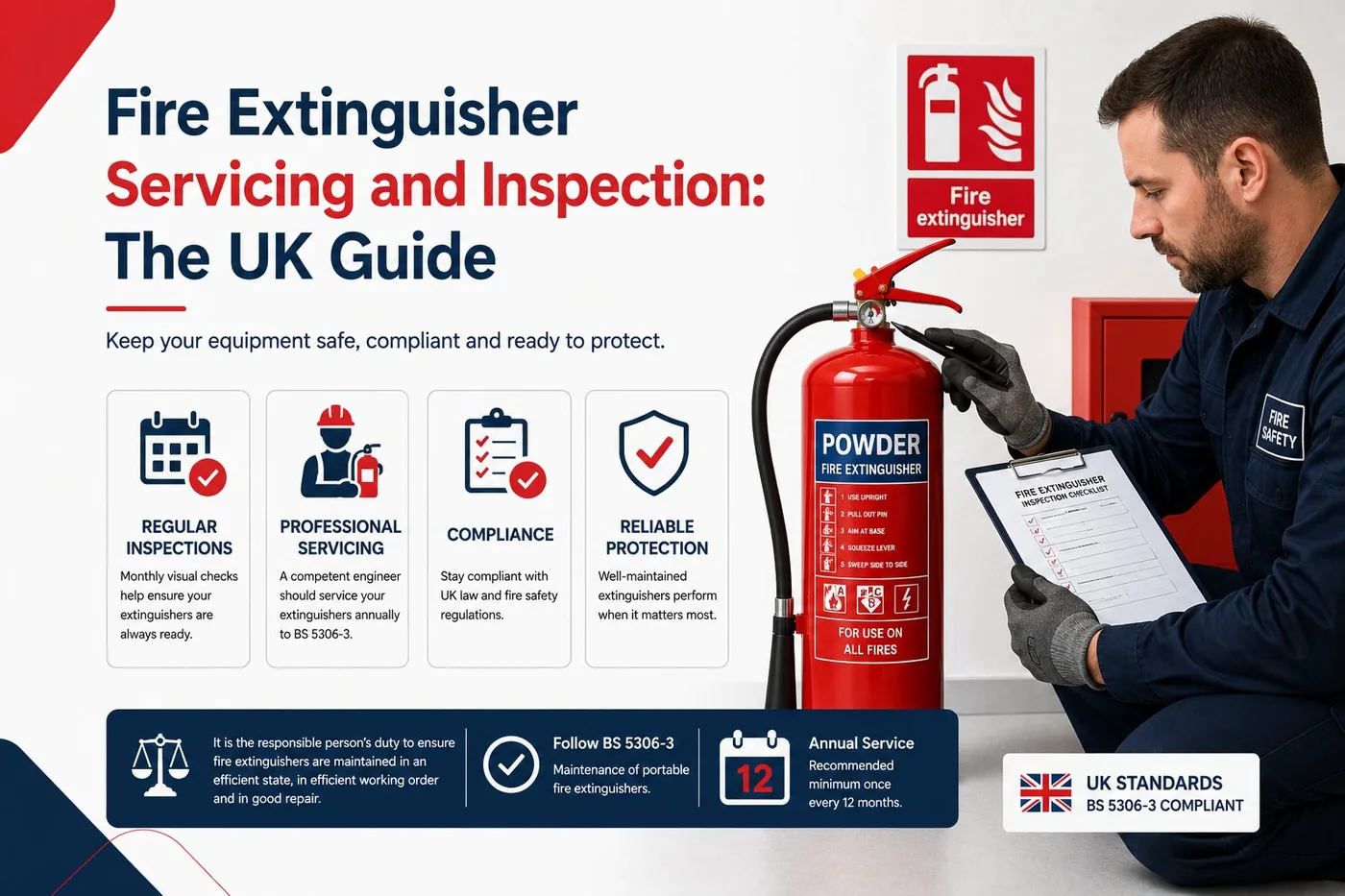
Fire extinguisher servicing in the UK follows a specific schedule set out in BS 5306-3:2017 — monthly visual checks, an annual basic service by a competent person, and an extended service every five years (or every ten years for CO2). The schedule is simple in outline; the practical questions about who can do what, what is genuinely required by law, and how the maintenance pattern interacts with extinguisher lifespan are where most UK premises run into uncertainty.
This page sets out the maintenance regime in full, answers the most common question (is annual servicing legally required?), explains the BAFE SP101 scheme and how to evaluate a contractor, covers the lifespan and end-of-life replacement decision, and addresses the modern alternative — P50 service-free extinguishers — that some premises now use.
What "maintenance" covers under BS 5306-3:2017
BS 5306-3:2017 — Commissioning and maintenance of portable fire extinguishers — Code of practice — sets out four distinct service levels for UK fire extinguishers. The four are not optional alternatives; they are a sequence, with each level adding to the previous one over the lifespan of the unit.
Monthly visual check (sometimes called a routine inspection) — performed on-site by the responsible person. A quick visual confirmation that the extinguisher is in place, undamaged, with the pressure gauge in the green, the seal intact, and the signage visible. Takes seconds per unit and does not require specialist training.
Annual basic service — performed by a competent person. A more thorough inspection that includes checking the pressure, examining the body and fittings for damage or corrosion, weighing CO2 units, and confirming the unit is in working condition. The unit is not normally discharged at this service.
Extended service — performed by a competent person, every 5 years for water, foam, dry powder and wet chemical extinguishers; every 10 years for CO2. The unit is partially discharged, internally inspected, and recharged. Components subject to wear (O-rings, valves, gauges) are replaced as needed.
Overhaul — performed by a competent person, also at the 10-year mark for CO2. Hydraulic pressure testing of the cylinder, full strip-down, and replacement of any components that fail inspection. For water-based extinguishers, the overhaul is normally combined with the 10-year extended service or replaces the unit entirely.
The four levels together produce a maintenance schedule that, properly executed, keeps an extinguisher reliably operational for 20 years or more — and that produces the documented record needed to demonstrate compliance with the Regulatory Reform (Fire Safety) Order 2005.
Is annual servicing a legal requirement?
This is the question most UK premises ask first, and the question most casual guides answer poorly. The right answer needs a small distinction.
The Regulatory Reform (Fire Safety) Order 2005 does not name BS 5306-3:2017 specifically. What the Fire Safety Order requires (under article 13) is that the responsible person ensures any non-automatic fire-fighting equipment is provided where the fire risk assessment identifies the need, and that the equipment is "easily accessible, simple to use and indicated by signs." Article 17 then requires that fire-fighting equipment, fire detectors and fire alarms are subject to a "suitable system of maintenance" and are "maintained in efficient working order and in good repair."
BS 5306-3:2017 is the recognised British Standard for that "suitable system of maintenance." A premises that follows the BS 5306-3 schedule — monthly checks, annual basic service, extended service at 5 or 10 years — is meeting the article 17 duty. A premises that does not follow it has to be able to demonstrate, through some other evidence, that its extinguishers are being kept in efficient working order.
In practice, that demonstration is hard to produce without an annual service. The Fire Safety Order is a goal-based regulation: it sets the outcome (efficient working order) and expects the responsible person to demonstrate how it is achieved. The recognised route is BS 5306-3. Insurers, fire and rescue authority enforcement officers, and prosecution case law all treat BS 5306-3 compliance as the working evidence of compliance with article 17.
So the honest answer is: annual servicing is not literally named in primary legislation, but in practice it is required to demonstrate compliance with the legislation that does exist. A premises that skips annual servicing and tries to argue that its extinguishers are still in efficient working order is on weak ground if anything goes wrong.
Monthly visual checks — who can do them
Monthly visual checks are the responsibility of the on-site responsible person — typically the building manager, facilities lead, or designated fire warden. No specialist training or qualification is required, and the check itself is fast.
What to look for at each unit:
- In place — the extinguisher is where it should be, on its bracket or stand, not moved or missing.
- Visible and accessible — no obstructions in front of it, signage is visible, access is clear.
- Pressure gauge in the green — for stored-pressure units, the needle should sit in the green band. CO2 units don't have a gauge; they are weighed at annual service.
- Seal and tamper indicator intact — the safety pin tag should be unbroken. A broken tag may indicate prior use, attempted tampering, or accidental discharge.
- Body undamaged — no dents, severe corrosion, or visible damage to the cylinder, hose or nozzle.
- Label legible — the operating instructions and class markings should be readable.
Findings get recorded in the fire logbook (covered below). Anything beyond a simple "in place and unchanged" — particularly a low pressure reading, a missing or damaged unit, a broken seal — should trigger a call to the servicing contractor for follow-up.
The monthly check is genuinely useful. Most extinguisher problems found at the annual service have been visible at a monthly check for weeks or months previously; the responsible person who looks each month catches issues earlier than the engineer who looks once a year.
Annual basic service — what a competent person does
The annual service is more thorough. It is performed by a "competent person" — a term BS 5306-3 defines as someone with the necessary training, experience and access to manufacturer information to carry out the work properly. In practice, this is normally a technician from a fire safety contractor, with the strongest evidence of competence being registration on the BAFE SP101 scheme (covered below).
The basic service includes:
- All the visual checks of the monthly inspection, in more detail.
- Removing the unit from its bracket; weighing it (for CO2) or checking pressure (for stored-pressure units).
- Inspecting the operating mechanism — lever, pin, hose and nozzle for wear, blockage or damage.
- Checking the safety seal, replacing if necessary.
- Inspecting the body for corrosion, dents, damage to threads.
- For water-based units, briefly checking the discharge mechanism without firing.
- Replacing the safety pin tag with a new one.
- Affixing a service label to the body, dated and signed.
- Updating the maintenance record / logbook.
A typical annual service takes 5 to 10 minutes per unit. A site with 20 extinguishers might be done in two to three hours, including paperwork.
What the annual service does not include is full discharge or internal inspection. Those are part of the extended service, which is on a different cycle.
5-year extended service — water, foam, powder, wet chemical
Water, foam, dry powder and wet chemical extinguishers undergo an extended service every five years. The procedure:
- Full discharge of the unit under controlled conditions.
- Strip down — removing the head assembly, draining or removing the agent, cleaning the cylinder.
- Internal inspection — the inside of the cylinder is examined for corrosion, pitting, or any damage that would compromise pressure rating.
- Component replacement — valves, O-rings, gauges, hoses and any other wear parts are replaced as needed against manufacturer specification.
- Recharge with new agent (water, foam, powder or wet chemical as appropriate) and re-pressurisation with nitrogen.
- Full pressure test against manufacturer specification.
- Re-labelling with the extended service date and details.
The extended service can be done in-place by some contractors with specialist equipment, or the unit can be taken off-site to a workshop. A loan unit of equivalent type and capacity should be left in place during the absence to maintain cover.
Cost is significant — typically a meaningful fraction of the cost of replacement. For older units (15+ years old), most servicing contractors will recommend replacement rather than extended service, because the cost difference is small and a new unit comes with a fresh service cycle.
10-year extended service / overhaul — CO2 specifically
CO2 extinguishers are on a longer cycle because the cylinder pressure rating is higher and the agent doesn't degrade in the same way as water-based agents. Under BS 5306-3:2017, CO2 units undergo an extended service every 10 years, which includes:
- Hydraulic pressure testing of the cylinder against the manufacturer's stamped test pressure.
- Full strip-down, internal inspection, and component replacement.
- Recharge with fresh CO2 to the specified weight.
- Re-marking with the test date and the next-test date.
The mismatch with the 5-year cycle for the rest of the cluster is the easiest schedule mistake to make. A servicing contract that treats every unit on the same cycle is over-servicing CO2 at year 5 and under-budgeting it at year 10. The schedule has to match the unit type — confirm with your contractor what is being done at each visit.
For most premises, the 10-year mark on a CO2 extinguisher is also the practical replacement decision point. The cost of overhaul (with hydraulic testing) often exceeds the cost of a new unit, so older CO2 units typically get replaced at year 10 rather than overhauled. The detail on CO2 is on our CO2 fire extinguisher page.
Lifespan and end-of-life replacement
UK fire extinguishers do not have a statutory expiry date in the way medicines do. With proper maintenance, a typical extinguisher remains in service for around 20 years, with the practical end-of-life triggered by one of three things:
Failure at extended service
Internal corrosion, body damage, or test failure during the 5-year (or 10-year for CO2) extended service. The cylinder is no longer fit for re-pressurisation, and replacement is the only option.
Component obsolescence
Older units may use valves, gauges or hoses that are no longer manufactured. The annual service can spot the issue, but replacement parts may not be available. Once a critical component cannot be replaced, the unit reaches end of life.
Cost-effectiveness threshold
Around the 15-20 year mark, the cost of continued servicing typically exceeds the cost of replacement, particularly when an extended service falls due. Most servicing contractors recommend replacement rather than overhaul beyond that point.
The corollary: a fire extinguisher with no service record, or with a manufacture date more than 20 years ago, should be assumed end of life and replaced — not because it has necessarily failed, but because the maintenance evidence to demonstrate it is in working order doesn't exist.
For disposal of an extinguisher at end of life, see our fire extinguisher disposal page.
BAFE SP101 — the scheme that matters
BS 5306-3:2017 specifies that maintenance must be carried out by a "competent person" but doesn't define competence in detail. The strongest evidence of competence in the UK market is registration on the BAFE SP101 scheme.
BAFE — the British Approvals for Fire Equipment — is an independent third-party certification body for fire safety services. The SP101 scheme certifies organisations to maintain portable fire extinguishers in accordance with BS 5306. To be registered, an organisation must:
- Employ technicians who have completed BAFE-recognised training.
- Operate a quality management system audited by a UKAS-accredited certification body.
- Demonstrate technical competence on each extinguisher type they service.
- Maintain insurance and traceability for all work.
For a premises responsible for fire extinguisher maintenance, choosing a BAFE SP101-registered contractor provides:
- Strong evidence of competence under article 17 of the Fire Safety Order.
- Insurance recognition — most insurers prefer or require BAFE-registered servicing.
- Audit trail — work performed by a BAFE-registered firm is documented to the standard expected by enforcement.
- Recourse if work is substandard — BAFE operates a complaints process.
Choosing a non-BAFE-registered contractor is not illegal, but the burden of proving competence falls on the responsible person rather than being established by the registration. In practice, BAFE SP101 registration is the most efficient way to satisfy the competence requirement.
P50 service-free fire extinguishers — a modern alternative
Worth knowing about, because they represent the most significant change to UK extinguisher maintenance in decades. P50 extinguishers — sometimes called service-free or low-maintenance extinguishers — are a category of composite-bodied unit (typically aramid fibre over a polyethylene liner, rather than steel) that is rated for a 10-year extended service interval rather than 5 years, and can typically have its annual service conducted by the responsible person on-site rather than a competent person.
The trade-offs:
- Higher initial cost — P50 units are typically two to three times the price of a conventional steel-bodied equivalent.
- Lower lifetime maintenance cost — annual servicing is simplified, and the 10-year extended service cycle (rather than 5-year) reduces servicing visits.
- Compliance evidence is different — the responsible person needs to demonstrate they have followed the manufacturer's maintenance protocol rather than BS 5306-3:2017 (which P50 units sit outside of).
P50 extinguishers are a reasonable choice for premises that prefer to manage maintenance internally and that want to reduce the frequency of contractor visits. They are not a suitable choice for premises that want the BS 5306-3 audit trail, or for tenants who don't have continuity of personnel to maintain the on-site records over a multi-year cycle.
If P50 units are being considered, the manufacturer's instructions and the fire risk assessment should both reflect the alternative maintenance approach. Mixing P50 and conventional units in the same premises is workable but creates two parallel maintenance regimes — worth a deliberate decision rather than ending up with that arrangement by accident.
Recordkeeping and the fire logbook
Every UK premises covered by the Fire Safety Order should maintain a fire logbook (sometimes called a fire safety logbook or fire register). The logbook is the primary record that demonstrates ongoing compliance and is the document a fire and rescue authority enforcement officer asks to see first.
For fire extinguisher maintenance, the logbook should record:
- A list of all extinguishers on the premises, with their location, type, capacity, manufacture date, and service history.
- Monthly visual check records — date, person who performed the check, findings.
- Annual service records — date, contractor, technician, any work performed, the next service due date.
- Extended service records — date, work performed, next due date.
- Any incidents — discharge for use, accidental discharge, damage, or removal from service.
- Replacement records — when units have been replaced, and where the old units went.
The logbook can be a physical book, a structured spreadsheet, or a dedicated fire safety management system. What matters is that it provides a continuous, contemporaneous record. Servicing contractors normally provide a service report for each visit; that report should be filed in or linked from the logbook.
Records should be kept for at least the lifetime of the extinguishers they relate to — typically 20 years — and longer where the records may be relevant to an investigation following a fire.
Frequently asked questions
Is annual fire extinguisher servicing a legal requirement?
Not literally named in primary legislation, but in practice required to demonstrate compliance with the Regulatory Reform (Fire Safety) Order 2005. The Fire Safety Order requires equipment to be in efficient working order; BS 5306-3:2017 is the recognised standard for that maintenance, and following it (annual service, 5-year extended service, 10-year CO2 overhaul) is the working evidence of compliance.
Who can service a fire extinguisher?
A "competent person," as defined in BS 5306-3:2017 — someone with the necessary training, experience and access to manufacturer information. Registration on the BAFE SP101 scheme is the strongest evidence of competence and is recognised by insurers and enforcement authorities.
How long do fire extinguishers last?
With proper maintenance, typically 20 years or more. Replacement is normally triggered by failure at extended service, component obsolescence, or cost-effectiveness — most premises replace units in the 15-20 year range when extended service costs approach the cost of a new unit.
What's the difference between a basic service and an extended service?
The basic service is annual and includes external inspection, pressure check, weighing (for CO2), seal replacement and labelling. The extended service is every 5 years (or 10 years for CO2) and includes full discharge, internal inspection, component replacement and recharge. Both are required for full BS 5306-3:2017 compliance.
Why do CO2 extinguishers need a 10-year overhaul rather than 5?
The cylinder pressure rating and internal conditions are different from water-based extinguishers, and the BS 5306-3:2017 maintenance schedule reflects that. The 10-year cycle includes hydraulic pressure testing of the cylinder, which is unique to CO2.
What records do I need to keep?
A fire logbook recording all extinguishers, monthly visual checks, annual services, extended services, and any incidents or replacements. Records should be kept for at least the lifetime of the equipment — typically 20 years — and should be available for inspection by enforcement officers.
What's a P50 fire extinguisher?
A composite-bodied extinguisher (aramid fibre over polyethylene) rated for a 10-year extended service interval and on-site maintenance by the responsible person. Higher initial cost, lower lifetime maintenance cost. Sits outside the standard BS 5306-3:2017 regime; manufacturer instructions take precedence.
Where this connects
For where extinguisher maintenance fits in the wider compliance picture, see who is responsible for fire extinguishers in UK workplaces. For end-of-life and replacement, see our fire extinguisher disposal page. For the CO2-specific schedule and the underlying product context, see our CO2 fire extinguisher page. For the wider type and colour system, the fire extinguisher types hub is the place to start.
If you are responsible for fire safety in a UK workplace and need to train your team on the basics, the online fire safety awareness training course covers what every employee needs to know in 90 minutes — RoSPA-approved and CPD-accredited.
Related guides
- Who Is Responsible for Fire Extinguishers in the UK?
- Fire Extinguisher Disposal: The UK Guide
- UK Fire Classes Explained: A, B, C, D, F (and L)
Make sure every employee knows what to do when a fire alarm sounds.
Explore the Fire Safety Awareness Training course →
Mark writes about workplace fire safety, fire awareness and accredited online training for Fire Safety Awareness Training, part of Online CPD Academy.