
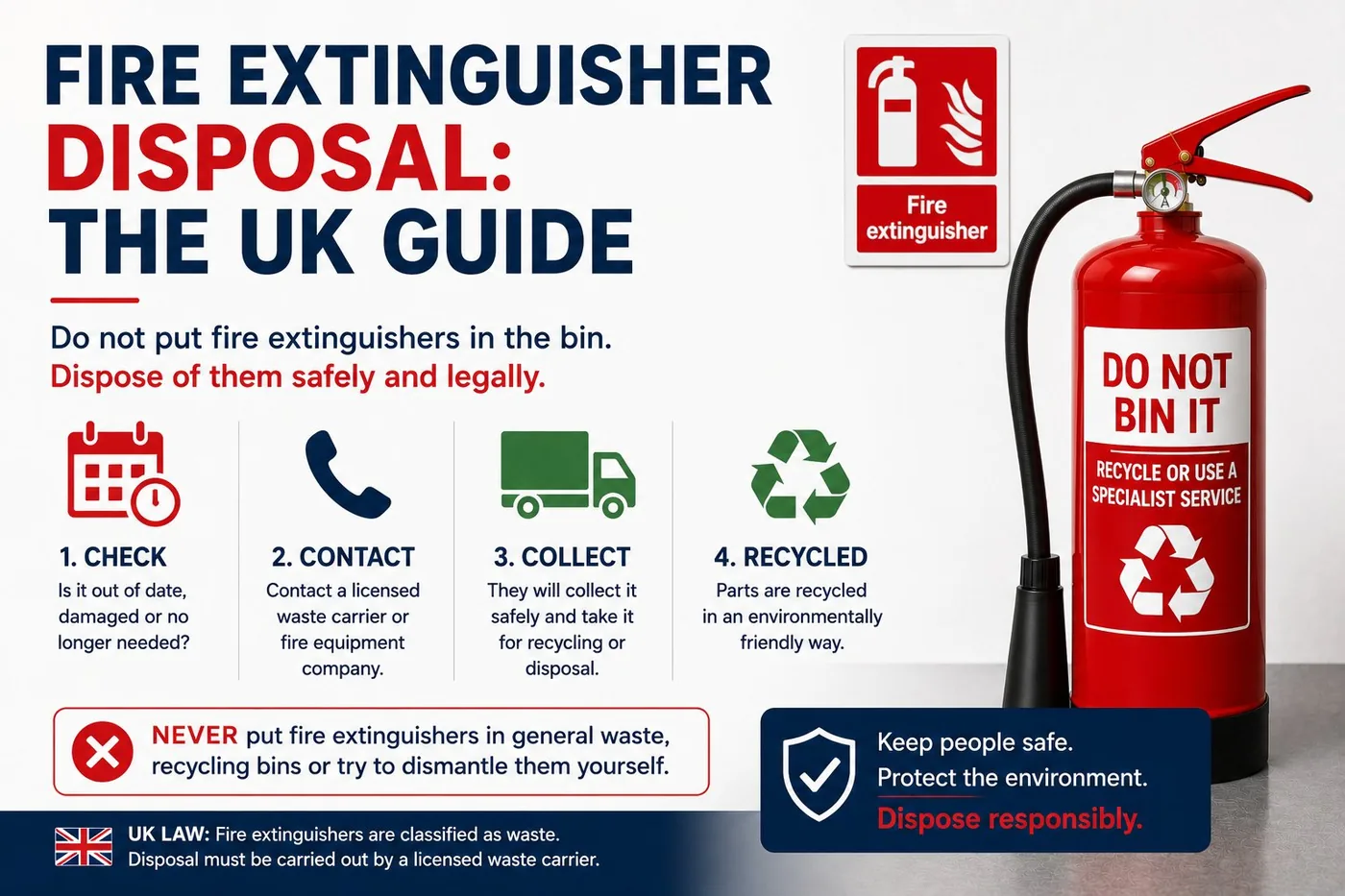
A fire extinguisher cannot go in general waste. It is a pressure vessel, often containing chemicals that are now classified as hazardous, sometimes containing agents that have been banned or restricted. Putting one in a household bin or a commercial skip is illegal under the Hazardous Waste Regulations and is dangerous in the narrow sense that a pressurised cylinder in a refuse vehicle compactor can rupture violently.
This page sets out the right route for disposing of a fire extinguisher in the UK — separately for domestic and business waste, with specific notes on the two categories of unit that need extra attention: halon (banned for general use since 2003) and PFOA-containing foam (banned from 4 July 2025).
Why a fire extinguisher isn't general waste
Three reasons together.
Pressure
A fully-charged extinguisher contains its agent under pressure (typically 12-15 bar for stored-pressure water, foam and powder; up to 60 bar for CO2). A waste compactor that crushes the cylinder produces an explosion — fragments, projectile valves, and a sudden release of agent and propellant. Workers have been seriously injured by this in UK waste facilities; the disposal route has to ensure the unit is depressurised and dismantled safely, not crushed.
Chemistry
Foam extinguishers manufactured before the early 2000s often contained PFOS-based AFFF; foam manufactured up to mid-2025 commonly contained PFOA-based AFFF. Both are now classified as persistent organic pollutants (POPs) and require specific high-temperature destruction. C6 fluorotelomer foam and fluorine-free foams are less restricted but are still classified as hazardous waste in many disposal contexts. Halon (in older units) is an ozone-depleting substance with its own disposal regime under the Montreal Protocol implementation.
Documentation
Hazardous waste in the UK requires a Hazardous Waste Consignment Note tracking it from origin to destruction. General refuse can't carry that documentation. Disposing of an extinguisher through general waste creates a documentation gap that ends in regulatory liability for the person who threw it in the bin.
Domestic disposal — taking it to the HWRC
For a private household with one or two old extinguishers — typically a unit that came with the property, a unit that has expired, or a unit that has been partially discharged — the standard route is the local Household Waste Recycling Centre (HWRC), sometimes still called “the tip” or “the dump.”
Most UK local authorities accept fire extinguishers at HWRCs as part of their household hazardous waste service. The unit is taken in person, signed in at the gate, and directed to the appropriate bay (typically alongside gas canisters, paint, and other small hazardous items).
Practical points:
- Phone ahead or check the council website. Not every HWRC accepts extinguishers, and some only accept them on certain days. A short check saves a wasted trip.
- Identify the type. If you don't know what the extinguisher contains (foam, water, CO2, powder, halon), the HWRC staff may need to ask before accepting it. The label will tell you most of what's needed.
- Halon is different. A green-bodied halon extinguisher is not normally acceptable at a local HWRC. Halon disposal goes through a specialist contractor (see below).
- Bring identification if asked. Some HWRCs check residency to ensure they're handling household rather than commercial waste.
- Don't try to discharge it first. Discharging a foam or powder extinguisher into the garden or down a drain is not the right answer; the agent is what makes the unit hazardous, and discharging spreads it rather than disposing of it. The exceptions are water and CO2, which can be discharged outdoors safely under specific conditions — covered below.
For the council's specific guidance, search “fire extinguisher disposal [your local authority]” or check the Recycle Now website (an official UK recycling guidance service operated by WRAP).
Business disposal — Duty of Care and licensed waste carriers
For a business — any premises covered by the Regulatory Reform (Fire Safety) Order 2005 — the picture is different. Businesses cannot use HWRCs for waste that arises from commercial activity, and fire extinguisher disposal is subject to the Duty of Care under section 34 of the Environmental Protection Act 1990 plus the Hazardous Waste Regulations 2005 (in England and Wales; equivalent regulations apply in Scotland and Northern Ireland).
The Duty of Care requires a business to:
- Use a licensed waste carrier registered with the relevant environment agency (Environment Agency in England, Natural Resources Wales, SEPA in Scotland, NIEA in Northern Ireland).
- Document the transfer with a Waste Transfer Note (for general business waste) or a Hazardous Waste Consignment Note (for waste classified as hazardous).
- Ensure the waste reaches an authorised disposal facility — the carrier should be able to provide evidence of where the waste went.
- Retain the documentation for at least two years (Waste Transfer Note) or three years (Hazardous Waste Consignment Note).
For most businesses, the easiest disposal route is through the fire extinguisher servicing contractor. A BAFE SP101-registered firm carrying out an annual service or extended service is well placed to take old units away at the same time, with the necessary documentation built into the service contract. The cost is normally rolled into the servicing arrangement, and the audit trail is automatic.
Alternative routes — using a separate hazardous waste contractor, returning units to the manufacturer, or arranging disposal through the building's general waste contractor (if licensed for hazardous waste) — all work, but each requires the documentation to be set up explicitly.
Halon and BCF — specialist disposal only
Halon (sometimes called BCF, for Bromochlorodifluoromethane, or Halon 1211) was banned for general use in the UK in 2003 under the implementation of the Montreal Protocol. Halon depletes the ozone layer significantly more than other refrigerant gases, and its production was phased out internationally.
A halon extinguisher should not be:
- Put in general waste.
- Taken to a local HWRC (most do not accept halon).
- Discharged to atmosphere (this is illegal under ozone-depleting substances regulations).
- Returned to general use (other than in the very narrow critical-use exemptions for aviation and certain military applications).
The right disposal route for halon is:
- Return to the manufacturer or original supplier. Most major UK extinguisher manufacturers operate take-back schemes for halon.
- Specialist halon disposal contractor. Several UK firms specialise in recovering halon for destruction or, where critical-use exemption applies, recycling for those specific applications.
- Through a BAFE SP101-registered fire safety contractor. If you have an annual servicing arrangement, the contractor will normally arrange halon disposal as part of the service.
The disposal process for halon involves recovery of the agent under controlled conditions, with the agent either destroyed by high-temperature thermal oxidation or — for critical-use exempt applications — purified and stored. A halon recovery certificate should be provided as documentation.
PFOA foam — high-temperature incineration
The PFOA ban that took effect on 4 July 2025 introduced a specific disposal challenge. Foam extinguishers containing PFOA-based AFFF must be removed from service, and the agent itself is now classified as a persistent organic pollutant (POP) requiring high-temperature destruction.
For a UK premises with PFOA-containing foam:
- The unit must be removed from service immediately. Continuing to use, store, or refill a PFOA-containing foam extinguisher is now illegal under UK REACH.
- Disposal must go through a licensed hazardous waste contractor with the capability to direct the waste to a high-temperature incineration facility — typically a specialist facility licensed for POPs destruction.
- Documentation under the Hazardous Waste Regulations applies. The Hazardous Waste Consignment Note should specify the foam chemistry and the destruction method.
- Refilling a PFOA unit with new fluorine-free foam does not solve the problem. Residual PFOA remains in the cylinder after refilling, and the unit is still non-compliant. A PFOA-containing extinguisher must be replaced and disposed of, not converted.
The cost of disposing of PFOA foam properly is meaningfully higher than for conventional disposal — high-temperature destruction is a specialised process. For premises with significant numbers of legacy AFFF units, planning the transition to fluorine-free foam is best done through the servicing contractor, with the disposal cost factored in as part of the changeover. The wider context on the foam regulatory situation is on our foam fire extinguisher page.
Documentation — Waste Transfer Note, Consignment Note, EWC codes
For business disposal, the documentation matters as much as the physical disposal. A few specifics worth knowing.
Waste Transfer Note (WTN)
Required for non-hazardous business waste transfers under section 34 of the Environmental Protection Act 1990. The WTN records who produced the waste, who transported it, what the waste was, and where it went. WTNs must be retained for at least two years.
Hazardous Waste Consignment Note (HWCN)
Required for hazardous waste transfers under the Hazardous Waste Regulations 2005 (as amended). More detailed than a WTN, and must be retained for at least three years. Most fire extinguisher disposal in a business context will require a HWCN rather than a WTN, because the agents (and certainly the cylinders if they retain pressure) qualify as hazardous waste.
European Waste Catalogue (EWC) codes
UK hazardous waste documentation uses EWC codes to identify waste streams. Common codes for fire extinguisher disposal include 16 05 04* (gases in pressure containers containing hazardous substances) and 16 05 05 (gases in pressure containers other than those mentioned in 16 05 04). PFOS and PFOA-containing foams typically attract additional POPs-related codes. The contractor should specify the correct codes; the responsible person should check the documentation matches what was actually disposed of.
Environment Agency registration
The waste carrier must be registered with the Environment Agency (or the equivalent in Wales, Scotland, Northern Ireland). The carrier's registration number should appear on the WTN or HWCN. A search on the Environment Agency's public register confirms the registration.
A premises that retains all WTN/HWCN documentation alongside its fire logbook is well placed to demonstrate Duty of Care compliance during any inspection or investigation.
Discharging safely — for water and CO2 only
For the simplest cases, discharging the extinguisher safely is a workable disposal step. This applies only to water and CO2 units, and only with caveats.
Water extinguishers
A water extinguisher can be discharged outdoors onto suitable ground (a lawn or grassed area, away from drains). The water itself is harmless. After discharge, the empty cylinder is no longer pressurised and is much easier to dispose of through an HWRC or a metal recycling facility. Note: water extinguishers with additive (hydrospray) contain surfactants and should be treated more cautiously — preferably routed through a contractor.
CO2 extinguishers
A CO2 unit can be discharged outdoors, at a safe distance from any people, in a well-ventilated area. The gas disperses into the atmosphere harmlessly (CO2 contributes to the greenhouse effect at scale, but a single 5 kg release is negligible). The empty cylinder can then be recycled as scrap metal, ideally via a specialist who confirms the cylinder is fully depressurised first.
For all other types — foam, dry powder, wet chemical — DIY discharge is not the right answer. Foam and powder spread the agent into the environment in ways that are not appropriate for disposal; wet chemical involves alkaline chemicals that should not be released to drains or ground. Use a licensed contractor for these.
What it costs
For a domestic disposal at an HWRC, the cost is normally zero (households pay for HWRC services through council tax). For a business disposal, the cost varies:
- A few extinguishers as part of an annual service. Often included in the servicing contract or charged at a small per-unit fee.
- A larger consignment (10-50 units) at site clearance. Typically arranged as a one-off collection by a hazardous waste contractor, with cost driven by the type of agent and the volume.
- PFOA-containing foam. Higher cost than conventional disposal because of the high-temperature incineration requirement.
- Halon. Higher cost than conventional disposal because of the specialist recovery requirement; some manufacturers operate free or subsidised take-back to encourage compliance.
For most UK premises, building disposal cost into the servicing contract from the outset is the simplest commercial arrangement. The contractor knows the units, the documentation flows automatically, and the costs are predictable.
Servicing engineers as the easiest route for businesses
Worth restating because it is the simplest answer for most readers: if you have a BAFE SP101-registered servicing contractor, they will dispose of old extinguishers as part of the service relationship. The technician who removes a unit from service at the annual visit takes it away with the necessary documentation, processes it through a licensed disposal route, and provides the WTN or HWCN as part of the service report.
This is the right answer for most businesses because it removes the burden of arranging disposal separately, and it integrates the disposal documentation into the same audit trail as the rest of the maintenance regime. The detail on contractor selection is on our fire extinguisher servicing and inspection page.
Frequently asked questions
Can I throw a fire extinguisher in the bin?
No. Fire extinguishers are pressure vessels containing potentially hazardous chemicals; they cannot go in general or recycling waste. Domestic units go to a Household Waste Recycling Centre; business units go via a licensed waste carrier with a Waste Transfer Note or Hazardous Waste Consignment Note.
Where can I take an old fire extinguisher?
For a household, the local HWRC (“the tip”). Phone ahead or check the council website to confirm acceptance. For a business, through a licensed waste carrier — most easily, your fire safety servicing contractor.
Can I dispose of a halon extinguisher at the council tip?
Usually not — most local HWRCs do not accept halon because the disposal regime is different. Halon disposal goes through the manufacturer's take-back scheme, a specialist halon recovery contractor, or a BAFE-registered servicing firm.
How do I get rid of a foam extinguisher with PFOA?
Through a licensed hazardous waste contractor that can route the unit to a high-temperature incineration facility for POPs destruction. The contractor provides the Hazardous Waste Consignment Note. PFOA-containing foam cannot be put in general waste, cannot be discharged, and cannot be refilled to compliance — the unit must be replaced.
What's a Waste Transfer Note?
A document required for business waste transfers under the Environmental Protection Act 1990, section 34. The WTN records the waste, the carrier, and the disposal destination. For fire extinguishers — which usually qualify as hazardous waste — the equivalent document is the Hazardous Waste Consignment Note, with stricter retention and content requirements.
Where this connects
For end-of-life timing — when an extinguisher needs disposing of versus being maintained for further service — see our fire extinguisher servicing and inspection page. For the foam-specific PFOA context, see our foam fire extinguisher page. For the wider regulatory framework, see who is responsible for fire extinguishers in UK workplaces. For the wider type and colour system, the fire extinguisher types hub is the place to start.
If you are setting up fire safety in a UK workplace and need to train your team on the basics, the online fire safety awareness training course covers what every employee needs in 90 minutes — RoSPA-approved and CPD-accredited.
Related guides
- Who Is Responsible for Fire Extinguishers in the UK?
- Fire Extinguisher Servicing and Inspection: The UK Guide
- UK Fire Classes Explained: A, B, C, D, F (and L)
Make sure your team knows the fire safety basics — recognise risks, raise the alarm, and evacuate safely.
Explore the Fire Safety Awareness Training course →
Mark writes about workplace health & safety, fire safety awareness and accredited online training for Fire Safety Awareness Training, part of Online CPD Academy.