
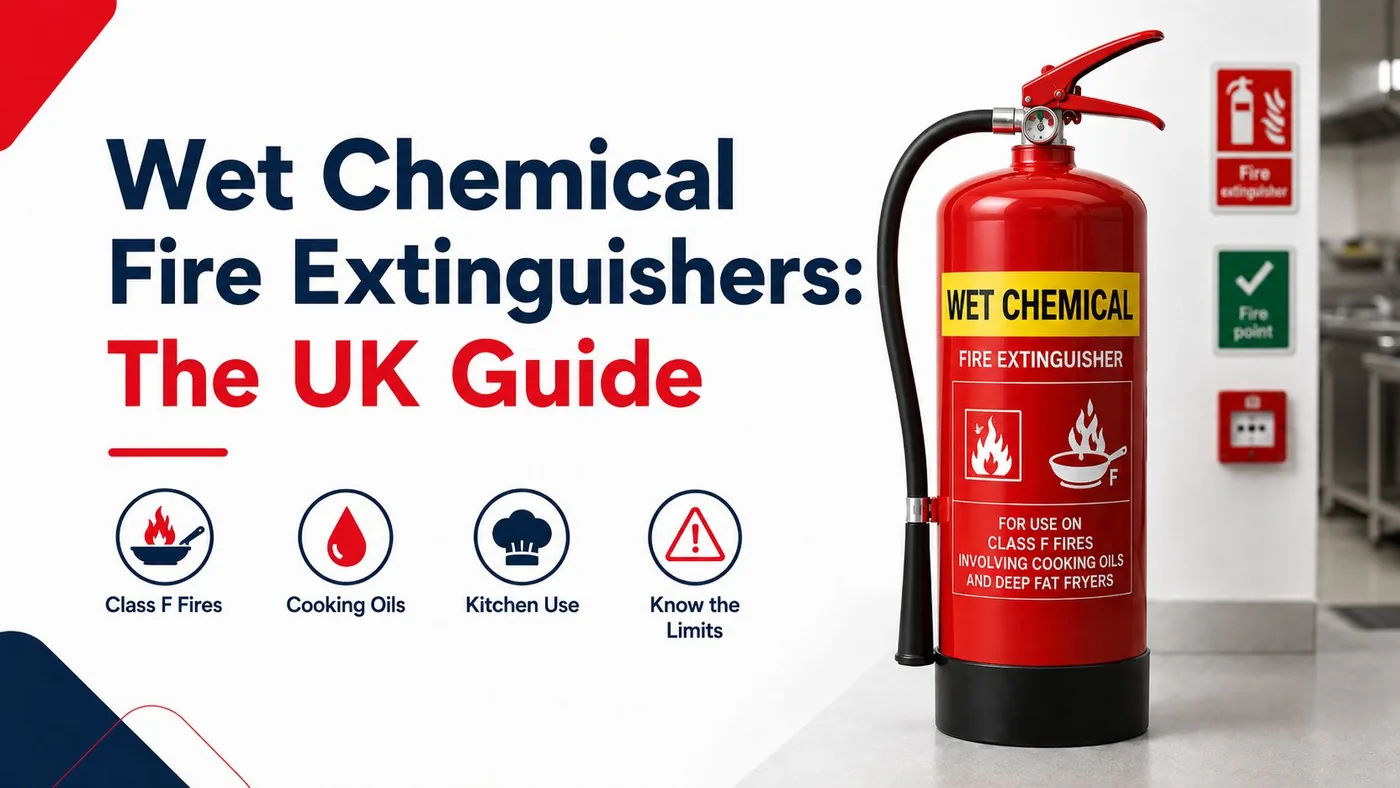
The yellow-labelled wet chemical fire extinguisher is the dedicated answer for Class F fires — cooking oils and fats. It is the standard equipment for commercial kitchens, takeaways, hotel kitchens, school catering, and anywhere a deep fat fryer is in use. It is also the type most often misunderstood: the same chemistry that makes wet chemical effective on hot cooking oil is irrelevant on petrol, paint, or a normal Class B liquid fire.
This page covers what wet chemical extinguishers do, the saponification chemistry that gives them their name, how F-rating sizing works for different kitchen scales, and how wet chemical fits alongside the fire blanket as the two-part answer for kitchen fire safety in UK premises.
What a wet chemical fire extinguisher is
A wet chemical extinguisher is a stored-pressure unit containing an aqueous solution of potassium salts — typically potassium acetate, sometimes with potassium citrate or potassium bicarbonate. The body is signal red with a yellow panel near the label. Standard UK capacities are 2 L, 3 L and 6 L.
The most distinctive feature is the discharge mechanism. Wet chemical extinguishers are supplied with a long lance rather than a short nozzle — typically a metal tube around 30 to 40 cm long ending in a fine spray head. The lance is not optional or decorative; it is fundamental to safe operation, and it is why a wet chemical extinguisher is used differently from any other type.
Wet chemical extinguishers are tested under BS EN 3 and selected and positioned under BS 5306-8:2023.
How wet chemical works — saponification
Drop a wet chemical mist onto burning cooking oil and three things happen at once.
The mist cools the oil surface
A 6 L wet chemical unit empties enough water-based agent to drop the oil temperature from its burning state (often 350°C and above) toward something more manageable. Cooling reduces the rate of vapour generation, which reduces the fire.
The fine mist limits splashing
Hit a pan of hot oil with a heavy water jet and the oil ejects upwards in a fireball. A wet chemical mist arrives gently and at lower velocity — the lance is sized to deliver the agent in a soft, fine spray rather than a concentrated stream.
The potassium salts saponify the oil
This is the chemistry that gives wet chemical its name. The alkaline potassium salt reacts with the fatty acids in the burning oil through a process called saponification — the same reaction that turns vegetable oil and lye into soap. The reaction product is an inert, foamy soap layer that sits on the oil surface, sealing it from the air. With the surface sealed and the oil cooled, the fire goes out and stays out.
The combined effect is what makes wet chemical work where every other extinguisher type fails on cooking oil. Water vaporises and ejects the oil; foam and CO2 don't form a stable seal; powder splashes and doesn't interact chemically. Wet chemical is the only common extinguisher whose chemistry actually addresses the underlying fuel.
What wet chemical extinguishers tackle
Class F is the headline category — fires involving cooking oils and fats. This includes:
- Animal fats — beef dripping, lard, bacon fat
- Vegetable oils — sunflower, rapeseed, olive, palm
- The hot oil in deep fat fryers, chip pans, and cooking ranges
- Burning grease in extraction hoods and ducting (though primary cover for ducting is normally a fixed suppression system)
Most wet chemical extinguishers also carry a small Class A rating — useful for the surrounding combustible material (tea towels, packaging, curtains) that often becomes involved in a kitchen fire. Some are also rated for small Class B fires, but wet chemical is far less effective on conventional flammable liquids than foam or dry powder, and Class B is not the right reason to buy a wet chemical extinguisher.
What wet chemical doesn't tackle:
- Class B in the conventional sense (petrol, diesel, paint, solvents). The saponification reaction depends on cooking-oil chemistry; normal flammable liquids don't saponify. Foam, CO2 or dry powder is the answer for general Class B. See our flammable liquids fire guide.
- Class C (flammable gases). No relevant mechanism.
- Class D (combustible metals). The agent reacts unhelpfully with hot reactive metals.
- Live electrical equipment. Most wet chemical extinguishers are not dielectrically rated. A unit that does carry a current dielectric rating can be used on live equipment within stated limits, but standard wet chemical is conductive and not safe on energised equipment.
F-rating — sizing for the right kitchen
Wet chemical extinguisher capacity is matched to the kitchen by F-rating. The number expresses the volume of cooking oil the extinguisher has been tested to handle in a controlled fire-rating test. Common F-ratings:
- 5F — small domestic deep fat fryers, around 3 to 5 litres of oil
- 13F — larger domestic and small commercial kitchen units, around 8 to 13 litres
- 25F — small commercial fryers and cooking ranges
- 75F — full commercial kitchen line, larger fryers
- 100F+ — heavy commercial use, multiple fryers, busy fish-and-chip operations
The matching is not optional. A 5F-rated extinguisher applied to a 25 L commercial fryer will not produce a stable saponified blanket — it will look like progress, then the fire will re-establish. Sizing has to match the worst-case oil volume in the kitchen, not the average.
For most UK premises:
- Domestic kitchens with no deep fat fryer don't need a wet chemical extinguisher. A fire blanket and (optionally) a small water mist with an F-rating handle the realistic risks.
- Domestic kitchens with a deep fat fryer benefit from a small wet chemical unit — typically 2 L or 3 L, rated 5F or 13F.
- Small commercial kitchens (cafés, sandwich bars, light catering) — typically a 6 L unit rated 25F.
- Full commercial kitchens (restaurants, hotel kitchens, takeaways) — 6 L units rated 75F or higher, often with multiple units placed near each cooking station.
The right specification comes from your fire risk assessment, with reference to the kitchen's actual cooking equipment.
Wet chemical and the fire blanket — the two-part kitchen answer
A wet chemical extinguisher is rarely the first response in a kitchen fire. The first response is a fire blanket.
For a small contained fire — a chip pan that has just ignited, a frying pan that has caught — a fire blanket is faster, simpler, and produces no clean-up. Switch off the heat, drape the blanket over the pan ensuring it covers the whole surface, leave it in place for at least 30 minutes for the oil to cool, and the fire is out.
The fire blanket has limits. It only works for fires the blanket can fully cover; once the fire has spread beyond the pan or the cooker top, the blanket cannot create the necessary seal. For anything larger, the wet chemical extinguisher takes over.
The standard kitchen fire safety pattern is therefore: a fire blanket within easy reach of the cooker, plus a wet chemical extinguisher within a few metres for anything that exceeds what the blanket can handle. Both are recognised under BS 5306-8:2023 as appropriate primary cover for cooking oil risk; neither replaces the other. The full fire-blanket-vs-wet-chemical decision is on our cooking oil fire guide.
Where wet chemical extinguishers belong
The genuinely good fits:
Commercial kitchens
Restaurants, takeaways, hotel kitchens, school catering, hospital catering, prison catering. Wet chemical is essential equipment alongside fire blankets and (for the wider kitchen) foam or water for Class A risk and CO2 for electrical risk. A typical commercial kitchen might have a 6 L 75F wet chemical unit at the cooking line, a fire blanket beside the fryer, a foam unit at the entrance, and a CO2 unit for the electrical equipment.
Catering vans and food trucks
Small wet chemical units (2 L or 3 L) sized to the fryer or hotplate. The space is tight, but a Class F fire in a catering van is a serious risk and the equipment is expected by environmental health and most insurance schemes.
Domestic kitchens with a deep fat fryer
A 2 L wet chemical unit plus a fire blanket. For most other domestic kitchens, the fire blanket alone is sufficient.
Less suitable:
- General office or commercial premises without cooking facilities. No Class F risk; no need for wet chemical.
- Industrial or chemical settings. Wet chemical addresses cooking oil specifically; conventional Class B flammable liquids need foam or dry powder.
How to use a wet chemical extinguisher
The PASS technique applies — Pull, Aim, Squeeze, Sweep — but the wet chemical lance changes how it looks in practice:
- Pull the safety pin as with any extinguisher.
- Aim the lance at the burning oil from a distance — typically 1 to 1.5 metres, with the lance fully extended. The lance is there to keep you back from the heat and to deliver the agent gently.
- Squeeze the lever to release the mist. Expect a fine, sustained spray rather than a forceful jet.
- Sweep the mist across the oil surface in a slow, deliberate motion. The aim is to lay a continuous layer of saponified foam over the entire surface; rapid sweeping breaks the layer before it can stabilise.
A few wet chemical-specific notes:
- Switch off the heat source first if it is safe to do so. The fire cannot be properly extinguished if the burner is still heating the oil.
- Do not lift or move the pan or fryer. Doing so spreads burning oil and is the most common cause of injury in a chip-pan fire.
- After discharge, leave the saponified blanket in place. Disturbing it before the oil has cooled allows re-ignition. Allow at least 20 to 30 minutes before approaching closely.
- Ventilate the area afterwards. The agent itself is non-toxic in the levels involved, but the smoke and combustion products from the fire are unpleasant.
For the full step-by-step, see our PASS technique guide.
Servicing
Wet chemical extinguishers are on the same maintenance schedule as water, foam and dry powder: monthly visual checks, annual basic service by a competent person (BAFE SP101-registered), and an extended service every 5 years. The detail is on our fire extinguisher servicing and inspection page.
One specific watch-point for kitchen environments: wet chemical extinguishers are usually placed close to cooking equipment, where heat, grease and steam are part of daily life. The cylinder, the lance, the pressure gauge and the labelling can all degrade faster than for an extinguisher in a corridor or office. Monthly visual checks are particularly useful in kitchens; replace any unit where the label is unreadable or the gauge no longer reads clearly.
Frequently asked questions
What does Class F mean?
Class F under BS EN 2 covers fires involving cooking oils and fats — animal and vegetable. It is distinguished from Class B (general flammable liquids) because the chemistry, the temperature, and the fire behaviour are different. Class F needs a wet chemical extinguisher; Class B does not.
Why is it called wet chemical?
The name distinguishes it from dry powder (which is dry chemical) and from water-based agents. The "wet" refers to the aqueous (water-based) carrier; the "chemical" refers to the active potassium salts that drive the saponification reaction.
Can I use a wet chemical extinguisher on a chip pan fire?
Yes — that is exactly what it is designed for. For a small contained fire, a fire blanket is usually quicker. For anything larger, or where the blanket cannot fully cover the pan, the wet chemical extinguisher takes over.
Do I need a wet chemical extinguisher in my home kitchen?
Only if you have a deep fat fryer. For general domestic cooking, a fire blanket plus working smoke alarms is sufficient. A small water mist extinguisher with an F-rating is a reasonable additional choice but is not essential.
What F-rating do I need?
Match the rating to the worst-case oil volume in the kitchen. Common pairings: 5F for small domestic, 13F for larger domestic / small commercial, 25F for small commercial kitchens, 75F for full commercial, 100F+ for heavy commercial. Your fire risk assessment should specify.
What's the difference between wet chemical and a fire blanket?
A fire blanket is the first-response option for small, contained pan fires — fast, simple, no clean-up. The wet chemical extinguisher is the second-response option for larger fires the blanket cannot cover. Most commercial kitchens have both, and they are not interchangeable.
Where this connects
For the cooking oil fire decision in detail — when to use a fire blanket versus wet chemical, what to do in the first seconds, when to evacuate — see our cooking oil fire guide. For where wet chemical sits in the wider type and colour system, the fire extinguisher types hub is the place to start. For Class F context within the wider classification, see our UK fire classes guide.
If you run a commercial kitchen and your team needs the basics of fire safety — alarms, evacuation, equipment, the law — the online fire safety awareness training course covers it in 90 minutes, RoSPA-approved and CPD-accredited.
Related guides
- Fire extinguisher for cooking oil: the UK guide
- Types of fire extinguisher explained
- Fire extinguisher servicing and inspection: the UK guide
Make sure your team knows the fire safety basics — alarms, equipment, evacuation and the law.
Explore the Fire Safety Awareness Training course →
Mark writes about workplace health & safety, fire safety awareness and accredited online training for Fire Safety Awareness Training, part of Online CPD Academy.