
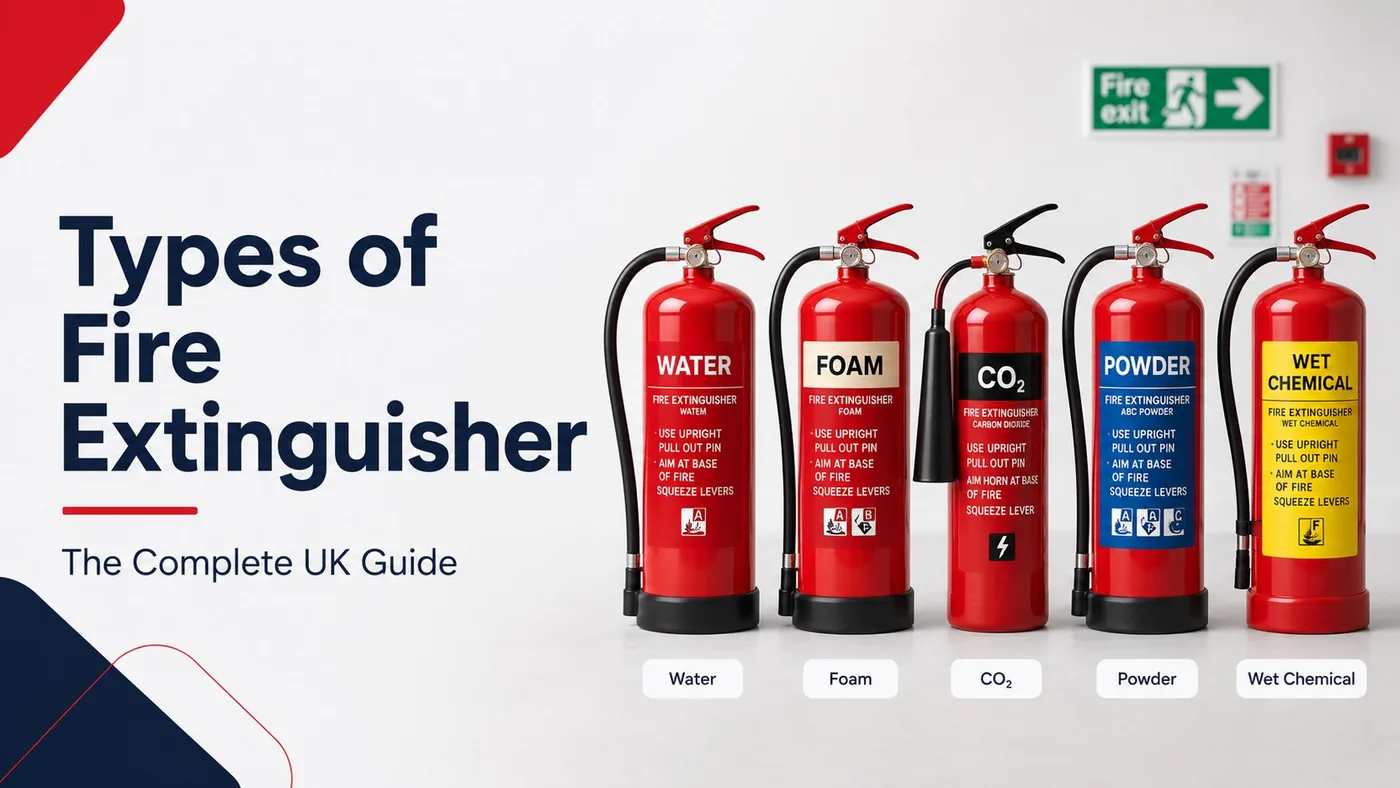
Britain has settled on five primary types of fire extinguisher, each designed for a specific kind of fire. The right one tackles the flames; the wrong one can make things worse, sometimes dangerously so. This guide walks through what each of the five types does, what the colours mean, which fires they handle, and where the regulations sit in 2026.
A note before we begin. UK fire safety law does not name a brand or model you must buy. What it requires is that the equipment in your premises matches the risks identified in your fire risk assessment, that it meets recognised British Standards, and that it is maintained in working order. Everything below is the framework for making those judgements well.
The UK colour code at a glance
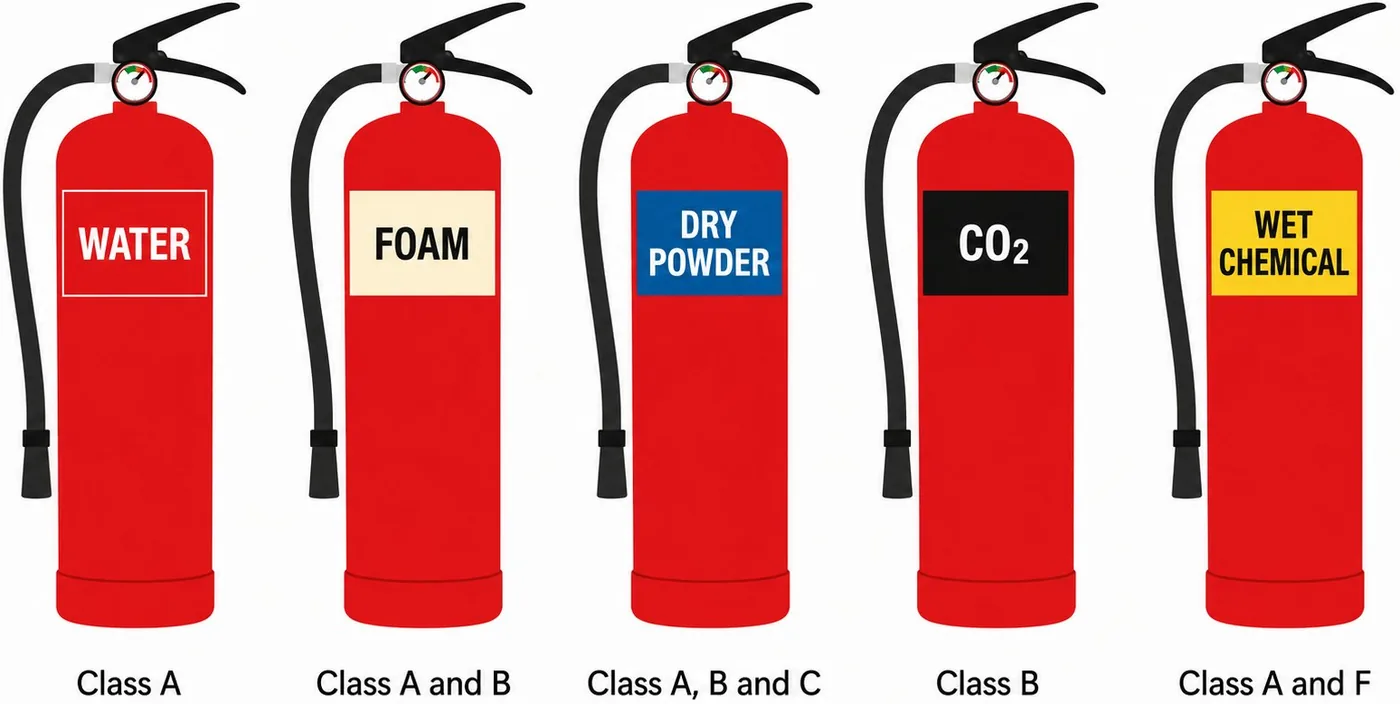
Modern UK fire extinguishers have a red body — specifically “signal red” — with a smaller coloured panel near the label that tells you what is inside. The red body makes the unit visible in smoke; the coloured panel tells you what kind of fire it tackles. The system is set out in BS EN 3 (the European product standard) and BS 5306-10:2019 (the colour-coding standard).
The five panels you will see in UK premises:
| Colour panel | Type | Main fire classes |
|---|---|---|
| Red (no contrast panel) | Water | A |
| Cream | Foam | A and B |
| Blue | Dry powder | A, B, C and electrical (≤1000 V) |
| Black | Carbon dioxide (CO2) | B and electrical |
| Yellow | Wet chemical | F (and sometimes A) |
Older extinguishers from before 1997 had bodies coloured throughout — a fully blue powder unit, a fully cream foam unit, and so on. Those remain legal in most premises covered by the Regulatory Reform (Fire Safety) Order 2005, provided they are not defective and are still being maintained. New replacements all follow the red-body-with-coloured-panel convention.
The five primary extinguisher types
Each section below is a quick orientation. Each links to a fuller page with the chemistry, capacities, sizing, and the situations each one belongs in.
Water (red label)
The traditional, simplest extinguisher. Water tackles Class A only — solid combustibles like paper, wood, fabric and most plastics. It cools the burning material below its ignition temperature, leaves no chemical residue, and is by far the cheapest type to buy and to service.
It must never be used on flammable liquids (the water sinks below the burning fuel and turns to steam, ejecting the fire) or on live electrical equipment (water conducts). A modern variant, water mist, uses de-ionised water and a fine spray to widen the use case — some water mist units are dielectrically tested for use on live electrical equipment up to 1000 V at 1 metre. For the full picture, see our guide to water fire extinguishers.
Foam (cream label)
Foam extinguishers handle Classes A and B — solids and flammable liquids. The agent forms a film over a burning liquid, cutting off vapour and oxygen while cooling the fuel. They are a common workplace choice because most premises carry both Class A risks (paper, furniture) and small Class B risks (cleaning solvents, paint, fuel for forklifts).
Foam carries one important regulatory wrinkle in 2025-26. Older foam extinguishers contained AFFF (aqueous film-forming foam) with PFOS or PFOA — known as “forever chemicals.” PFOS was banned in UK firefighting foams more than a decade ago; PFOA has been banned since 4 July 2025 under UK REACH. The newer C6 fluorotelomer foam is currently still legal but is under DEFRA and HSE consultation, and a wider PFAS phase-out is expected this decade. The detail, including how to check whether your existing foam unit is still compliant, is on our guide to foam fire extinguishers.
Carbon dioxide (black label)
CO2 extinguishers handle Class B and live electrical equipment fires. The gas displaces oxygen around the fire and leaves no residue, which is why CO2 is the standard choice for offices, server rooms, and electrical cabinets. Two cautions matter. The discharge horn becomes very cold during use — frostbite is a real risk if you grip it directly. And CO2 must not be used in confined spaces because it can asphyxiate the user.
CO2 has the longest service interval of any extinguisher type — the extended service is every 10 years rather than every 5. For the rest of the picture see our CO2 fire extinguisher guide.
Dry powder (blue label)
Standard ABC dry powder is the most versatile single agent — Classes A, B, C (flammable gases), and electrical equipment up to 1000 V. The powder smothers the fire and interrupts the chemical reaction that sustains it.
Versatility comes with trade-offs. Powder discharge clouds the air, drastically reducing visibility, and inhalation is a respiratory hazard. BS 5306-8:2023 (clause 5.4.3) specifies that powder extinguishers should generally not be specified for indoor use unless mitigated by a health and safety risk assessment. They are at their best in garages, forecourts, vehicles, workshops, and other open or outdoor environments.
Specialist Class D variants exist for combustible-metal fires: L2 powder for lithium metal, M28 powder for magnesium, sodium, potassium and others. L2 powder is not the answer to lithium-ion battery fires — that is a different problem under the new Class L classification, covered below. The full guide is our page on dry powder fire extinguishers.
Wet chemical (yellow label)
The yellow-labelled wet chemical extinguisher is designed for Class F — cooking oils and fats. The agent (usually a potassium acetate solution) sprays as a fine mist that reacts with burning oil through a process called saponification, forming an inert soapy foam layer that smothers the flames and prevents re-ignition.
Wet chemical extinguishers are essential anywhere a deep fat fryer is in use — restaurants, takeaways, hotel kitchens. Some are also rated for small Class A fires, but they are far less effective on solids than water. For domestic kitchens, a fire blanket plus a small water mist extinguisher is usually the more practical answer. See our guide to wet chemical fire extinguishers for the detail.
A modern sixth option: water mist
Strictly speaking the UK has five extinguisher types, but water mist deserves a separate mention. Modern water mist extinguishers use de-ionised water and a supersonic nozzle to produce a microscopic mist. The fine droplets cool the fire, displace oxygen, and don’t conduct electricity in the way bulk water does. A single water mist extinguisher with the right rating can handle Classes A, F, and live electrical equipment — making it an attractive single-unit answer for smaller premises that would otherwise need two or three different extinguishers.
Water mist won’t replace dedicated wet chemical in commercial kitchens (the F-rating is small), and it is more expensive to buy. But for a small office, a holiday let, or a domestic kitchen, it is a sensible modern choice.
Which extinguisher for which fire — quick reference
A working table for everyday selection. Always confirm specifics against the extinguisher’s own label and your fire risk assessment.
| Fire scenario | Recommended | Acceptable alternative | Do NOT use |
|---|---|---|---|
| Class A — solids (paper, wood, fabric) | Water | Foam, water mist, ABC powder, wet chemical (small) | CO2 |
| Class B — flammable liquids (petrol, paint) | Foam | CO2 (small contained), ABC powder (outdoor) | Water, wet chemical |
| Class C — flammable gases | (Isolate the supply) ABC powder | — | Water, foam, CO2 |
| Class D — combustible metals | L2 or M28 specialist powder | — | Water, foam, CO2, ABC powder |
| Class F — cooking oils | Wet chemical | Fire blanket (small), water mist with F-rating | Water, foam, CO2, ABC powder |
| Live electrical equipment | CO2 | Dry powder (≤1000 V), tested water mist | Water, standard foam |
| Lithium-ion battery (Class L) | Specialist suppression, evacuate | (No portable extinguisher is currently rated) | Water, foam, ABC powder, L2 powder |
For deeper “which extinguisher and why” answers on the trickiest scenarios, see the right extinguisher for an electrical fire, the right extinguisher for a chip-pan or kitchen oil fire, and the right extinguisher for petrol or other flammable liquids.
The five UK fire classes — a brief tour
Fires are classified under BS EN 2 by the type of fuel involved. There are five UK fire classes: A, B, C, D and F. (You may notice E is missing from that list — that is on purpose; we will get to it.)
- Class A — solid combustibles. Wood, paper, textiles, soft plastics, most household materials.
- Class B — flammable liquids. Petrol, diesel, kerosene, paint, solvents, alcohols.
- Class C — flammable gases. Propane, butane, methane, LPG.
- Class D — combustible metals. Lithium, magnesium, sodium, potassium, aluminium swarf.
- Class F — cooking oils and fats. Animal and vegetable fats; the chip-pan fire.
For the deeper version, including examples by class and the right extinguisher choices, see our guide to UK fire classes.
Halon and other decommissioned types
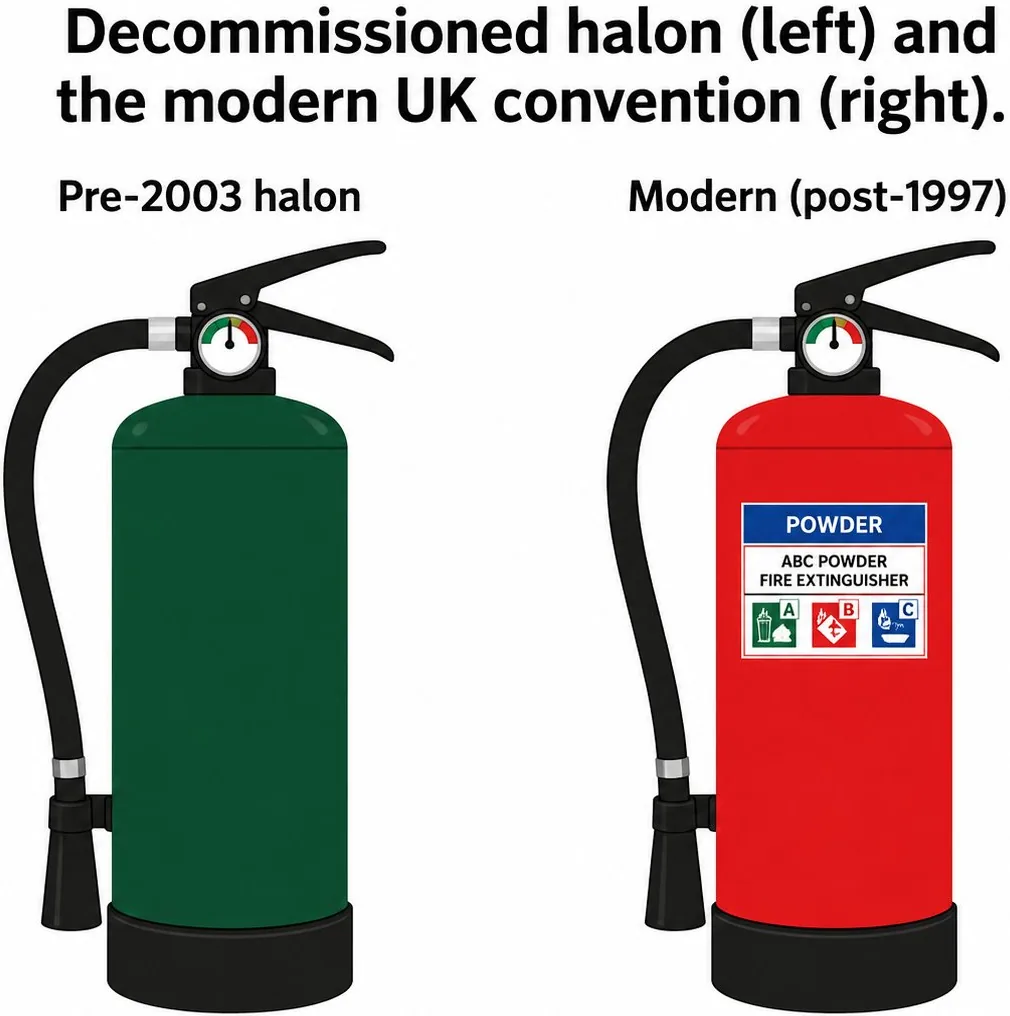
Some older premises still have green-bodied halon extinguishers tucked in a cupboard. These were banned for general use in the UK in 2003 under the Montreal Protocol because halon depletes the ozone layer. If you find one, do not use it and do not put it in general waste — halon disposal must go through a specialist or the original manufacturer. We cover the right route on our extinguisher disposal page.
A note on the older all-coloured-body extinguishers from before the 1997 standardisation: those remain legal in most UK premises covered by the Fire Safety Order, provided they are still being maintained and are not defective. You do not need to replace them on colour grounds alone. New units carry red bodies with coloured panels.
What’s new in 2026: BS ISO 3941 and Class L
January 2026 brought the most significant fire-classification update in many years. BS ISO 3941:2026 introduced Class L — a dedicated category for fires involving lithium-ion battery cells and packs.
Lithium-ion battery fires behave differently from anything else in the standard list. They generate heat through a self-sustaining electrochemical reaction inside the cell (“thermal runaway”); they release oxygen as part of that reaction, which means smothering doesn’t work well; they re-ignite easily, sometimes hours after they appear to be out; and they emit toxic gases. That hazard profile is poorly served by the existing Class A, Class B or “live electrical equipment” frameworks.
One important caveat. Class L sits in BS ISO 3941, the fire-classification standard. It does not yet sit in BS EN 2 or BS EN 3 — the standards used for portable extinguisher fire ratings. In practical terms, that means no portable fire extinguisher currently carries a Class L mark on its label. Specialist battery fire suppression products exist, but they are not yet category-defined under BS EN 3.
If you manage premises with lithium-ion batteries — battery energy storage systems, electric vehicle chargers, e-bike storage rooms — your fire risk assessment should now identify Class L explicitly. The classification change strengthens that expectation even though the extinguisher standards have not caught up.
Common things people read online that aren’t quite right
Several mistakes circulate widely enough to be worth correcting in one place.
There is no Class E fire in the UK
Many older guides still list “Class E” for electrical fires. Under BS EN 2, electricity is an ignition source or a hazard, not a fire class — electricity itself doesn’t burn, it just causes other things to. Modern UK extinguishers carry markings to indicate suitability for use on live electrical equipment, but they don’t have a “Class E” rating because the class doesn’t exist.
There aren’t six fire classes
You will sometimes see lists with Class A, B, C, D, E and F. The error usually comes from including the historical “Class E” or counting water mist as a class rather than an extinguisher type. The five UK classes under BS EN 2 are A, B, C, D and F. Class L from BS ISO 3941:2026 is the genuine new entry.
The law does not require “two extinguishers per floor” of any particular type
What the Regulatory Reform (Fire Safety) Order 2005 requires is appropriate firefighting equipment based on the findings of your fire risk assessment. BS 5306-8:2023 provides selection and positioning guidance — coverage, travel distances and rating combinations — but does not impose a one-size-fits-all rule.
CE marking has not been replaced by UKCA
As of writing, both marks remain valid in Great Britain for fire extinguishers; the deadline for ending CE acceptance has been deferred. Northern Ireland uses CE or UKNI under the Windsor Framework. A UK-supplied extinguisher displaying CE alone is not non-compliant.
Annual servicing is not strictly the law — but it is the recognised standard
The Fire Safety Order requires equipment to be in efficient working order. BS 5306-3:2017 sets out monthly visual checks, an annual basic service by a competent person, then extended service every 5 years (water, foam, powder, wet chemical) or 10 years (CO2). In practice you need to follow that schedule to demonstrate compliance, and a BAFE SP101-registered technician is the strongest evidence that your annual service has been done properly. The full picture is on our fire extinguisher servicing and inspection guide.
Frequently asked questions
How many types of fire extinguisher are there in the UK?
Five primary types — water, foam, CO2, dry powder and wet chemical — each with a distinct coloured panel. Water mist is increasingly common as a sixth option and is recognised under BS EN 3, although it is not a separate fire class.
Do older all-coloured-body extinguishers (pre-1997) need to be replaced?
No, not on colour grounds alone. They remain legal in most premises covered by the Fire Safety Order, provided they are still being serviced and are not defective. They get replaced at end of life like any other extinguisher.
Is “signal red” a real specification?
Yes. Modern UK fire extinguisher bodies are coloured signal red (RAL 3000), specified under BS EN 3. The contrasting panel — cream, black, blue or yellow — covers approximately 5% of the surface, near the label.
Is there a Class E fire in the UK?
No. Under BS EN 2, electrical is not a fire class. Extinguishers are tested and marked for use on live electrical equipment, but there is no “Class E” rating in current UK use.
What is Class L?
A new fire class introduced by BS ISO 3941:2026 in January 2026, covering fires involving lithium-ion cells and batteries. It is recognised in fire risk assessments, but it is not yet incorporated into the BS EN 2/EN 3 system that governs extinguisher ratings — so no portable extinguisher carries a Class L mark at present.
Does my workplace need every type of fire extinguisher?
No — it needs the types appropriate to the risks identified in your fire risk assessment. A typical office needs water or foam plus CO2. A commercial kitchen also needs wet chemical. A garage might need ABC powder. Your assessment specifies the mix.
How often should fire extinguishers be serviced?
Monthly visual checks, an annual basic service by a competent person, then extended service every 5 years for water, foam, powder and wet chemical, or every 10 years for CO2. The detail is on our fire extinguisher servicing guide.
What does a rating like “13A” or “55B” on a label mean?
The number expresses the size of fire the extinguisher has been tested to handle in a controlled fire-rating test. A 13A rating refers to a stack of timber of a specified size; 55B refers to a flammable-liquid fire of a given square-metre area. Larger numbers, larger fires.
Does my home need fire extinguishers?
There is no UK law requiring fire extinguishers in private homes. A fire blanket and working smoke alarms are the priorities. If you do want an extinguisher, a small water mist with an F-rating or a 1 kg dry powder unit covers most household risks. A wet chemical extinguisher is overkill unless you have a deep fat fryer.
Where to go from here
If you are working out what your premises need, start with a fire risk assessment — it is the document that drives every other choice. If you are training your team on fire safety basics, the foundation is our online fire safety awareness training course, which is RoSPA-approved, CPD-accredited, and designed for every employee in a UK workplace.
For deeper detail on a specific question, the spokes from this guide will take you there:
- Water fire extinguishers
- Foam fire extinguishers (and the PFAS picture)
- CO2 fire extinguishers
- Dry powder fire extinguishers
- Wet chemical fire extinguishers
- UK fire classes explained
- How to use a fire extinguisher (PASS)
- Fire extinguisher servicing and inspection
- Who is responsible for fire extinguishers in UK workplaces
Related guides
- Who Is Responsible for Fire Extinguishers in the UK?
- Fire Extinguisher Disposal: The UK Guide
- Fire Extinguisher Servicing and Inspection: The UK Guide
Train your whole team on fire safety basics with accredited online training.
Explore the Fire Safety Awareness Training course →
Mark writes about workplace health & safety, fire safety awareness and accredited online training for Fire Safety Awareness Training, part of Online CPD Academy.