
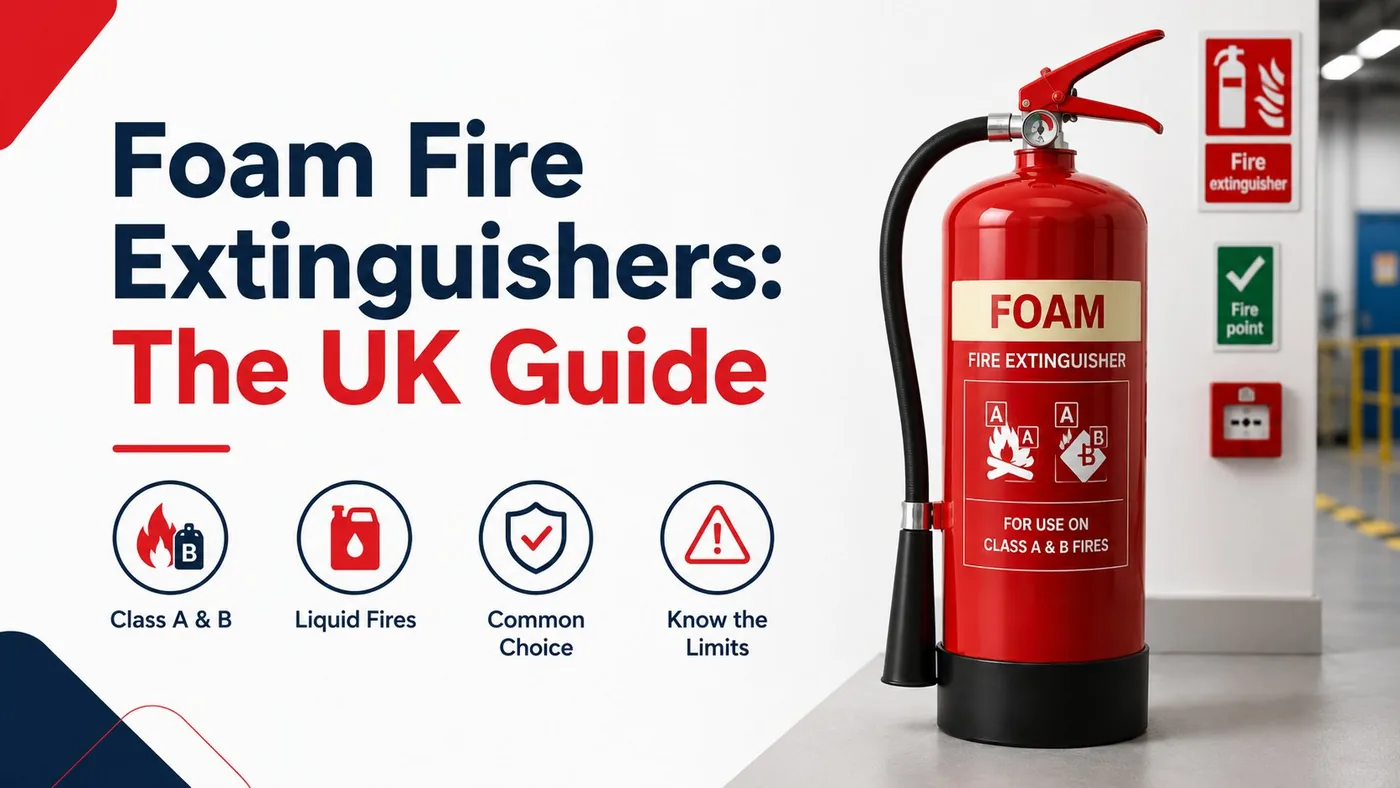
The cream-labelled foam fire extinguisher is one of the most widely used types in UK workplaces. It tackles both Class A (solid combustibles) and Class B (flammable liquids), making it a sensible single-unit choice for premises that carry a mix of paper, furniture, fuel, paint and solvents. Most UK offices, hotels, factories and small workshops have at least one.
In 2025-26, foam is also the type going through the most regulatory change in a generation. The “forever chemical” PFOA was banned in UK firefighting foams from 4 July 2025, and a wider phase-out of fluorinated foams is under consultation. This page covers what foam extinguishers do, how they work, and exactly where the regulatory line currently sits — because most older guides on the topic are now out of date.
What a foam fire extinguisher is
A foam extinguisher is a stored-pressure unit containing a foam concentrate dissolved in water. When discharged, the agent expands as it leaves the nozzle, producing a layer of foam that smothers the fire and cools the fuel surface.
The body is signal red, with a cream-coloured panel near the label that identifies the type — the cream panel is the visual cue everyone learns. The unit is rated under BS EN 3 (the European product standard) and selected and positioned in UK premises under BS 5306-8:2023.
Foam extinguishers come in two main capacities — 6 L and 9 L — with typical fire ratings around 13A 113B for a 6 L unit and 21A 183B for a 9 L unit. Some are also dielectrically tested for use on live electrical equipment, normally up to 1000 V at 1 metre — that rating must be on the label of the specific unit; it cannot be assumed.
How foam extinguishers work
Foam extinguishers attack the fire on two fronts. The foam layer forms a continuous blanket over the burning fuel — particularly important for flammable liquids — that physically separates the fuel from the air. With no oxygen reaching the surface, the fire suffocates. At the same time, the water content of the foam cools the fuel and the surrounding material, lowering the temperature below the ignition point.
For a Class B fire (a tray of burning solvent, a small fuel spill), the foam blanket is the critical mechanism. Once a continuous layer is established, the fire is starved of oxygen and the vapours trapped under the foam can no longer feed the flames. Break the blanket — for example, by walking through it — and the fire can re-ignite. That is why the standard technique for foam on a flammable-liquid fire is to sweep gently across the surface and build a continuous layer, rather than blasting straight at the fuel.
For a Class A fire (paper, wood, fabric), the foam works more like water with a longer residence time. The water content cools, the foam clings to vertical surfaces, and the agent penetrates burning fabric and upholstery more readily than plain water.
What foam extinguishers tackle
Class A and Class B. The standard examples:
- Class A: paper, cardboard, wood, fabric, soft plastics, coal — the same combustibles a water extinguisher handles, with the foam giving better coverage on vertical surfaces and through upholstery.
- Class B: petrol, diesel, paraffin, kerosene, oil-based paints, solvents — small to medium liquid fires, particularly contained ones (a tray, a spill, a small fuel store).
That coverage makes foam a very practical workplace primary — a single foam extinguisher addresses both the dominant Class A risk in a typical office and the smaller Class B risks (cleaners, paint, small fuel tins) that often sit alongside it.
What foam doesn’t tackle:
- Class C (flammable gases) — foam does nothing useful.
- Class F (cooking oils and fats) — foam can splash burning oil, much like water; wet chemical is the right answer.
- Class D (combustible metals) — foam reacts with hot reactive metals.
- Live electrical equipment — only with a current dielectric rating on the label, and even then with the stated voltage and distance limits respected.
The PFAS picture in 2025-26
This is the section where most foam-extinguisher guides are now stale, so it is worth working through carefully.
Many older foam extinguishers contain AFFF — Aqueous Film-Forming Foam — which historically used a class of synthetic chemicals called PFAS (per- and poly-fluoroalkyl substances), or “forever chemicals,” to lower the foam’s surface tension and improve performance on flammable liquids. The two specific PFAS chemicals that have been at the centre of UK regulatory attention are PFOS and PFOA.
PFOS has been banned in UK firefighting foams for over a decade. Most foam extinguishers manufactured since around 2011 are PFOS-free.
PFOA is the change that took effect on 4 July 2025. Under UK REACH regulations, the use, service, maintenance, testing, refilling and sale of fire extinguishers containing PFOA-based foam — including older AFFF units — is now prohibited. The ban aligns the UK with broader international action on persistent organic pollutants.
C6 fluorotelomer foam, the chemistry that most AFFF units installed since the late 2010s use, is currently still legal in the UK as of writing. It contains PFAS but at a different chain length than PFOA. DEFRA and HSE are conducting a consultation on whether and how to restrict C6 and other PFAS chemicals in firefighting applications. The FIA has indicated that wider UK PFAS restrictions are likely from 2026 onwards, with phase-out periods possibly extending toward 2030.
The EU has moved further than the UK on this. EU restrictions on PFAS in firefighting foams are now in force, with timelines running through 2035 for fixed systems. The UK is not bound by these directly, but they are a clear indicator of where the UK is heading.
Does my foam extinguisher contain PFOA?
The practical question for most readers. A few ways to work it out:
Check the manufacture date
Foam extinguishers manufactured since around 2016 are unlikely to contain PFOA — major UK manufacturers had transitioned to C6 by then. Units manufactured before 2016 are increasingly likely to contain PFOA the older they are.
Check the label
The Safety Data Sheet for the foam should specify the chemistry. Older units may list “AFFF” without further detail; newer compliant units typically state “C6,” “fluorotelomer,” “PFOA-free,” or “fluorine-free.”
Ask the manufacturer or supplier
For ambiguous cases, the manufacturer or your servicing contractor can confirm the chemistry. A BAFE SP101-registered servicing organisation will be able to identify and document the agent.
Don’t assume refilling fixes the problem
Refilling a previously-PFOA extinguisher with new fluorine-free foam does not make it compliant — residual PFOA remains in the cylinder, and the unit’s fire-test ratings may also have been compromised. A non-compliant unit must be replaced, not refilled.
If you have foam extinguishers that contain PFOA, they must be removed from service and disposed of via a licensed hazardous waste contractor. PFOA-containing foams require high-temperature incineration; they cannot be put into general waste or discharged to drain. The disposal route is on our fire extinguisher disposal page.
Fluorine-free foam — the long-term answer
The replacement for AFFF is fluorine-free foam, often called F3 or FFF. These products use synthetic surfactants and other agents to achieve film-forming performance without any PFAS content. They are tested and approved to BS EN 3 and carry equivalent fire-rating capability for Class A and Class B fires.
Two practical considerations. First, fluorine-free foams may have different application rates and discharge patterns than legacy AFFF — when transitioning, check the new unit’s rating against the fire risks identified in your fire risk assessment. Second, manufacturers’ “PFAS-free” or “fluorine-free” claims should be checked against the product’s Safety Data Sheet to confirm what the unit actually contains.
Most major UK extinguisher manufacturers now offer fluorine-free foam ranges, and the FIA is recommending organisations plan transitions toward fluorine-free agents — particularly for higher-risk applications and for shorter regulatory derogation periods. For most UK premises, the practical pattern is to retain compliant C6 units in service to end of life, and specify fluorine-free for new installations and for replacements.
Use on electrical equipment — only with the rating
Some foam extinguishers are dielectrically tested and carry a marking authorising use on live electrical equipment, normally up to 1000 V at a minimum distance of 1 metre. Where a foam extinguisher carries that marking, it can be used on an electrical fire within the stated limits.
Without that marking, foam should be assumed unsafe on live electrical equipment. Standard foam contains enough water to conduct, and the conductivity worsens once the foam contacts heated and partially-combusted material. If electrical fire cover is a primary requirement for your premises, a CO2 fire extinguisher or a dielectrically-tested water mist unit are simpler and safer choices than foam. The detail is on our guide on the right extinguisher for electrical fires.
Where foam extinguishers belong
Typical UK placements:
Offices, retail, hotels
A 6 L foam extinguisher per fire point covers Class A (paper, furniture) and small Class B (cleaning solvents, alcohol-based hand sanitisers), often paired with a CO2 unit for electrical risk.
Workshops, light industrial
A 9 L foam extinguisher near workbenches, fuel storage, or paint stores covers both the Class A debris fires and the small Class B liquid risks. Larger workshops add ABC dry powder for outdoor or specialist coverage.
Hotel kitchens (back-of-house)
Foam covers the Class A risk in storage and prep areas. The cooking line itself needs a wet chemical extinguisher and a fire blanket — foam is not a kitchen-line answer.
Garages and forecourts
Foam is appropriate inside the building (offices, parts stores). Outdoors near pumps, dry powder is usually preferred for the higher Class B exposure.
UK capacities are normally 6 L and 9 L for hand-held units. Larger wheeled foam extinguishers exist for industrial sites and aviation contexts.
Servicing
Foam extinguishers follow the standard maintenance schedule under BS 5306-3:2017: monthly visual checks by the on-site responsible person, annual basic service by a competent person (BAFE SP101-registered is the strongest evidence of competence), and an extended service every 5 years.
The PFAS situation adds two extra considerations at service time. First, the engineer should be able to identify and document the foam chemistry. Second, any foam extinguisher containing PFOA found during servicing must be removed from service immediately and routed to compliant disposal — a unit found to contain PFOA cannot be returned to service even if the rest of it is in good condition. The full picture is on our fire extinguisher servicing and inspection page.
How to use a foam extinguisher
The PASS technique applies, with one foam-specific note: aim to build a continuous foam blanket on a flammable-liquid surface, sweeping gently rather than blasting directly at the fuel. A direct blast at a liquid surface can splash burning fuel; a gentle sweep lays the blanket over the top.
For Class A fires, foam can be used much like water — at the base of the fire, sweeping across the burning material. Expect a wet, foam-coated mess afterwards; foam clings to surfaces longer than water and the residue requires cleaning up.
The full step-by-step is on our PASS technique guide.
Frequently asked questions
Is my foam extinguisher banned?
Only if it contains PFOA — that ban took effect on 4 July 2025. Most foam extinguishers manufactured since around 2016 are likely PFOA-free; older units are increasingly likely to contain PFOA. The Safety Data Sheet, the manufacture date, or your servicing contractor can confirm.
Does the July 2025 ban affect every foam extinguisher?
No. The ban specifically prohibits PFOA-containing foam. C6 fluorotelomer foam is currently still legal in the UK. PFOS-containing foam was already banned over a decade ago. Fluorine-free foam is unaffected.
What’s the difference between C6 and C8?
The numbers refer to the carbon chain length of the PFAS chemistry. C8 (which includes PFOA) is the longer-chain, more environmentally persistent type now banned in firefighting foams. C6 (fluorotelomer) is the shorter-chain replacement, currently legal but under consultation.
Can I refill an old AFFF extinguisher with fluorine-free foam?
No, not for compliance purposes. Residual PFOA remains in the cylinder after refilling, and the fire-rating tests no longer apply. A non-compliant unit must be replaced, not refilled.
What is fluorine-free foam?
Foam that contains no PFAS — instead using synthetic surfactants and other agents to achieve film-forming performance. Often labelled F3 or FFF. The long-term direction of travel for foam extinguishers in the UK and EU.
Can foam be used on electrical fires?
Only if the specific unit carries a current dielectric rating, with stated voltage and distance limits. Standard foam without that marking should not be used on live electrical equipment.
When will C6 foam be banned in the UK?
A specific date has not been set. The DEFRA/HSE consultation on wider PFAS restrictions is ongoing as of writing; the FIA’s published guidance suggests UK restrictions on C6 foam are likely from 2026 onwards, with phase-out periods possibly extending toward 2030.
Where this connects
If you are deciding what extinguisher mix your premises needs, the hub guide on fire extinguisher types gives the full picture across all five types. For the related use cases, see the right extinguisher for flammable liquids and the right extinguisher for electrical fires. The compliance and servicing context is on fire extinguisher servicing and inspection and fire extinguisher disposal.
For the basics of fire safety in a UK workplace — what to do, who is responsible, and how to train staff — start with our online fire safety awareness training course, which is RoSPA-approved and CPD-accredited.
Related guides
- Who Is Responsible for Fire Extinguishers in the UK?
- Fire Extinguisher Disposal: The UK Guide
- Fire Extinguisher Servicing and Inspection: The UK Guide
Make sure your team knows how to recognise fire risks and act safely when an alarm sounds.
Explore the Fire Safety Awareness Training →
Mark writes about workplace health & safety, fire safety awareness and accredited online training for Fire Safety Awareness Training, part of Online CPD Academy.