
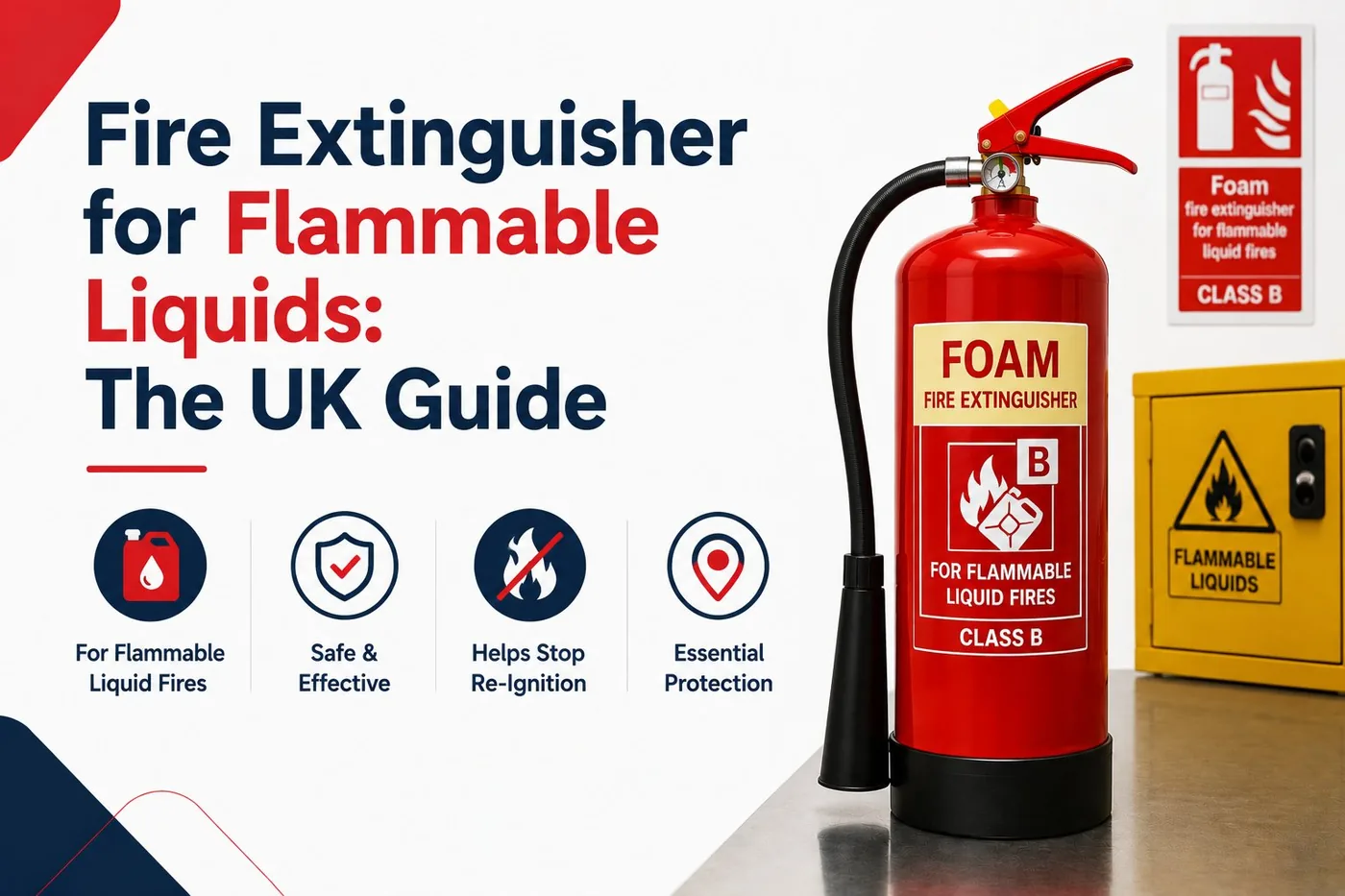
The most-searched question on flammable liquid fires in the UK is which extinguisher you must not use to put one out. The answer comes first because it is the answer that prevents harm: never use water on a flammable liquid fire. Doing so does not extinguish the fire — it spreads it, often violently.
This page explains why water is so dangerous, sets out what to use instead (foam first, with CO2 and dry powder as alternatives for specific scenarios), and works through the practical specifics for the flammable liquids most UK premises actually deal with: petrol, diesel, paint and solvents.
Which extinguisher should you NOT use on flammable liquids
Water. Standard red-label water extinguishers must never be used on a burning flammable liquid. Wet chemical extinguishers — despite the "chemical" in the name — also must not be used on conventional flammable liquids; they are designed for cooking oils only.
The reason both fail comes down to physics, and it is worth understanding because it explains the rest of the page.
Why water on flammable liquids is so dangerous
Most flammable liquids — petrol, diesel, kerosene, paint thinners, white spirit, alcohols — are less dense than water. Pour water onto a burning pool of fuel and the water sinks beneath the burning layer.
Once the water is below the fuel, two things happen at once. The water hits a layer of liquid that may be at 200°C, 300°C or more. It vaporises explosively. One volume of water becomes roughly 1,700 volumes of steam in the moment it takes to convert.
The steam erupts upward through the burning fuel, throwing it into the air. The liquid is now airborne, in droplet form, with each droplet exposed to fresh oxygen. What was a contained pool fire becomes a fireball that can reach the ceiling, ignite walls, and reach people standing back from the original fire.
The same mechanism is why water is so catastrophic on cooking oil fires (covered separately on our cooking oil fire guide) and why dielectrically-tested water mist is the only water-based agent that handles flammable-liquid scenarios at all — and even then, only on the very small contained fires its rating covers.
What to use — foam, first
The standard answer for a flammable-liquid fire in a UK workplace is a foam extinguisher. The cream-labelled foam unit produces a layer of expanded foam that floats on top of the burning liquid, sealing the surface from the air. With no oxygen reaching the fuel, the fire suffocates. The water content of the foam also cools the fuel, reducing vapour generation.
The technique matters. Sweep the foam gently across the surface to build a continuous blanket; do not aim the discharge directly into the fuel, which will splash burning liquid out of the container. The blanket needs to be unbroken — once a continuous foam layer covers the fuel surface, the fire is starved. If a gap opens up (someone walks through it, or the foam dissipates before a hot spot has cooled), re-ignition is a real risk.
A 6 L foam extinguisher with a 113B rating handles a tray-scale Class B fire — a tin of paint, a small fuel spill, a contained workshop incident. A 9 L unit rated 183B handles larger incidents. Above that, you are into the territory of fixed suppression systems or the fire and rescue service. The detail on foam itself, including the regulatory situation for older AFFF foam containing PFOA, is on our foam fire extinguisher page.
CO2 for small contained fires near electrics
CO2 extinguishers are also rated for Class B and are the right choice when the burning liquid is near energised electrical equipment — a contained solvent fire on a workbench beside a power supply, a small fuel-on-charger fire in a workshop, a benchtop spill near electronics.
The advantages over foam in this scenario: CO2 is non-conductive, so it is safe to use on or near live electrics, and it leaves no residue on the equipment. The disadvantages: CO2 cools very little, so re-ignition is more likely, and the gas dissipates fast in any normally-ventilated space.
CO2 is best at the small end of the scale. For anything beyond a tray-scale fire, foam handles it better. Use CO2 when the electrical hazard tips the choice. The product detail is on our CO2 fire extinguisher page.
Dry powder for outdoor and large-scale fires
ABC dry powder is rated for Class B and is the appropriate choice for outdoor flammable-liquid fires — vehicle fires, forecourt incidents, large workshop or yard scenarios. Powder smothers the fire and interrupts the chemical chain reaction at a molecular level; the agent is non-conductive up to 1000 V, which is useful where the fire is mixed with electrical risk on a vehicle or a piece of plant.
Indoors, dry powder runs into the visibility and respiratory problems that BS 5306-8:2023 (clause 5.4.3) specifically cautions against — the discharge cloud reduces visibility within seconds, and inhalation is genuinely unpleasant. For most UK workplaces, the practical pattern is to keep foam as the indoor primary for Class B and reserve dry powder for outdoor or vehicle use. The full picture is on our dry powder fire extinguisher page.
Wet chemical is NOT the answer for flammable liquids
Worth flagging clearly because the name confuses people: a wet chemical extinguisher is not a Class B extinguisher in the conventional sense. The yellow-labelled wet chemical unit is designed for Class F — cooking oils and fats — and works through a saponification reaction that depends specifically on the chemistry of cooking oils. Petrol, diesel, paint and solvents do not saponify; the wet chemical agent has nothing useful to react with.
The discharge of a wet chemical unit on a petrol or solvent fire produces a water-based mist that adds water to the fuel without forming a stable seal. The result is closer to the water-on-flammable-liquid problem than to a useful extinguishing action. Don't use wet chemical for anything other than cooking oils.
Petrol, diesel and kerosene specifics
The most common flammable liquids in UK premises split roughly into two groups by behaviour.
Petrol ignites readily — at room temperature, petrol vapour above an open container is normally above its lower flammable limit, which means a single spark is enough. A petrol fire is fast and aggressive; the vapour pressure keeps generating fuel for the flames as the liquid heats. Foam extinguishers handle petrol fires well within their rated capacity, but the effective window is short — the longer the fire burns, the more the surrounding air heats, and the harder it becomes to establish a stable foam blanket.
Diesel and kerosene ignite less readily. Both have higher flash points than petrol — diesel typically above 55°C, kerosene above 38°C — which means they need to be heated before vapours ignite. Once burning, they behave similarly to petrol in terms of extinguisher selection, but the fires are usually slower to start and easier to control. Foam works well; CO2 handles small contained fires; dry powder is the outdoor choice.
For all three, the primary safety control is not the extinguisher but the storage and ignition control: keeping fuel in approved containers, away from ignition sources, with appropriate bunding and spill control. A fire extinguisher is the response of last resort, not the first line of defence.
Paint, solvents and spirits
The flammable liquids most non-fuel UK premises encounter:
Oil-based paints, varnishes and stains
Class B; the carrier is normally white spirit or another petroleum-derived solvent. Foam handles paint fires effectively; the foam blanket seals the liquid surface. Beware of metal paint tins becoming pressurised in a fire — they can rupture and spray burning paint.
Solvents — white spirit, methylated spirits, isopropanol, acetone
Class B with varying flash points and behaviours. Methylated spirits and isopropanol are water-miscible, which means foam designed for fuel fires (designed to float on hydrocarbon fuels) can sink into them rather than forming a blanket — alcohol-resistant (AR) foam is the right specification for premises that handle significant quantities of polar solvents. Standard foam works for hydrocarbon solvents.
Spirits and alcohols (whisky, brandy, etc.) in commercial settings
Same issue as methylated spirits — water-miscible, requiring AR foam for effective coverage. Distilleries, bars and restaurants handling substantial alcohol stock should consider this in their fire risk assessment.
Adhesives, contact cement, sealants
Variable. Many are flammable in liquid form and produce flammable vapours; once cured, the fire risk reduces but doesn't disappear. Foam covers most.
Aerosol products
Not strictly liquid fires, but worth mentioning. Aerosol cans in a fire become projectile hazards as they pressurise and rupture; the propellants are typically flammable hydrocarbons. Treat the surrounding fire with foam or CO2; assume the cans themselves will rupture and clear the area accordingly.
Storage and ignition control — the better safety control
Worth saying directly: extinguisher selection matters less than not having the fire in the first place. UK fire safety law (the Regulatory Reform (Fire Safety) Order 2005, plus the Dangerous Substances and Explosive Atmospheres Regulations 2002 — DSEAR — for premises with significant flammable storage) requires you to identify and control the flammable-liquid risk through your fire risk assessment. The standard expectations include:
- Storing flammable liquids in approved containers, in dedicated cabinets or stores, separated from ignition sources.
- Bunding for larger quantities — secondary containment that catches a spill before it spreads.
- Good ventilation to disperse vapours, particularly in workshops and garages.
- Hot work permits for cutting, grinding or welding near stored flammables.
- Spill kits and trained users to deal with leaks before ignition.
- Smoking restrictions and signage in flammable storage areas.
A premises with proper storage controls and a sensible spill response rarely sees a flammable-liquid fire reach the point where extinguisher choice is the question. The extinguisher is the backup; the controls are the primary defence.
Frequently asked questions
Which extinguisher should you NOT use on flammable liquids?
Water and standard wet chemical. Water sinks beneath the burning liquid and instantly turns to steam, ejecting the burning fuel violently upwards. Wet chemical is designed for cooking oils only and adds water to the fuel without forming a stable seal.
What extinguisher do I use for petrol?
Foam is the standard answer indoors. CO2 for small contained fires near electrics. Dry powder for outdoor incidents or vehicle fires. Above tray-scale, evacuate and call 999 — fixed systems or the fire and rescue service take over.
Can I use a wet chemical extinguisher on petrol?
No. Wet chemical works through saponification, which is a reaction with cooking oils specifically. Petrol does not saponify; the wet chemical agent has no useful effect, and the water content adds risk.
Why doesn't water work on flammable liquids?
Most flammable liquids are less dense than water, so water sinks beneath the burning surface, vaporises in the heat, and erupts upward as steam — taking the burning fuel with it. The result is a much larger fire than the original.
What's the difference between Class B and Class F?
Class B covers conventional flammable liquids — petrol, diesel, paint, solvents, alcohols. Class F covers cooking oils and fats specifically. The chemistry, the fire behaviour, and the right extinguisher are different. Class B uses foam, CO2 or dry powder; Class F uses wet chemical or a fire blanket.
What about diesel?
Diesel has a higher flash point than petrol (typically above 55°C), so it ignites less readily, but once burning it behaves similarly. Foam handles diesel fires effectively within its rated capacity. Indoor: foam. Vehicle or outdoor: dry powder.
Where this connects
For the products themselves — chemistry, sizes, ratings — see our foam fire extinguisher page, our CO2 fire extinguisher page, and our dry powder fire extinguisher page. For where these sit in the wider type system, the fire extinguisher types hub is the place to start. For the wider fire classification context, see our UK fire classes guide. For the universal four-step technique, see how to use a fire extinguisher (PASS). For the maintenance and inspection picture, see fire extinguisher servicing and inspection.
If your team needs the basics of fire safety — what to do, what not to do, who is responsible — the online fire safety awareness training course covers it in 90 minutes, RoSPA-approved and CPD-accredited.
Related guides
- Who Is Responsible for Fire Extinguishers in the UK?
- Fire Extinguisher Disposal: The UK Guide
- Fire Extinguisher Servicing and Inspection: The UK Guide
Give your team the fire safety basics — what to do, what not to do, and who is responsible.
Explore the Fire Safety Awareness Training →
Mark writes about workplace health & safety, fire safety awareness and accredited online training for Fire Safety Awareness Training, part of Online CPD Academy.