
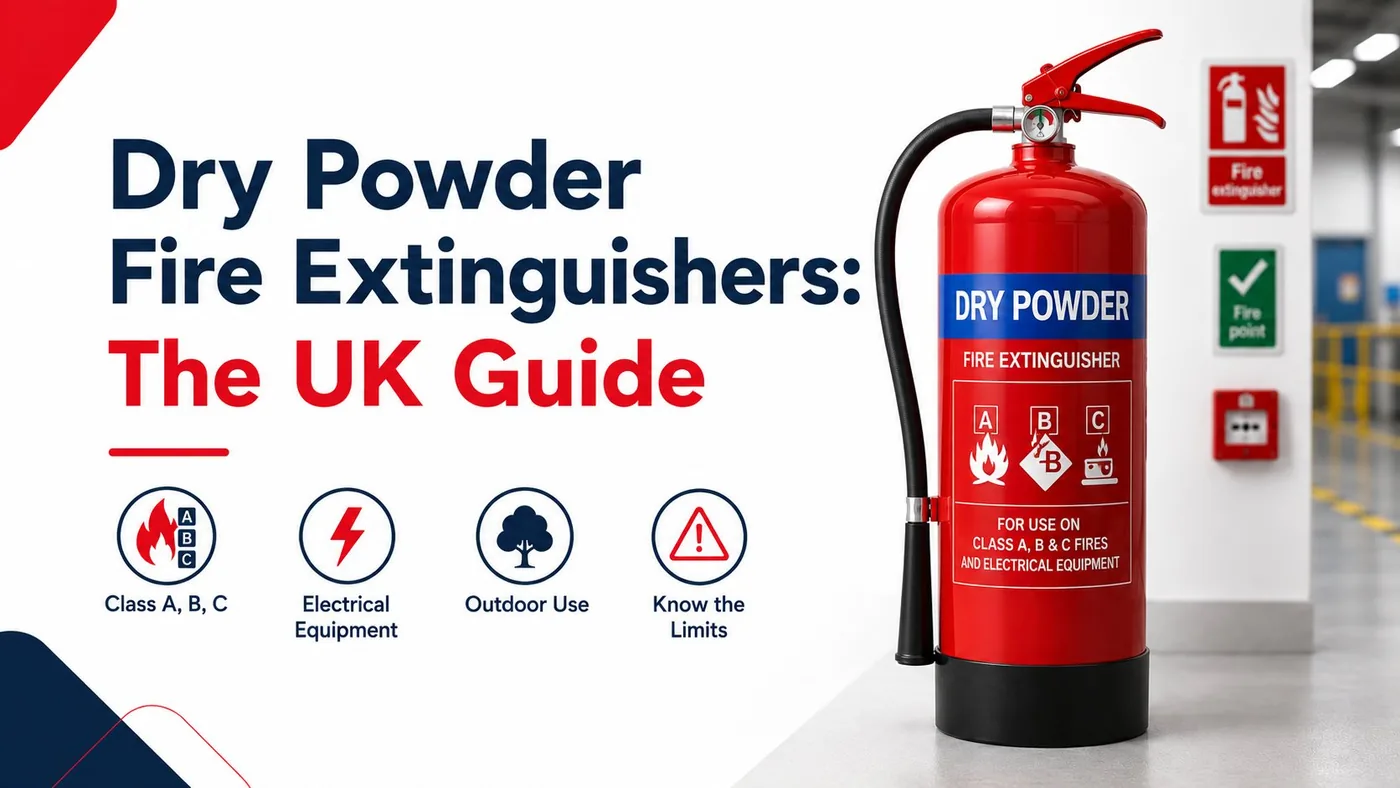
The blue-labelled dry powder fire extinguisher is the most versatile single agent in the UK lineup. Standard ABC powder tackles Class A solids, Class B flammable liquids, Class C flammable gases, and live electrical equipment up to 1000 V — four hazard categories from one unit. That versatility makes it a popular choice for vehicles, garages, forecourts and workshops, and a common second extinguisher in mixed-risk industrial settings.
But powder also comes with the most significant in-use restriction of any extinguisher type: BS 5306-8:2023 specifies that powder extinguishers should generally not be specified for indoor use unless that risk is mitigated through a health and safety risk assessment. That restriction shapes where powder genuinely belongs, and it is the part of the picture most casual guides understate.
This page covers what dry powder does, where it belongs, the Class D specialist variants for combustible-metal fires, and the increasingly important question that catches a lot of people out: dry powder (including L2 powder) is not the answer to a lithium-ion battery fire under the new Class L classification.
What a dry powder fire extinguisher is
A dry powder extinguisher contains a fine, dry chemical powder — usually a salt-based formulation — pressurised with an inert propellant gas (typically nitrogen). The body is signal red with a blue panel near the label. UK capacities range from 1 kg (typically a vehicle unit) up to 9 kg for hand-held workplace units, with larger wheeled units up to 50 kg for industrial sites.
The most common powder is ABC powder, named for the fire classes it tackles — A, B and C. The active agent is usually monoammonium phosphate, sometimes with sodium bicarbonate or other salts. Less common in UK premises but still produced is BC powder, which uses sodium bicarbonate or potassium bicarbonate and is rated for Class B and C only — slightly more effective on flammable-liquid fires but no use for Class A.
Dry powder extinguishers are tested under BS EN 3 and selected and positioned under BS 5306-8:2023. Most UK workplace units carry a Kitemark and a CE or UKCA mark, indicating compliance with the relevant performance and safety standards.
How dry powder works
Dry powder attacks the fire on two mechanisms simultaneously. The powder cloud smothers the fire, physically separating the fuel from the oxygen. At the same time, the chemical decomposition of the powder at high temperature interrupts the combustion chain reaction at a molecular level — the free radicals that propagate the fire are quenched by reaction products from the powder.
What powder doesn't do is cool. Unlike water or foam, dry powder removes very little heat from the burning material. The visible fire goes out quickly, but the fuel stays hot. If there is a continuing source of heat (a hot ember, a shorted circuit, a still-running fuel leak), re-ignition is a real risk after the powder cloud disperses. That is the same operational caveat that applies to CO2.
The lack of cooling is one reason powder is paired with a different type of extinguisher in many premises — a foam unit for Class A, a water mist unit for cooling — even where a single powder extinguisher would be technically sufficient.
What standard ABC powder tackles
Four categories from one unit:
- Class A (solid combustibles — paper, wood, fabric)
- Class B (flammable liquids — petrol, diesel, paint, solvents)
- Class C (flammable gases — propane, butane, methane, LPG)
- Live electrical equipment up to 1000 V (provided the user maintains a minimum 1 m distance)
The 1000 V limit matters. Above that voltage — high-voltage installations, distribution-grade equipment — dry powder is not rated, and CO2 takes over as the appropriate choice. Within the 1000 V limit, powder is non-conductive and the discharge is safe to direct at energised equipment, with the caveats below.
What powder doesn't tackle:
- Class F (cooking oils and fats). The discharge force can splash burning oil; the powder doesn't interact with the oil chemistry usefully. Wet chemical is the right answer.
- Class D (combustible metals). Standard ABC powder is not rated for metal fires; a specialist L2 or M28 powder is required (see below).
The 1000 V limit and the 1 m distance
The standard rating for ABC dry powder on live electrical equipment is "suitable for use on live electrical equipment up to 1000 V at a distance of 1 metre." The specific numbers come from the dielectric test that tested units undergo: a 35,000 V (35 kV) test voltage to verify safety, with the in-service rating set at 1000 V and the distance at 1 metre to provide a reasonable safety margin.
A few practical points:
- The rating only applies to units that have been individually tested and marked. Older or generic powder extinguishers may not carry the dielectric rating; check the label.
- 1000 V covers most general electrical equipment in UK premises — sockets, lighting, appliances, servers, kitchen equipment. Above that — substations, industrial high-voltage gear — powder is not the answer.
- The 1 m distance is from the discharge nozzle to the live equipment, not from the user. Stand far enough back that you can comfortably keep that distance with the discharge stream.
For more on the wider electrical-fire choice between CO2, dry powder, and water mist, see our guide on the right extinguisher for an electrical fire.
Specialist powder for Class D — L2 and M28
Combustible-metal fires (Class D) need different chemistry. Standard ABC powder is not rated for metal fires, and water and foam react dangerously with several of the metals involved. Two specialist variants exist:
L2 powder is formulated specifically for fires involving lithium metal — the elemental metal, used in laboratory and industrial settings. L2 powder works by smothering the fire and providing a chemical barrier between the metal and the air without the violent reactions that water or standard powder would trigger.
M28 powder is the more general Class D powder, used for fires involving magnesium, sodium, potassium, aluminium swarf and a range of other reactive metals. M28 also works through smothering and chemical inhibition.
Both L2 and M28 are specialist products. They are uncommon in general workplaces and are mostly found where Class D fire risks are explicitly identified — laboratories handling reactive metals, foundries, machine shops working with magnesium alloys. The use of either should follow specific training; they are not equivalent to general ABC powder.
L2 powder is NOT the answer to a lithium-ion battery fire
This is the disambiguation that most matters in 2026, because it catches a lot of people out.
L2 powder is rated for fires involving lithium metal — the pure elemental metal. Lithium-ion battery fires are something different: they involve lithium ions moving between cathode and anode in a self-sustaining electrochemical reaction once the cell goes into thermal runaway. The fuel chemistry, the heat generation mechanism, and the fire behaviour are not the same as a lithium-metal fire.
In January 2026, BS ISO 3941:2026 introduced Class L specifically for fires involving lithium-ion cells and batteries — explicitly noting that no metallic lithium is present. The introduction of Class L was needed precisely because these fires didn't fit cleanly into Class A, Class B, or Class D, and the existing extinguisher options didn't address the unique features (thermal runaway, self-oxygenating reaction, prolonged re-ignition risk).
Three things follow.
Class L sits in BS ISO 3941, not in BS EN 2 or BS EN 3. The fire-classification standard has been updated; the extinguisher fire-rating standard has not. As a result, no portable extinguisher currently carries a "Class L" rating on its label.
L2 powder, despite the name, is not rated for Class L
The "L" in L2 refers to lithium metal, not to the new Class L for lithium-ion. Treating L2 powder as a lithium-ion battery answer is a misreading.
For a lithium-ion battery fire, the practical answer is evacuation
Specialist suppression products exist — encapsulating agents, immersion bins for small devices — but they are not yet category-defined under BS EN 3, and most UK premises will not have them. A small device fire (a phone, a laptop battery) might be briefly knocked down by CO2, but re-ignition is the norm. Anything beyond that needs the fire and rescue service.
There is more on Class L on our fire classes guide.
BS 5306-8 clause 5.4.3 — the indoor restriction
Powder discharge produces a thick, opaque cloud that drastically reduces visibility within seconds of activation. In an enclosed indoor space, that has three immediate consequences:
- The user can lose sight of the fire, the escape route, and any other people in the room.
- The powder is a respiratory irritant; inhalation is unpleasant and, in larger discharges, hazardous.
- The clean-up afterwards is significant — the powder coats every surface in the room and works its way into electronics, fabrics, and ventilation.
Reflecting all of that, BS 5306-8:2023 (clause 5.4.3) specifically advises that powder extinguishers should not generally be specified for use indoors unless mitigated by a health and safety risk assessment. The wording matters: it is not a flat ban, but it is a strong steer. For most UK workplaces, the practical implication is that indoor primary cover is provided by foam or water (for Class A and B) and CO2 (for electrical), with powder reserved for outdoor or specifically-justified indoor settings.
That is why ABC powder, despite being the most versatile single agent, is not the workplace default. The trade-offs land too unfavourably indoors.
Where dry powder belongs
The genuinely good fits for ABC powder:
Garages, forecourts and vehicle workshops
Outdoor or large open-roof spaces, where the visibility issue matters less and where the mix of fuel, vehicles, electrics and gas cylinders all sit within powder's coverage.
Vehicles
A 1 kg or 2 kg powder extinguisher is the standard fit for cars, vans, HGVs, and commercial vehicles. The space inside a vehicle is small but ventilated when doors are open, and the multi-class capability suits the mixed risks (fuel, electrics, soft-furnishing).
Boiler rooms and plant rooms — where there is gas (Class C risk) alongside electrical equipment, and where the room is large and ventilated enough that the visibility trade-off can be managed.
Outdoor industrial. Large workshops, construction sites, agricultural buildings — where ABC's versatility outweighs the indoor restrictions.
Less suitable:
- Offices, schools, hotels, hospitals. Indoor primary cover is better handled by water or foam plus CO2.
- Server rooms and equipment-sensitive areas. Powder residue will write off the equipment.
- Confined spaces. BS 5306-8 cautions against both CO2 and powder in confined spaces; powder additionally creates a respiratory and visibility hazard.
How to use a dry powder extinguisher
The PASS technique applies — Pull, Aim, Squeeze, Sweep — with two powder-specific notes:
- Stand back. The powder cloud reduces visibility within seconds, and once you can no longer see the fire, you can no longer aim. Discharge from a slightly greater distance than you would with foam or water, and move closer cautiously as the fire shrinks.
- For a Class B liquid fire, sweep rapidly across the surface. For Class A solids, focus on the base of the fire and aim slightly low to ensure powder reaches the burning fuel.
Discharge is fast — a 6 kg powder extinguisher empties in around 20 seconds. Use the agent decisively; there isn't time for half-measures.
For the full step-by-step, see our PASS technique guide.
Servicing
Dry powder extinguishers are on the same maintenance schedule as water, foam and wet chemical: monthly visual checks, annual basic service by a competent person (BAFE SP101-registered), and an extended service every 5 years. The detail is on our fire extinguisher servicing and inspection page.
One powder-specific watch-point: the powder can compact over time, particularly in vehicles and outdoor units exposed to vibration and temperature change. Annual service includes a check to ensure the powder is still free-flowing. A unit with caked powder will not discharge correctly when needed and must be reconditioned or replaced.
Frequently asked questions
Can dry powder be used indoors?
Generally not, unless the risk has been mitigated through a health and safety risk assessment. BS 5306-8:2023 (clause 5.4.3) advises against indoor use because of visibility loss, respiratory irritation, and clean-up. Indoor primary cover in UK workplaces is more usually provided by foam or water plus CO2.
What's the difference between L2 and M28 powder?
Both are specialist Class D powders for combustible-metal fires. L2 is formulated specifically for lithium metal fires. M28 covers a wider range of reactive metals — magnesium, sodium, potassium, aluminium swarf and others. Neither is rated for Class L (lithium-ion battery) fires.
Can I use a dry powder extinguisher on a lithium-ion battery fire?
No. Class L (lithium-ion) is a different category from Class D (combustible metals). L2 powder is for lithium metal, not lithium-ion. No portable extinguisher is currently rated for Class L. For a small device fire, CO2 may briefly knock it down; for anything bigger, evacuate and call 999.
Why does dry powder have a 1000 V limit?
The dielectric test that certifies powder extinguishers for use on live electrical equipment uses a 35 kV test voltage and sets the in-service rating at 1000 V with a 1 m minimum distance. Above 1000 V, the agent isn't rated for safety; CO2 is the appropriate choice for higher-voltage applications.
What is ABC powder?
The most common UK dry powder formulation, rated for fires of Class A (solids), B (flammable liquids), and C (flammable gases), plus live electrical equipment up to 1000 V. The active agent is usually monoammonium phosphate. Standard for vehicles, garages, forecourts and outdoor workshops.
What's the difference between dry powder and CO2 for electrical fires?
Both are non-conductive and rated for live electrical equipment. CO2 is residue-free, making it the better choice indoors and around sensitive electronics. Dry powder is more versatile (covers Class A, B and C as well) but produces a visibility-reducing cloud and a difficult clean-up. Outdoor electrical fires often suit powder; indoor fires usually suit CO2.
Where this connects
For the deeper electrical-fire decision, see our guide on the right extinguisher for an electrical fire. For the flammable-liquids context, see our flammable liquids fire guide. For where dry powder sits in the wider type and colour system, the fire extinguisher types hub is the right starting point. The Class L disambiguation is covered more fully on our UK fire classes guide.
If you are responsible for fire safety provision in a UK workplace, the online fire safety awareness training course covers what every employee needs to know, in 90 minutes.
Related guides
- Who is responsible for fire extinguishers in the UK?
- Fire extinguisher disposal: the UK guide
- Fire extinguisher servicing and inspection: the UK guide
Make sure every employee in your workplace knows how to recognise fire risks and act safely.
Explore the Fire Safety Awareness Training course →
Mark writes about workplace health & safety, fire safety and accredited online training for Fire Safety Awareness Training, part of Online CPD Academy.