
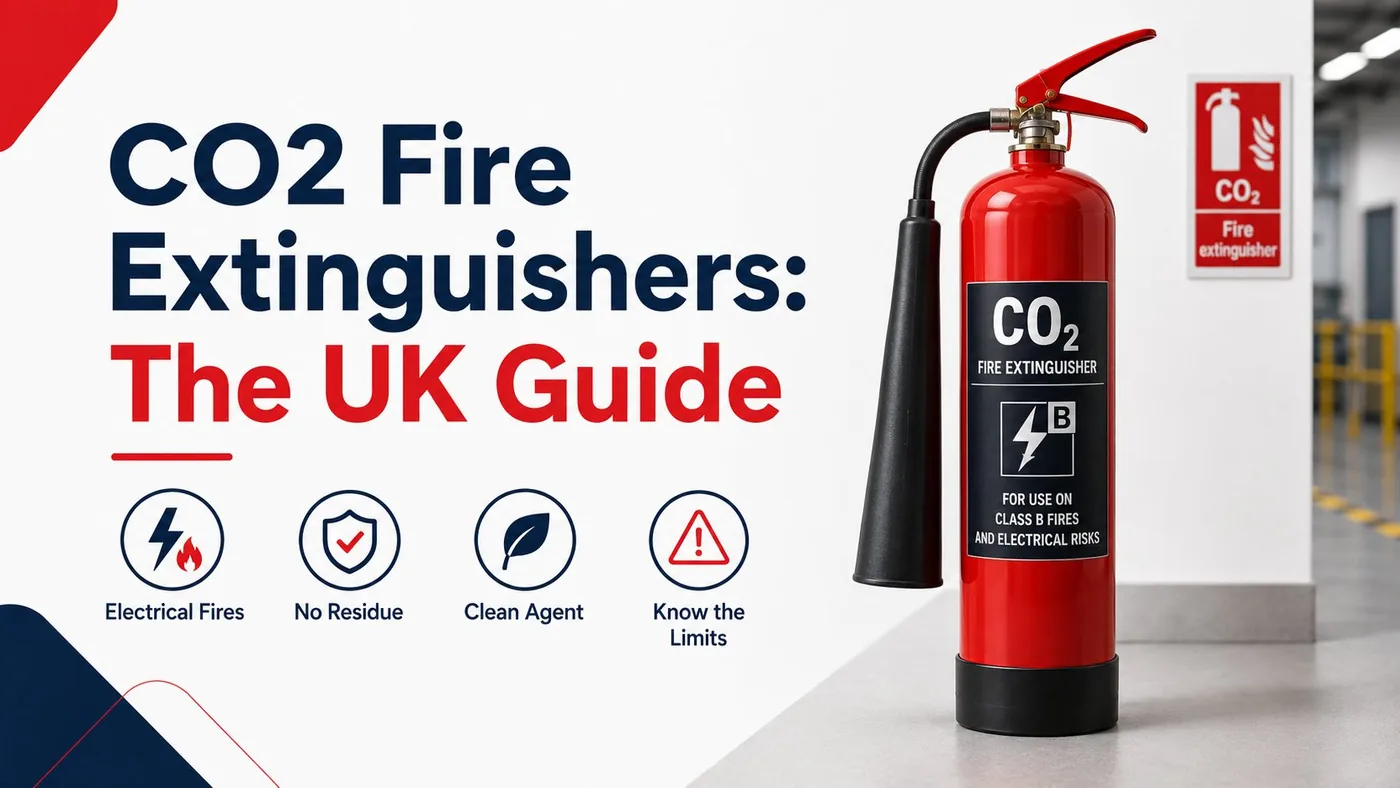
The black-labelled CO2 extinguisher is the standard answer for fires involving live electrical equipment in UK premises. It is also rated for Class B fires (flammable liquids), it leaves no residue, and it is by some way the most common second extinguisher you will see paired with a water or foam unit on a typical office wall.
This page covers what a CO2 extinguisher actually does, where it belongs, the cautions that genuinely matter (the cold horn, confined spaces, the limits on Class A), and one detail that catches a lot of premises out: CO2 has the longest service interval of any extinguisher type, and the schedule is different from everything else on the wall.
What a CO2 fire extinguisher is
A CO2 extinguisher is a high-pressure cylinder containing carbon dioxide stored as a liquid. The body is signal red with a black panel near the label — the black panel is the visual identifier. There is no separate charge propellant; the CO2 itself is both the agent and the propellant, which is why the cylinder is built to a higher pressure rating than water or foam.
The discharge horn is distinctive — a wide, flared plastic cone (sometimes wrapped in insulating material) at the end of a short rubberised tube. When the extinguisher is operated, liquid CO2 flashes to gas as it expands through the horn, dropping the temperature dramatically along the way.
UK CO2 extinguishers are tested under BS EN 3 and selected and positioned under BS 5306-8:2023, the same framework as the other types. Standard UK capacities are 2 kg and 5 kg.
How CO2 extinguishers work
CO2 extinguishes by displacing the oxygen around the fire. As the liquid CO2 expands to gas, it produces a large volume of cold, dense gas that flows over and around the fuel surface, pushing breathable air out of the way. With oxygen levels dropping below the threshold needed to sustain combustion, the fire goes out.
A small secondary effect comes from the cooling: the rapid expansion of compressed CO2 absorbs heat, which is why the discharge horn becomes so cold in use. The cooling helps slightly, but the dominant mechanism is oxygen displacement.
Two practical implications follow.
The agent doesn't cool the burning material much
Once the gas disperses (which it does quickly, especially outdoors or in any room with normal ventilation), the fuel is still hot. If there is a continuing source of heat — a shorted wire, a smouldering plastic — the fire can re-ignite. CO2 is excellent at putting fires out; it is less excellent at keeping them out.
The agent leaves no residue
This is the property that matters most for electrical and electronic equipment. Discharge a powder extinguisher onto a server rack and the rack is finished, even if the fire was small. Discharge a CO2 extinguisher and the rack is functionally clean.
What CO2 extinguishers tackle
Class B and live electrical equipment. The standard examples:
- Class B: small, contained flammable-liquid fires — a tray of solvent, a bench-top fuel spill, a small fire in a fume cupboard.
- Live electrical equipment: the dominant use case. Servers, IT cabinets, photocopiers, electrical risers, distribution boards (with appropriate caution — see below), kitchen appliances, anything energised that has caught fire.
CO2 is non-conductive, which is the whole reason it is the standard for electrical fires. The agent will not create a path for current back to the user. BS 5306-8:2023 (clause 7.7.1) names CO2 explicitly as one of three permissible non-conductive media for use on live electrical equipment, alongside non-conductive powder and clean agents.
What CO2 doesn't tackle:
- Class A (solids — paper, wood, fabric). CO2 will knock the visible flames down but won't cool the material, and re-ignition is highly likely. CO2 is not a Class A answer.
- Class F (cooking oils). The high-pressure discharge can splash burning oil out of the pan, and the gas does not interact usefully with the oil chemistry. Wet chemical, fire blanket, or water mist is the right answer. See our cooking oil fire guide.
- Class C (flammable gases). CO2 may temporarily knock the fire down, but the gas leak is the underlying problem; isolation of the supply is the only real fix.
The cold horn — why it matters
The discharge horn on a CO2 extinguisher becomes extremely cold during use. Hold it directly with bare skin and you will get a frostbite injury within seconds. The standard handling rule: grip the extinguisher by the carry handle and the operating lever, and direct the discharge using the body of the horn or the rubberised tube — never the metal or plastic at the cold end.
Modern CO2 extinguishers usually have a frost-resistant grip on the discharge tube to make this easier. Even with the grip, the cold is real, and the standard fire warden training is to keep your hand off the horn itself.
The cold also has a secondary effect at the fire. The first second or two of discharge produces a forceful, audible blast of gas at high velocity — enough to scatter loose paper, light objects or burning embers around the room. Aim with that in mind, particularly in office or document-storage settings.
Confined spaces — the genuinely serious caution
CO2 works by replacing the air around the fire. Used in a normal room with adequate ventilation, the gas disperses safely after the fire is out. Used in a confined or poorly-ventilated space — a server room, a small plant room, a vehicle interior, a basement — the gas can drop the oxygen level below what the user needs to breathe. Asphyxiation in this scenario is silent: CO2 has no smell, no irritating effect on the airways, and the early symptoms (light-headedness, confusion) feel internal rather than external.
The HSE defines a confined space as one which is both substantially enclosed and where there is a reasonably foreseeable risk of fire or asphyxiation. Many ordinary workplace spaces meet that definition more easily than people expect: a storage cupboard, a server room with the door closed, a small basement plant room.
BS 5306-8:2023 specifically cautions against the use of both CO2 and dry powder extinguishers in confined spaces unless the risk has been mitigated through a health and safety risk assessment. In practice, that means CO2 belongs in offices, retail spaces, and ordinary indoor environments with normal ventilation; for genuinely confined spaces, fire suppression is more often handled through fixed systems or through evacuation and fire-and-rescue response than through portable extinguishers.
If you do use a CO2 extinguisher indoors, ventilate the room afterwards. Open doors and windows; let the gas disperse before the area is reoccupied for any extended period.
What about Class A — re-ignition risk
CO2 will visibly knock down a small Class A fire. The flames go out; the immediate danger appears to pass. But because the agent does not cool the fuel, the underlying material remains at or near its ignition temperature. As soon as the gas disperses (which can be within seconds), oxygen reaches the still-hot fuel and the fire re-ignites.
The practical consequence is that CO2 should not be used on Class A fires unless you have nothing else. A typical workplace pattern is to place a CO2 extinguisher near electrical risk and pair it with a Class A unit (water or foam) at the same fire point. The CO2 deals with the electrical problem; the water or foam deals with the burning paperwork that probably accompanies it.
This is why BS 5306-8 indicates that CO2 should generally be provided alongside a water or foam extinguisher in offices and commercial premises, rather than as a sole provision.
The 10-year overhaul
This is the operational detail that catches a lot of premises out. Under BS 5306-3:2017, water, foam, dry powder and wet chemical extinguishers all undergo an extended service every 5 years. CO2 extinguishers do not. CO2 cylinders are subject to a longer extended service / overhaul interval of every 10 years, reflecting the higher cylinder pressure rating and the very different internal conditions.
What that means in practice: a CO2 extinguisher you bought today will receive an annual basic service for nine years, then an overhaul (which includes hydraulic pressure testing of the cylinder) at the ten-year mark. Many premises run their CO2 units to the 10-year point and then replace rather than overhaul, because replacement is often cheaper than the cost of overhaul plus discharge testing.
The mismatch with the 5-year cycle for the rest of the cluster is the easiest schedule mistake to make. If your servicing contract treats every unit on a 5-year extended-service cycle, your CO2 units are over-serviced at year 5 and under-budgeted at year 10. Confirm with your contractor that the schedule matches the unit type. The full picture is on our fire extinguisher servicing and inspection page.
Where CO2 extinguishers belong
Typical UK placements:
Offices and retail
A 2 kg or 5 kg CO2 unit at each fire point, paired with a water or foam unit. The CO2 covers electrical risk (printers, screens, kitchens with electric appliances, server cabinets); the water or foam covers Class A.
Server rooms and IT cabinets
A CO2 unit within a few metres, mounted at standard height, with clear signage. The residue-free property is the whole point — a powder discharge in a server room would write off the equipment along with the fire.
Electrical risers and distribution rooms
CO2 is the standard, often as the only portable extinguisher in the immediate vicinity. Be cautious about confined-space asphyxiation risk in small rooms; ventilation matters.
Commercial kitchens (back-of-house electrical)
CO2 for refrigeration, electric ovens, dishwashers — paired with wet chemical and a fire blanket on the cooking line.
Workshops and laboratories
CO2 alongside dry powder or foam for Class B contained liquid fires, particularly where small quantities of solvents are used near electrical bench equipment.
CO2 is less common in domestic settings — the cylinders are heavier, the use case is narrower, and a water mist extinguisher is often a more practical single-unit answer. Where CO2 is used at home, it is usually for a specific reason (a home server, a workshop in a garage, a hobbyist setup with electrical equipment).
How to use a CO2 extinguisher
The PASS technique applies — Pull, Aim, Squeeze, Sweep — with three CO2-specific notes:
- Hold the extinguisher by the body and the operating lever, never by the discharge horn.
- Stand close — about 1 to 1.5 metres from the fire. CO2 disperses quickly; standing too far back wastes the agent into the surrounding air.
- Aim at the base of the fire and sweep across the burning material. The first second of discharge is the most forceful; expect a noisy, visible blast.
For Class B liquid fires, the same gentle-sweep approach used with foam doesn't apply: with CO2, the discharge is gas, not liquid, and the agent works by displacing oxygen rather than forming a blanket. Sweep across the surface, then continue applying for a few seconds after the visible flames go out — the gas needs to remain in place long enough for the fuel to cool below re-ignition temperature.
For the full step-by-step, see our PASS technique guide.
Frequently asked questions
Can a CO2 extinguisher be used in a server room?
Yes — it is the standard choice for server rooms because it leaves no residue. The caveat is confined-space ventilation: a small, sealed server room may need ventilating after discharge, and a fixed suppression system is sometimes the better answer for a room that is genuinely confined.
Why doesn't CO2 work on Class A fires?
CO2 puts the visible fire out by displacing oxygen, but it doesn't cool the fuel. As soon as the gas disperses, the still-hot Class A material re-ignites. CO2 is good for electrical and small Class B fires; for Class A, water or foam is the right choice.
What's the asphyxiation risk?
CO2 displaces breathable air. In an enclosed or poorly-ventilated space, discharging a CO2 extinguisher can drop the oxygen level below what a person needs to breathe. Use CO2 in normally-ventilated rooms; ventilate after use; do not use CO2 in genuinely confined spaces without a specific risk assessment.
Why is the discharge horn dangerous?
The horn becomes extremely cold during use because the rapid expansion of compressed CO2 absorbs heat. Direct skin contact with the horn produces a frostbite injury within seconds. Hold the extinguisher by the handle and lever, never by the horn.
Why do CO2 extinguishers need overhaul at 10 years rather than 5?
The cylinder pressure rating and internal conditions differ from water-based extinguishers, and the BS 5306-3:2017 maintenance schedule reflects that. Water, foam, dry powder and wet chemical extinguishers are on a 5-year extended-service cycle; CO2 is on a 10-year overhaul cycle.
What size CO2 extinguisher do I need?
For most offices and retail, a 2 kg unit is adequate at each fire point. For larger electrical risk areas, server rooms, or industrial settings, 5 kg is often specified. Your fire risk assessment, with reference to BS 5306-8:2023 coverage rules, should drive the choice.
Where this connects
For the wider question of which extinguisher to use on an electrical fire — when to choose CO2 versus dry powder versus tested water mist — see our guide to fire extinguishers for electrical fires. For the dry powder alternative, see our dry powder fire extinguisher page. For where CO2 sits in the wider type and colour system, the fire extinguisher types hub is the place to start.
If you are responsible for setting up a workplace's fire safety from scratch — including who needs to be trained — the online fire safety awareness training course covers the basics every UK employee needs.
Related guides
- Who Is Responsible for Fire Extinguishers in the UK?
- Fire Extinguisher Disposal: The UK Guide
- Fire Extinguisher Servicing and Inspection: The UK Guide
Make sure every employee knows what to do when the alarm sounds.
Explore the Fire Safety Awareness Training course →
Mark writes about workplace health & safety, fire safety awareness and accredited online training for Fire Safety Awareness Training, part of Online CPD Academy.